
Yalta Conference 1945: From Post-War Settlement to the ‘Yalta 2.0’ Debate
The 1945 Yalta Conference shaped key elements of the post-war European order. Comparisons with a modern U.S.-China-Russia summit evoke fears of great-power spheres of influence, but the historical circumstances are fundamentally different.
- Syllabus Mapping: GS Paper I — World History, World Wars, Redrawing of National Boundaries, Cold War and Post-War International Order.
- Source & Date: The Indian Express, 19 November 2026.
Why in News?
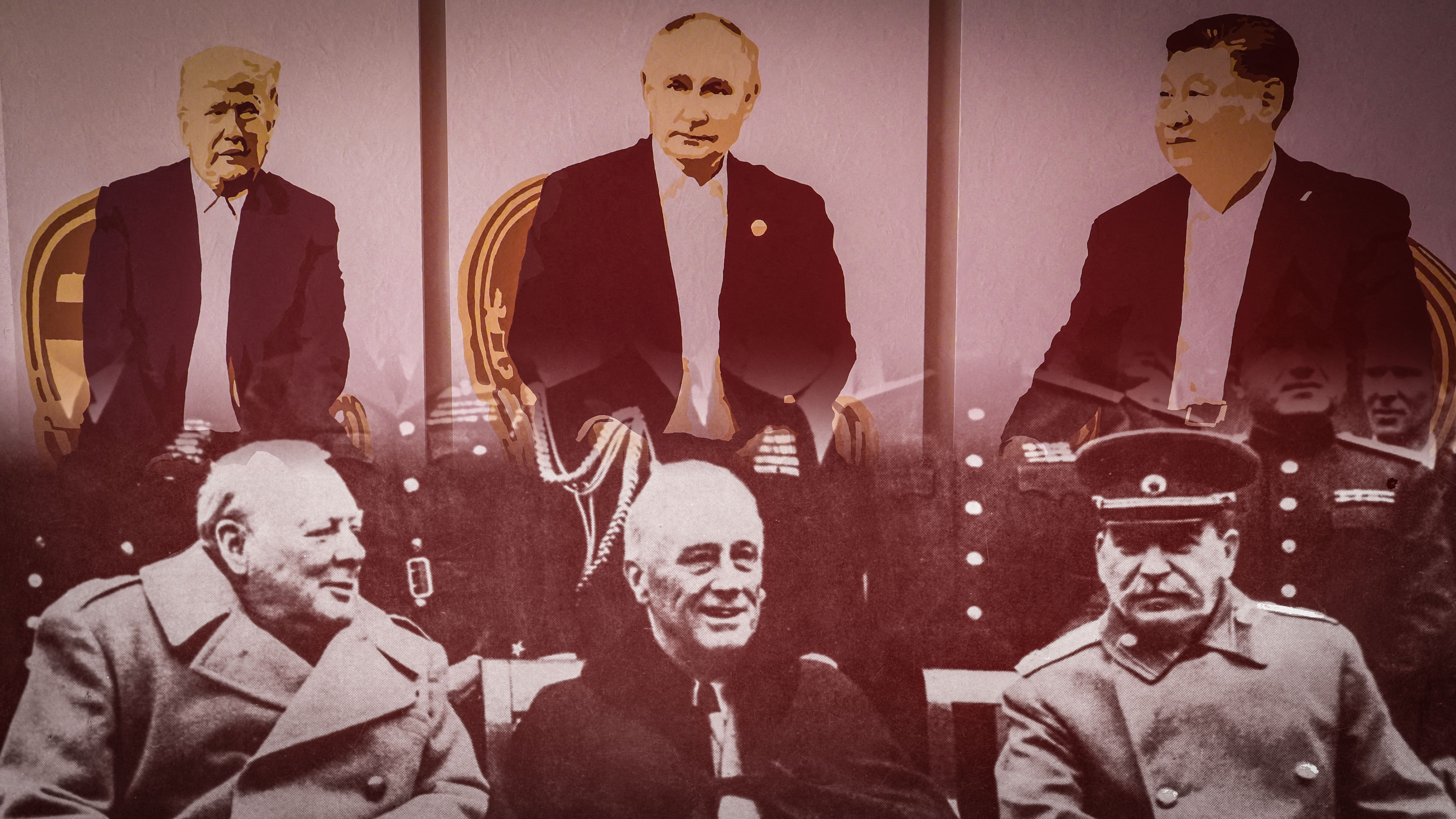
The meeting of U.S. President Donald Trump, Chinese President Xi Jinping and Russian President Vladimir Putin in Shenzhen has revived references to a possible “Yalta 2.0”.
The expression recalls the Yalta Conference of February 1945, where the leaders of the United States, Britain and the Soviet Union negotiated major elements of the post-World War II settlement.
The comparison raises a larger question: can powerful states once again shape the security arrangements of smaller countries through bargains among themselves?
What Was the Yalta Conference?
The Yalta Conference was held in Crimea from February 4–11, 1945, when Allied victory in Europe had become increasingly certain.
The three leaders were:
- Franklin D. Roosevelt — United States;
- Winston Churchill — Britain;
- Joseph Stalin — Soviet Union.
They were collectively known as the Big Three.
Their central objective was to coordinate the final stages of World War II and determine major aspects of the post-war international order.
What Had Happened Before Yalta?
World War II began in Europe in 1939 after Nazi Germany invaded Poland.
The Soviet Union initially had a non-aggression pact with Germany but joined the Allied side after Hitler invaded Soviet territory in June 1941.
The United States entered the war after Japan attacked Pearl Harbor in December 1941.
At the Tehran Conference of 1943, Roosevelt, Churchill and Stalin coordinated Allied strategy. Britain and the U.S. committed to opening a western front in Europe, while Stalin agreed in principle to join the war against Japan after Germany's defeat.
By early 1945, Soviet forces were advancing rapidly through Eastern Europe towards Berlin, giving Stalin substantial bargaining power at Yalta.
Germany After the War
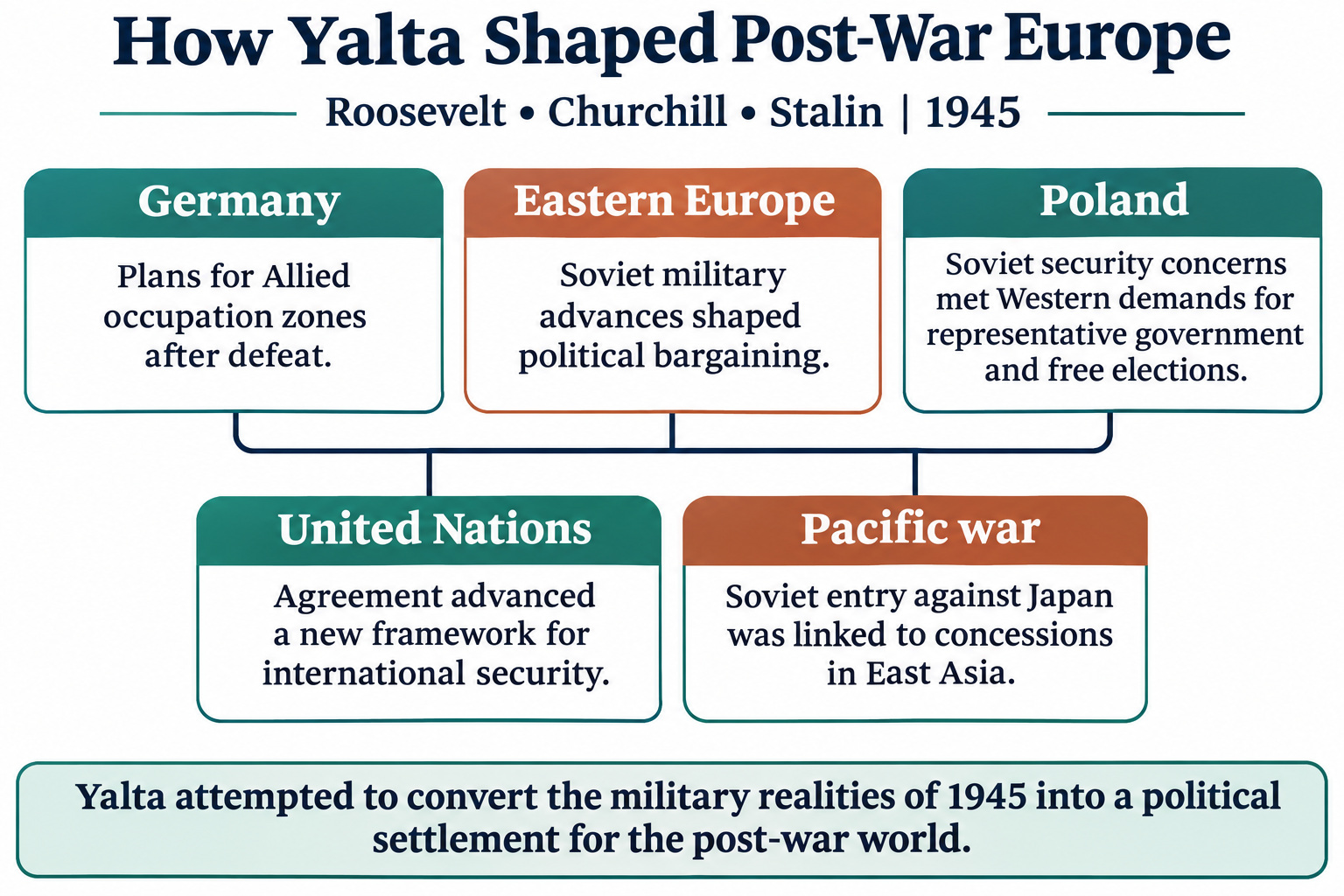
The Big Three agreed that defeated Germany would be occupied after surrender.
Germany was ultimately divided into four occupation zones controlled by the United States, Britain, France and the Soviet Union.
Berlin itself was similarly divided.
The Allies also agreed on:
- demilitarisation;
- denazification;
- reparations;
- destruction of Germany's capacity to launch another major war.
This occupation arrangement later contributed to the emergence of West Germany and East Germany as the Cold War hardened.
Why Was Poland So Important?
Poland represented one of the most difficult disputes.
Stalin regarded control over Poland and neighbouring Eastern European states as vital to Soviet security because Russia had repeatedly been invaded from the west.
The Soviet Union had already established considerable military and political influence in Poland.
At Yalta, Stalin agreed that Poland's provisional government would be broadened and that elections would eventually be held.
The Western powers, however, effectively accepted that governments in countries bordering the Soviet Union would need to be “friendly” to Moscow.
This helped create the conditions for a Soviet-dominated Eastern European bloc.
The Meaning of a “Sphere of Influence”
A sphere of influence exists when a powerful country exercises dominant political, strategic or economic influence over other states in a particular region.
The Yalta settlement became associated with this concept because Soviet military control on the ground enabled Moscow to dominate much of Eastern Europe.
In practice, countries such as Poland, Romania, Bulgaria and Hungary later developed communist governments closely aligned with the Soviet Union.
Europe therefore became increasingly divided between Western and Soviet spheres.
Yalta and the United Nations
One of Yalta's most enduring institutional outcomes involved the emerging United Nations.
The Soviet Union agreed to participate in the new international organisation.
The major powers also agreed on the Security Council voting structure under which the five permanent members would possess veto power.
This reflected a central principle of post-war institutional design: international cooperation would be more sustainable if the most powerful states were given a privileged role within the system.
Soviet Entry into the War Against Japan
The Pacific War was still continuing.
Roosevelt wanted Soviet participation against Japan because an invasion of the Japanese home islands was expected to be costly.
Stalin agreed that the Soviet Union would enter the war against Japan after Germany's defeat.
In return, the Soviet Union was promised strategic concessions in East Asia, including interests connected with southern Sakhalin and the Kuril Islands.
The Soviet Union eventually declared war on Japan in August 1945.
From Yalta to Potsdam
Yalta did not settle every post-war issue.
After Germany surrendered, Allied leaders met again at the Potsdam Conference in July-August 1945.
But the political environment had changed significantly.
Roosevelt had died and been replaced by Harry Truman, while tensions between the Western Allies and the Soviet Union were growing.
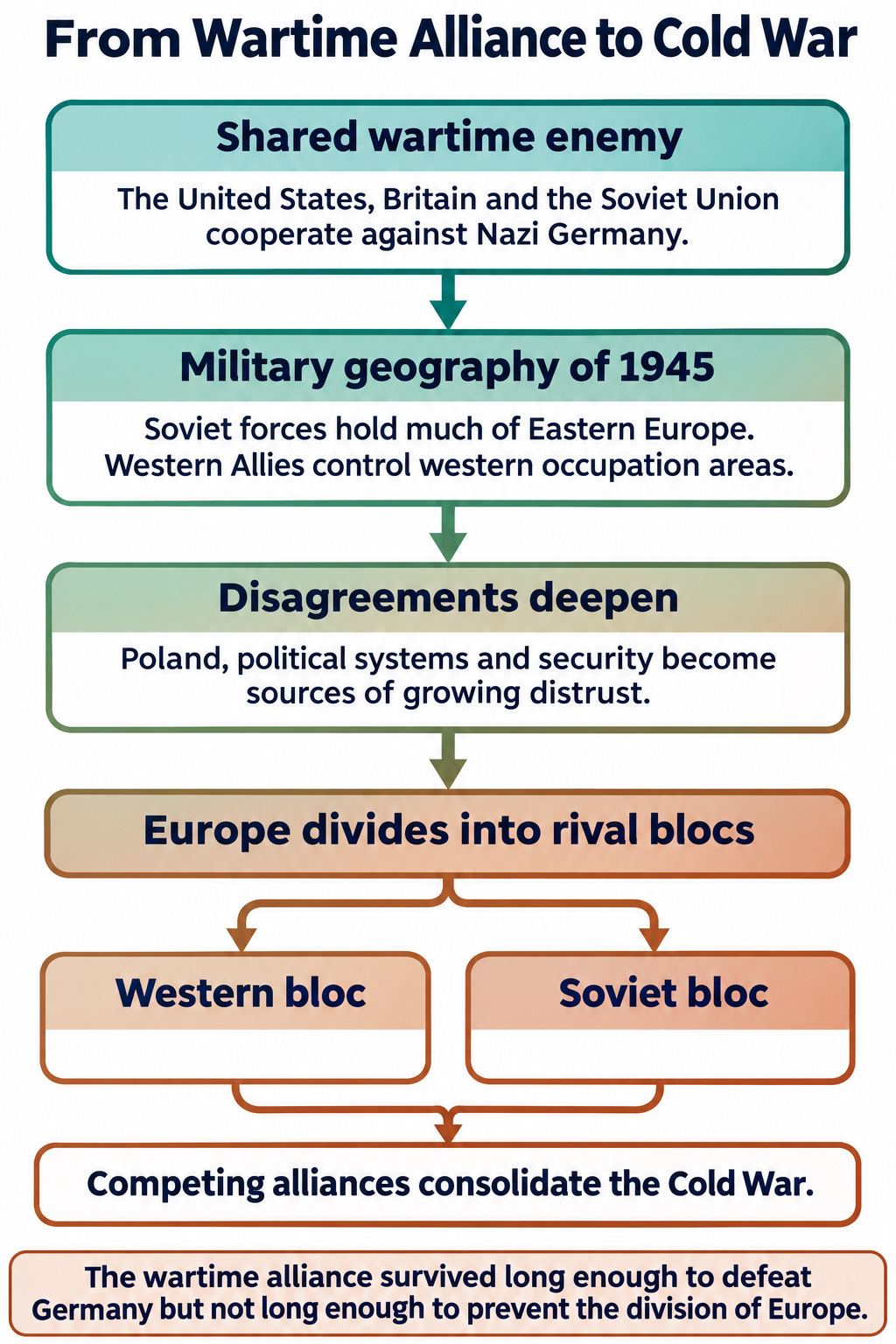
The wartime alliance was increasingly giving way to geopolitical rivalry.
Did Yalta Cause the Cold War?
Yalta alone did not cause the Cold War.
The deeper conflict arose from incompatible strategic interests, political systems and security concerns between the Soviet Union and the Western powers.
However, the agreements and ambiguities surrounding Eastern Europe became major sources of mistrust.
Western governments accused Stalin of failing to allow genuinely free political competition in Eastern Europe.
The Soviet Union, meanwhile, prioritised a strategic buffer zone against future invasions.
By 1946, Churchill famously described an “Iron Curtain” dividing Europe.
Why Is Shenzhen Being Compared With Yalta?
The comparison arises because the leaders of the United States, China and Russia represent three major centres of military and geopolitical power.
Their talks may cover global security issues such as nuclear arms, major wars and strategic stability.
This creates fears that major powers could attempt to reach agreements affecting countries that are not themselves represented in the negotiations.
That resembles one controversial aspect of Yalta: powerful states discussing the security and political future of smaller countries.
Why “Yalta 2.0” Is an Imperfect Analogy
The similarities should not be overstated.
At Yalta, the three powers were wartime allies approaching victory against a common enemy.
They also commanded enormous armies occupying much of Europe and possessed direct ability to determine post-war territorial arrangements.
The United States, China and Russia today are not allies.
They are major competitors with conflicting interests in security, technology, trade and regional influence.
Nor can they simply divide the contemporary world into rigid spheres without resistance from other states.
Smaller Powers Have Greater Agency Today
The contemporary international system contains far more sovereign states, international institutions, economic interdependence and overlapping partnerships than existed in 1945.
Countries such as India, Japan, European states and many middle powers pursue independent strategies.
Even weaker states can seek alternative partnerships, international support and economic leverage.
Thus, today's great powers may bargain over major issues, but their ability to impose a complete geopolitical settlement on others is much more constrained.
Yalta vs a Possible “Yalta 2.0”
The distinction can be summarised clearly:
Yalta 1945: victorious wartime allies negotiating a post-war settlement from positions of direct military control.
Shenzhen 2026: competing great powers exploring limited bargains while remaining geopolitical rivals.
Yalta was about constructing a new order after a world war.
Today's trilateral diplomacy is primarily about managing rivalry within an existing international order.
Core Historical Lesson
Yalta remains important because it demonstrates how military power on the ground can shape diplomatic settlements.
Stalin's influence over Eastern Europe did not originate simply from negotiating skill; Soviet forces already controlled large parts of the region.
The conference also demonstrates both the necessity and danger of great-power diplomacy.
Major powers may need to cooperate to manage war and international security, but bargains among them can also restrict the autonomy of smaller states.
The modern “Yalta 2.0” debate therefore reflects an enduring tension in international politics: how to accommodate major-power interests without allowing the world to be divided into exclusive spheres of influence.
---
Probable Mains Question
“The Yalta Conference reflected both the necessity of great-power cooperation and the dangers of sphere-of-influence politics.” Examine its role in shaping the post-World War II order and assess the limits of comparing contemporary U.S.-China-Russia diplomacy with a ‘Yalta 2.0’.
---
Prelims Drill
MCQ 1
With reference to the Yalta Conference of 1945, consider the following statements:
1. It was attended by Franklin D. Roosevelt, Winston Churchill and Joseph Stalin.
2. It dealt with the occupation of Germany and the political future of Eastern Europe.
3. It took place after the formal surrender of Nazi Germany.
Which of the statements given above are correct?
A. 1 only
B. 1 and 2 only
C. 2 and 3 only
D. 1, 2 and 3
Correct Answer: B
Explanation: Yalta was held in February 1945, before Germany surrendered in May 1945. It addressed Germany, Poland, Eastern Europe, the United Nations and Soviet participation in the war against Japan.
MCQ 2
Consider the following statements regarding the post-World War II settlement:
1. The Soviet Union agreed at Yalta to participate in the emerging United Nations framework.
2. Permanent members of the UN Security Council were given veto powers.
3. The Cold War immediately ended the military occupation of Germany and prevented its subsequent political division.
Which of the statements given above are correct?
A. 1 only
B. 1 and 2 only
C. 2 and 3 only
D. 1, 2 and 3
Correct Answer: B
Explanation: The Yalta negotiations helped settle Security Council voting arrangements, including the veto. Germany remained under occupation after the war and was later divided into the Federal Republic of Germany and the German Democratic Republic.
More Current Affairs - Daily
- India’s State Capacity Stagnation: The Missing Link in Reform 21 Nov 2026
- Holding Two Offices: What Does the Constitution Say About an Office of Profit? 21 Nov 2026
- The Price of War: West Asia Crisis Is Raising India’s Energy Import Bill 21 Nov 2026
- Surveillance Pricing : How Is Personal Data Used to Set Prices? 21 Nov 2026