
India’s State Capacity Stagnation: The Missing Link in Reform
India’s economy and the responsibilities of government have expanded, but administrative capacity has not kept pace. Weak local governments, chronic vacancies, bureaucratic overload and poor HR planning constrain implementation and public-service delivery.

- Syllabus Mapping: GS Paper II — Governance, Transparency and Accountability, Local Government, Civil Services and Delivery of Public Services.
- Source & Date: The Indian Express, 20 November 2026.
Why in News?
India’s development debate often focuses on economic growth, private investment, infrastructure and welfare schemes.
A deeper problem is that the capacity of the state to implement, regulate and deliver has not expanded at the same pace as the economy or the government's responsibilities.
The result is a paradox: India may announce more programmes and regulations while the administrative machinery required to execute them remains thin.
What Is State Capacity?
State capacity refers to the ability of government institutions to:
- design policies;
- raise and spend public resources;
- enforce laws and regulations;
- deliver public services;
- maintain administrative presence;
- resolve disputes;
- implement programmes consistently.
It is therefore broader than the size of government expenditure.
A government may spend large amounts but still have weak state capacity if it lacks personnel, skills, systems or local administrative reach.
Why Staffing Matters
Public policy ultimately has to be implemented by people.
If the number of officials does not keep pace with the growth of population, regulations and government schemes, each official must handle a larger workload.
This creates bureaucratic overload.
Officials then have to prioritise some tasks while leaving others incomplete.
A shortage of personnel therefore becomes a direct constraint on implementation.
India’s Public Employment Problem
India has a relatively small public workforce compared with the scale of its population and government responsibilities.
At the same time, vacancies often remain unfilled even against sanctioned posts.
The problem becomes more severe at lower levels of government, where citizens actually interact with the state.
This creates a gap between policy ambition at the top and administrative capacity on the ground.
Why Weak Local Government Is Central
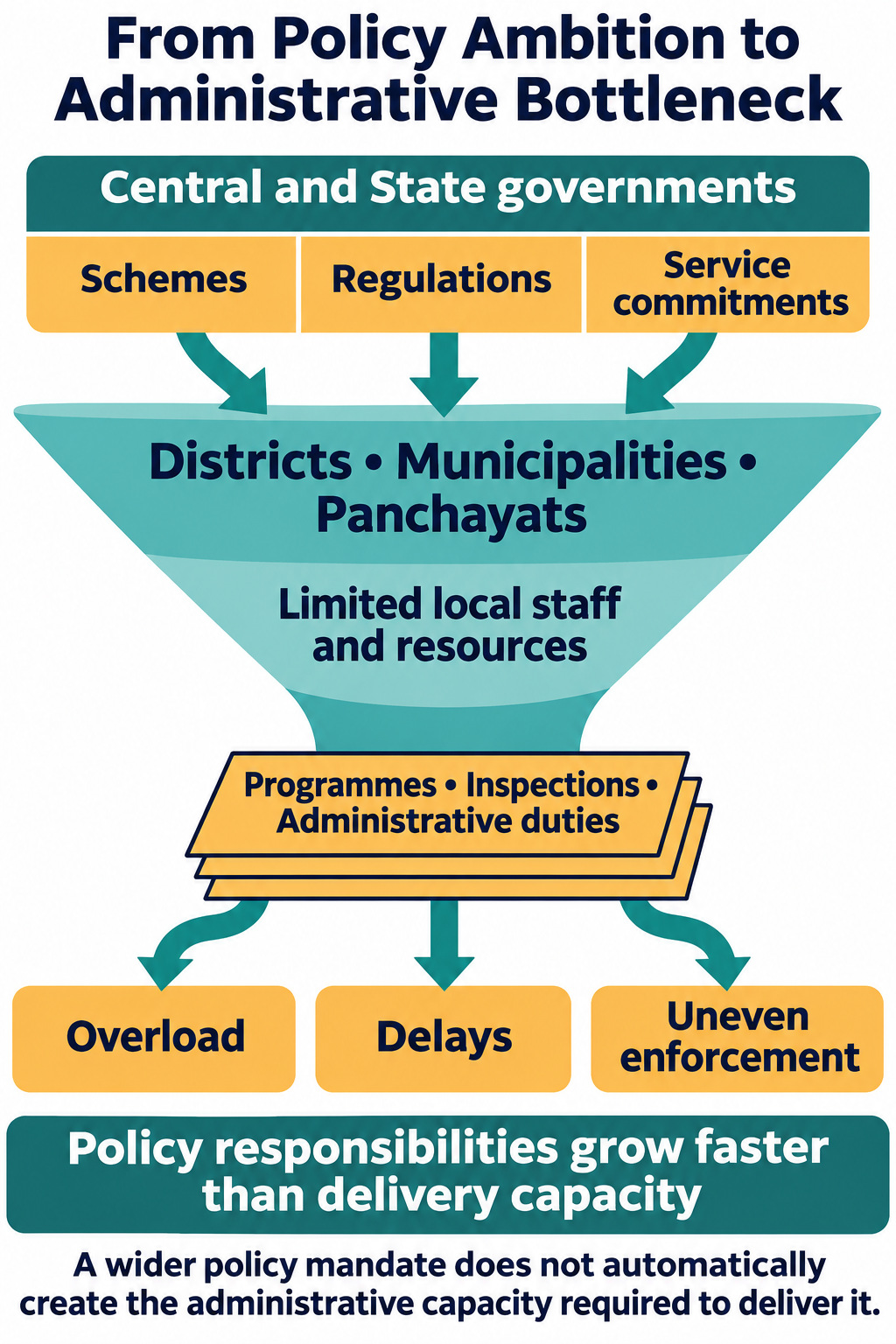
Most everyday development functions are delivered locally.
Urban sanitation, building regulation, local roads, waste management, water supply and many welfare functions depend heavily on municipalities and local administrations.
Rural development similarly depends on panchayats and block- and district-level institutions.
Yet local governments often have limited personnel, finances and technical expertise.
This means that the weakest administrative layer is frequently the one closest to the citizen.
Centralisation and State Capacity
Weak local government is also linked to excessive centralisation.
Higher levels of government may design programmes and prescribe targets, while the institutions responsible for implementation remain understaffed.
A capable state therefore requires not only stronger central ministries but also administrative depth at district, municipal and panchayat levels.
Decentralisation without personnel and resources can remain largely formal.
How Personnel Scarcity Creates Discretion
When there are too few inspectors, officials or regulators, rules cannot be enforced everywhere.
Enforcement then becomes selective.
This creates two problems.
First, genuine violations may go unchecked.
Second, selective enforcement can generate perceptions of arbitrariness or opportunities for rent-seeking.
Thus, administrative scarcity can weaken both effectiveness and legitimacy.
What Is Bureaucratic Overload?
Bureaucratic overload occurs when officials are given more programmes, regulations and responsibilities than they can realistically manage.
An overburdened official may have to:
- supervise multiple schemes;
- prepare reports;
- attend meetings;
- conduct inspections;
- respond to courts;
- manage emergencies;
- implement new directives.
As responsibilities multiply without corresponding personnel, programme quality falls.
The state may therefore be capable of implementing a few priorities well but not all simultaneously.
Why States May Fail to Spend Allocated Funds
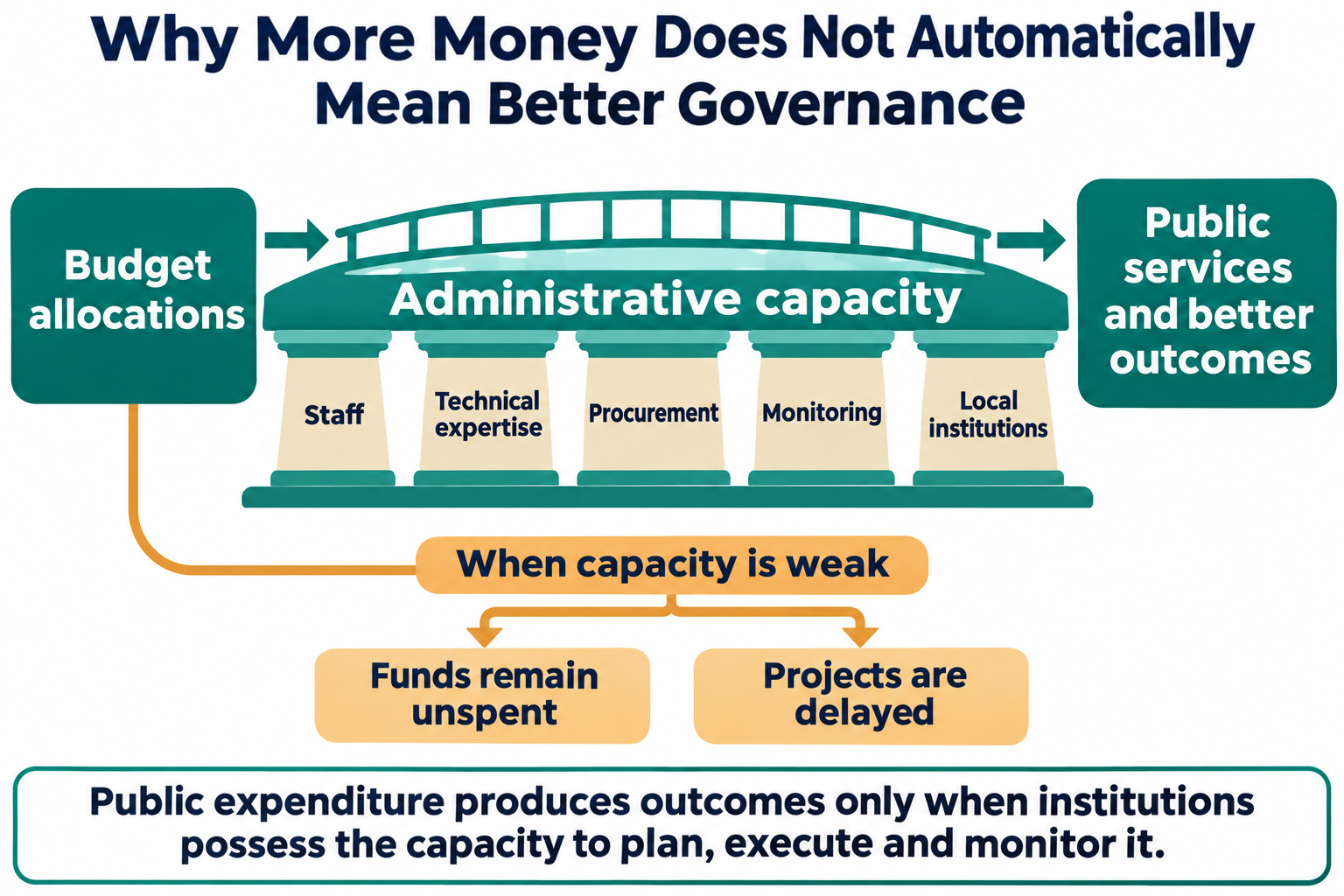
Low state capacity can also appear as underspending.
Governments may have budgetary resources but lack enough officials, engineers, procurement specialists or project managers to convert allocations into completed projects.
Thus, under-expenditure does not always mean lack of demand or lack of money.
It can indicate a shortage of administrative capacity.
Does Liberalisation Reduce the Need for the State?
Economic liberalisation reduced the government's direct role in some areas of production.
But it did not eliminate the need for state capacity.
Markets themselves generate new regulatory demands involving:
- competition;
- financial stability;
- environmental externalities;
- consumer protection;
- labour regulation;
- urbanisation;
- digital markets.
The role of the state changes rather than disappears.
A market economy can therefore require a more specialised and capable regulatory state, not simply a smaller one.
Why Technology Cannot Replace a Minimum Administrative Base
Digital systems can improve efficiency.
Direct transfers, online applications and automated databases can reduce transaction costs.
But technology cannot fully replace:
- inspections;
- dispute resolution;
- social work;
- municipal engineering;
- policing;
- public health;
- local planning.
Technology works best when it strengthens an existing administrative system.
It cannot compensate indefinitely for the absence of adequate personnel.
Cash Transfers and Administrative Capacity
Cash transfers are relatively easy to administer once identification and payment systems exist.
By contrast, improving schools, hospitals, policing, sanitation or urban transport requires complex organisational capacity.
This can create an institutional bias towards schemes that are easier to administer.
The structure of welfare policy may therefore partly reflect what the state is capable of delivering, not only what citizens need.
Why Vacancies Persist
Leaving sanctioned posts vacant can function as a hidden form of fiscal restraint.
Personnel expenditure is recurring and politically difficult to reverse.
Governments may therefore control expenditure by delaying or restricting recruitment.
However, this approach undermines long-term workforce planning.
The apparent fiscal saving may be offset by weaker implementation, delayed projects and poor regulatory outcomes.
The Public-Sector Wage Trade-Off
One explanation for low staffing is that government salaries may be relatively attractive compared with many private-sector jobs.
This can produce a structure of fewer, better-paid permanent employees rather than a larger workforce.
Governments may then rely increasingly on contractual employees.
But contractualisation alone does not solve deeper questions of skills, accountability, continuity and institutional knowledge.
India’s Missing HR Strategy
A capable state needs more than recruitment drives.
It requires a serious human-resource strategy covering:
- workforce planning;
- recruitment frequency;
- examination design;
- specialist skills;
- training;
- career progression;
- deployment;
- performance management;
- use of contractual and permanent staff.
Without such planning, hiring becomes episodic and vacancies become chronic.
Every New Policy Has an Administrative Cost
A new scheme or regulation does not implement itself.
Each creates additional requirements for:
- staff time;
- inspections;
- data collection;
- grievance handling;
- monitoring;
- enforcement.
A useful reform principle would therefore be to assess the administrative burden of new policies before they are introduced.
Policy design should ask not only whether a programme is desirable, but also whether the state possesses sufficient implementation capacity.
State Capacity as Public Investment
Administrative expenditure is often treated simply as a recurring cost.
But spending on judges, regulators, municipal staff, engineers, health workers and administrative systems can also be understood as investment in institutional capacity.
A stronger state can improve the effectiveness of every other rupee of development expenditure.
The relevant issue is therefore not simply “big government versus small government,” but whether government has the right personnel and capabilities for its assigned functions.
Core Policy Lesson
India’s central governance challenge is not merely excessive bureaucracy or insufficient reform.
It is a mismatch between an expanding state mandate and limited implementation capacity.
Economic growth, welfare expansion, urbanisation and complex regulation have increased the demands placed on government, while staffing, local institutions and HR architecture have not kept pace.
A serious reform agenda therefore requires stronger local governments, regular recruitment, specialist capability, administrative impact assessment and modern workforce planning.
The deeper lesson is simple: a state cannot deliver more simply by announcing more; it must also build the institutional capacity to implement what it promises.
---
Probable Mains Question
“India’s governance challenge is increasingly characterised by a mismatch between expanding policy ambitions and stagnant state capacity.” Discuss with reference to public employment, local government, bureaucratic overload and administrative reform.
---
Prelims Drill
MCQ 1
With reference to state capacity, consider the following statements:
1. It includes the ability of the government to enforce laws and deliver public services.
2. Higher budgetary allocation automatically implies stronger state capacity.
3. Chronic vacancies can weaken implementation even when policies and funds are available.
Which of the statements given above are correct?
A. 1 only
B. 1 and 3 only
C. 2 and 3 only
D. 1, 2 and 3
Correct Answer: B
Explanation: State capacity depends on institutions, personnel, skills and implementation systems, not expenditure alone. Vacancies can weaken execution even where funds are available.
MCQ 2
Consider the following statements regarding local government and administrative capacity:
1. Decentralisation can remain ineffective if local institutions lack personnel and resources.
2. Digitalisation can completely substitute for physical administrative capacity in all public services.
3. Bureaucratic overload may lead to selective implementation of government programmes and regulations.
Which of the statements given above are correct?
A. 1 only
B. 1 and 3 only
C. 2 and 3 only
D. 1, 2 and 3
Correct Answer: B
Explanation: Effective decentralisation requires administrative and fiscal capacity. Technology can improve efficiency but cannot fully replace personnel-intensive functions such as inspection, public health, policing and local service delivery.
More Current Affairs - Daily
- Holding Two Offices: What Does the Constitution Say About an Office of Profit? 21 Nov 2026
- Surveillance Pricing : How Is Personal Data Used to Set Prices? 21 Nov 2026
- The Price of War: West Asia Crisis Is Raising India’s Energy Import Bill 21 Nov 2026
- Assessing Health Product Claims : From Hypothesis to Scientific Evidence 21 Nov 2026