
The Price of War: West Asia Crisis Is Raising India’s Energy Import Bill
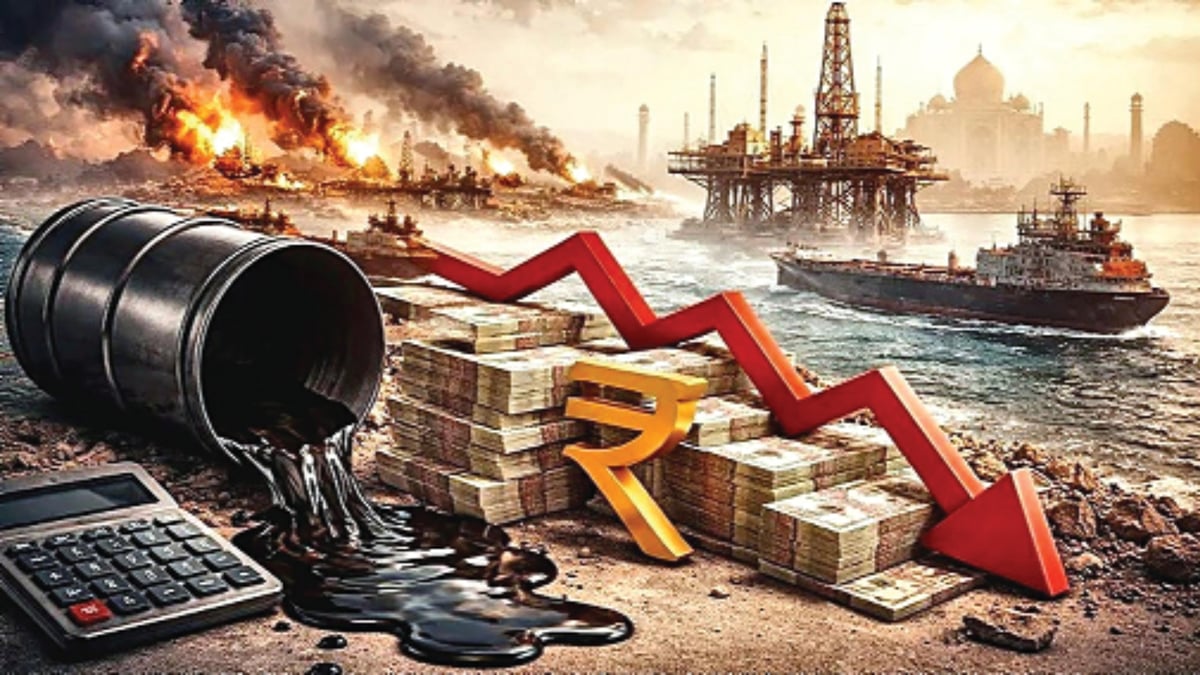
The West Asia crisis has sharply increased India’s landed cost of crude oil and LNG. Even with limited growth in import volumes, higher prices, freight and war-risk insurance are worsening pressure on the trade balance, current account, inflation and the rupee.
- Syllabus Mapping: GS Paper III — Indian Economy, Energy Security, External Sector, Inflation, Balance of Payments and Geopolitical Risks.
- Source & Date: The Indian Express, 20 November 2026.
Why in News?
India’s crude oil import bill has risen sharply in the current financial year even though import volumes have increased only marginally.
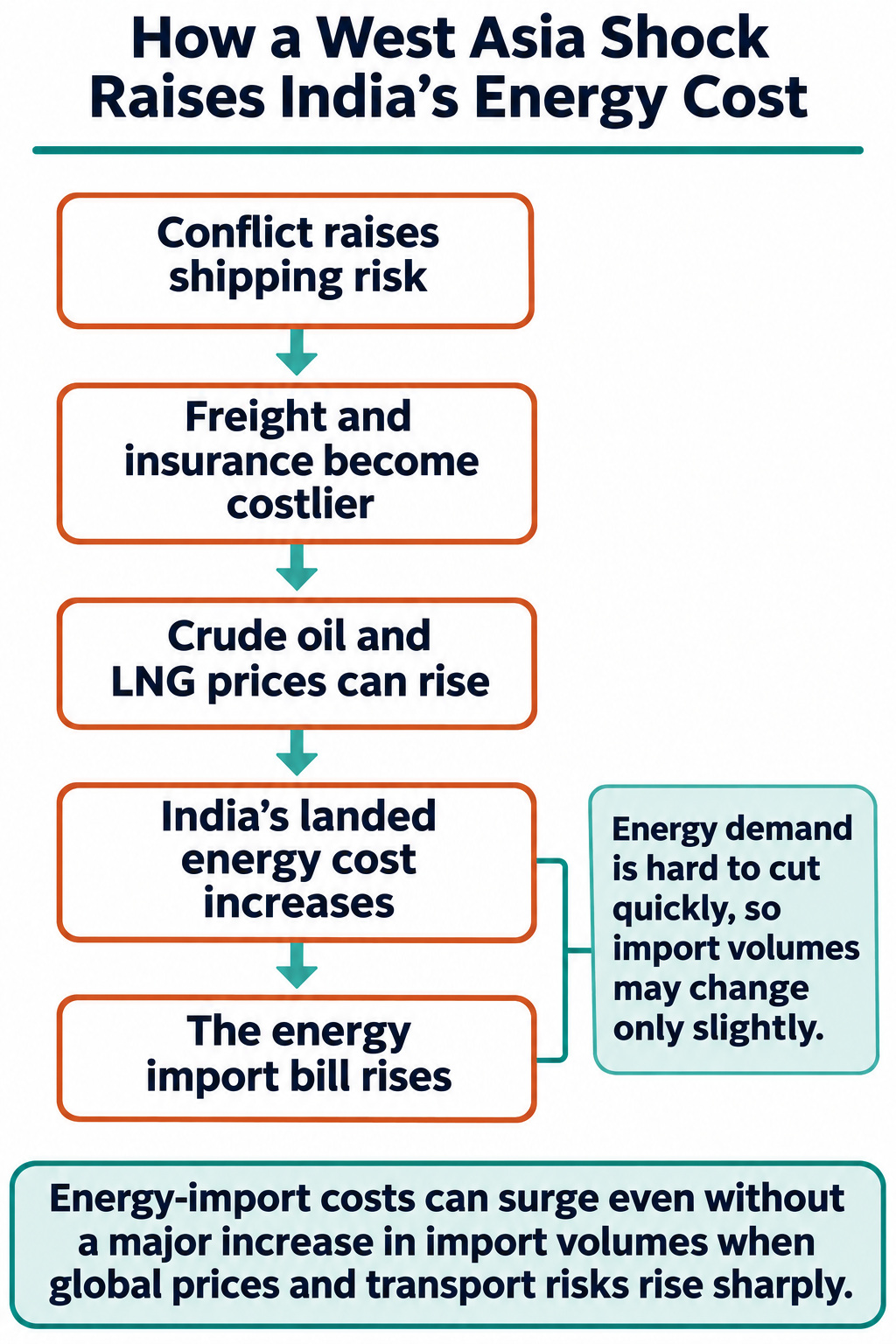
The main reason is the West Asia conflict and disruption risk around the Strait of Hormuz, which have pushed up crude oil, LNG, freight and insurance costs.
This has raised India’s overall net oil and gas import burden and highlighted the vulnerability of an economy that depends heavily on imported energy.
Why Has the Import Bill Risen Faster Than Import Volumes?
The key distinction is between quantity imported and price paid.
In April-October 2026, crude oil import volumes rose only modestly, but the value of imports increased much more sharply.
This happened because the average landed price of crude increased substantially.
So even if India imports nearly the same physical quantity of oil, a much higher price per barrel can cause the total import bill to surge.
What Is the Strait of Hormuz’s Importance?
The Strait of Hormuz is one of the world’s most important energy chokepoints.
A large share of crude oil, LNG and LPG moving from the Persian Gulf to Asian markets passes through it.
Before the West Asia war intensified, a substantial share of India’s:
- crude oil imports;
- LNG imports;
- LPG imports
came through the Persian Gulf-Hormuz route.
This makes India vulnerable not only to physical supply disruption but also to higher freight, insurance and risk premiums.
Why Prices Can Stay High Even When Supplies Improve
Physical shortages and prices do not always move together.
Even after immediate supply tightness eases, energy prices can remain elevated if traders expect future disruption.
War-risk insurance, longer shipping routes, security costs and uncertainty all raise the landed cost of energy.
Thus, geopolitical risk can create a price shock without a complete supply collapse.
Why India Is Especially Vulnerable
India imports more than 88% of its crude oil requirement and about half of its natural gas consumption.
This means domestic demand is heavily exposed to international prices.
Oil demand is also relatively inelastic in the short run.
Transport, industry, aviation, agriculture and households cannot quickly reduce energy consumption simply because prices rise.
India may therefore have to keep importing even at very high prices.
Crude Oil and LNG Are Both Affected
The oil shock is not limited to crude.
LNG import costs also rise when global gas prices increase.
Even when LNG import volumes grow moderately, a sharp increase in unit prices can push the total import bill much higher.
This widens the broader energy-import burden beyond crude oil alone.
Why Petroleum Product Exports Matter
India is unusual because it is a major crude oil importer but also a large petroleum product exporter.
Its large refining capacity allows imported crude to be converted into products such as diesel, petrol and aviation fuel for export.
When international fuel prices rise, the value of petroleum product exports can also increase.
Therefore, the economically relevant measure is often net oil and gas imports, not crude imports alone.
Net Energy Import Burden
Net oil and gas imports are broadly calculated by subtracting petroleum product exports from the total value of:
- crude oil imports;
- LNG imports;
- petroleum product imports.
Even after accounting for higher export earnings, India’s net energy-import burden has risen significantly.
This shows that export gains from refined products have not fully offset the jump in the cost of imported crude and gas.
Impact on the Trade Balance
Crude oil is one of India’s largest merchandise imports.
When oil prices rise sharply, the value of imports increases even if quantities remain stable.
If exports do not rise by a similar amount, the trade deficit widens.
A larger trade deficit can then contribute to a wider current account deficit.
Impact on the Current Account
The current account includes trade in goods and services as well as income and transfers.
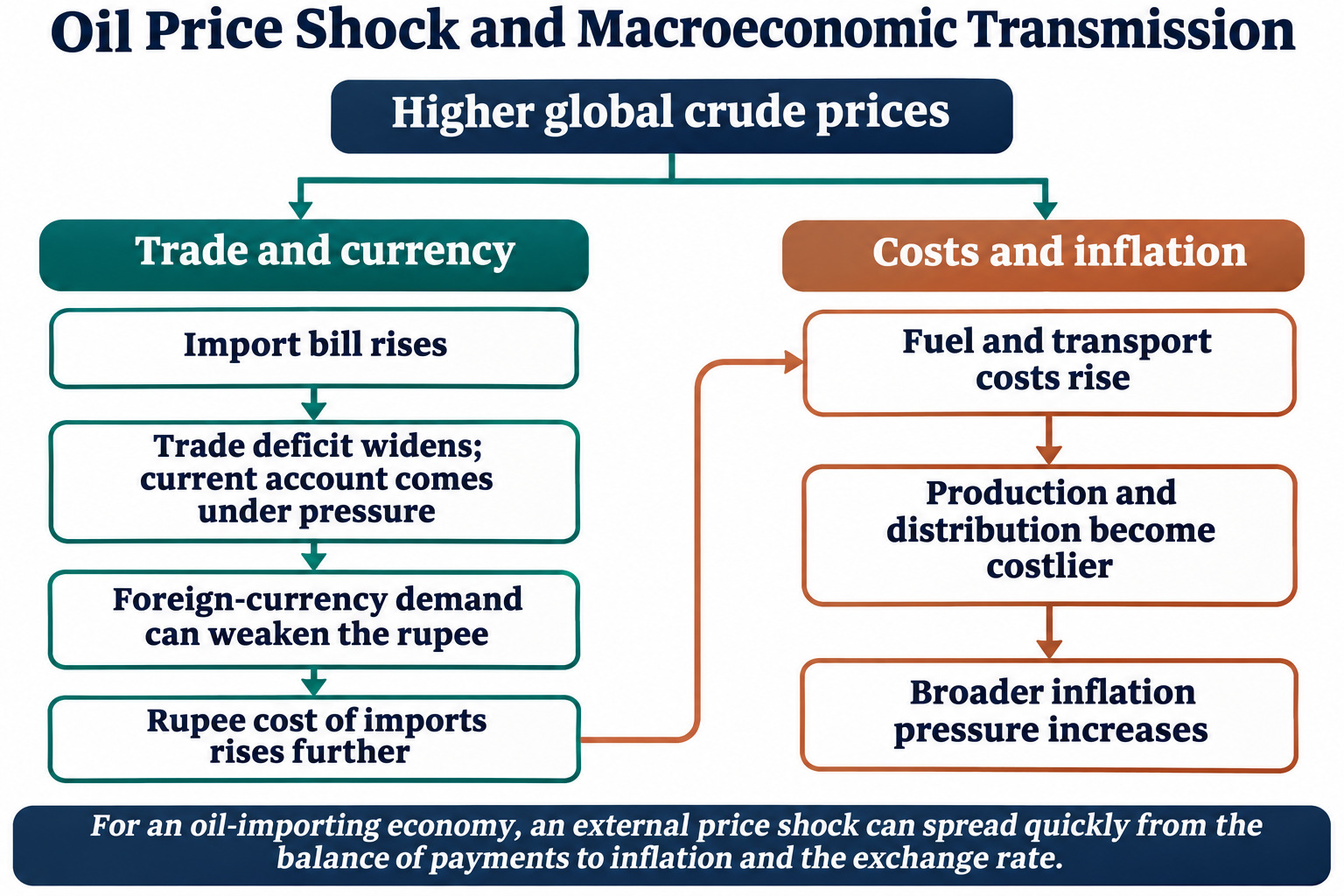
A higher oil import bill worsens the merchandise trade balance and therefore tends to weaken the current account position.
For an energy-importing economy, even modest movements in international oil prices can have significant macroeconomic effects.
Impact on the Rupee
Oil imports are generally paid for in foreign currency.
When the import bill rises, demand for dollars increases.
If capital inflows or export earnings do not offset this demand, the rupee can come under depreciation pressure.
A weaker rupee then makes dollar-priced crude even more expensive in domestic currency terms.
This can create a reinforcing cycle:
higher oil price → larger dollar demand → weaker rupee → still higher rupee cost of oil.
Impact on Inflation
Energy is embedded throughout the economy.
Higher crude and gas prices can raise:
- transport costs;
- electricity and industrial costs;
- fertiliser and chemical costs;
- logistics expenses;
- household fuel costs.
This can produce both direct and indirect inflation.
Wholesale fuel inflation may therefore rise sharply before the effect fully passes through to consumer prices.
Why Supply Security Can Take Priority Over Price
During a geopolitical crisis, governments may prioritise physical availability over cost.
India cannot allow shortages of crude, diesel, petrol, aviation fuel or household gas simply because international prices are high.
This means importers may be willing to pay exceptional premiums to secure cargoes.
The result is a trade-off between energy security and import-cost control.
Role of Diversified Crude Sourcing
India has diversified its crude sourcing across multiple regions and suppliers.
This reduces dependence on any single country or route and improves resilience against physical disruption.
However, diversification cannot fully protect India from a global price shock.
If benchmark prices, freight charges and insurance premiums rise everywhere, India may maintain supply but still pay substantially more.
Why Gas Can Be More Vulnerable
Natural gas supply can be more difficult to substitute quickly than crude oil because LNG infrastructure, contracts and shipping arrangements are more specialised.
During severe shortages, some industrial and commercial consumers may face rationing so that households and priority sectors continue receiving supply.
This shows that energy security has both price and allocation dimensions.
What Can India Do?
India’s response needs to combine short-term and long-term measures.
In the short run, it can:
- diversify suppliers;
- use strategic petroleum reserves;
- secure long-term contracts;
- manage demand in non-priority sectors;
- strengthen shipping and insurance arrangements.
In the long run, vulnerability can be reduced through:
- higher domestic oil and gas production where viable;
- renewable energy expansion;
- electric mobility;
- biofuels;
- energy efficiency;
- diversified LNG contracts;
- larger strategic reserves.
Core Policy Lesson
The West Asia crisis demonstrates that energy security is not only about whether oil and gas physically reach India.
It is also about what price India must pay to secure them.
A country can successfully avoid shortages and still suffer a serious macroeconomic shock through higher import costs.
For India, therefore, true energy security requires both supply diversification and structural reduction of import dependence.
The broader lesson is that geopolitical conflict in a distant region can quickly become a domestic economic problem through the channels of trade, current account, inflation and the exchange rate.
---
Probable Mains Question
“For an energy-import-dependent economy, geopolitical conflict can generate a macroeconomic shock even without a major physical supply disruption.” Explain with reference to India’s rising oil and gas import bill amid the West Asia crisis.
---
Prelims Drill
MCQ 1
Consider the following statements regarding India’s energy trade:
1. India is heavily dependent on imported crude oil.
2. India can simultaneously be a major crude importer and a net exporter of petroleum products.
3. Higher global crude prices necessarily reduce India’s petroleum product export earnings.
Which of the statements given above are correct?
A. 1 only
B. 1 and 2 only
C. 2 and 3 only
D. 1, 2 and 3
Correct Answer: B
Explanation: India imports most of its crude oil but has large refining capacity and exports petroleum products. Higher global fuel prices can increase the value of such exports rather than necessarily reduce it.
MCQ 2
A sharp rise in global crude oil prices can affect India through which of the following channels?
1. Widening of the merchandise trade deficit.
2. Depreciation pressure on the rupee.
3. Higher transport and production costs.
4. Improvement in the current account balance as an automatic consequence.
Select the correct answer using the code below:
A. 1 and 2 only
B. 1, 2 and 3 only
C. 2, 3 and 4 only
D. 1, 2, 3 and 4
Correct Answer: B
Explanation: Higher oil prices typically worsen the trade and current account position of a net energy importer, increase demand for foreign currency, and raise domestic transport and production costs.
More Current Affairs - Daily
- Holding Two Offices: What Does the Constitution Say About an Office of Profit? 21 Nov 2026
- Surveillance Pricing : How Is Personal Data Used to Set Prices? 21 Nov 2026
- India’s State Capacity Stagnation: The Missing Link in Reform 21 Nov 2026
- Assessing Health Product Claims : From Hypothesis to Scientific Evidence 21 Nov 2026