
Medicine prices in India are not left entirely to the market. NPPA fixes ceiling prices for scheduled medicines and can also regulate trade margins and price increases in other cases.
Medicine prices in India are not left entirely to the market. NPPA fixes ceiling prices for scheduled medicines and can also regulate trade margins and price increases in other cases.
Drug Price Regulation in India
- Syllabus Mapping: GS Paper II — Health Governance and Welfare; GS Paper III — Pharmaceutical Sector, Regulation and Inclusive Growth.
- Source & Date: The Hindu, 2 November 2026.
Why in News?
The Supreme Court recently questioned steep mark-ups between the price at which some medicines reach retailers and the much higher maximum retail price ultimately paid by patients.
Subsequently, the National Pharmaceutical Pricing Authority (NPPA) imposed a 30% cap on trade margins for 137 anti-cancer drugs, effective from November 9, 2026.
The development has renewed attention on how India regulates medicine prices and why a legally compliant price may still remain unaffordable.
Who Regulates Medicine Prices?
The principal authority is the National Pharmaceutical Pricing Authority, which functions under the Department of Pharmaceuticals, Ministry of Chemicals and Fertilisers.
NPPA was established in 1997 to administer pharmaceutical price regulation.
Its functions include fixing and revising drug prices, monitoring availability, investigating overcharging, recovering excess amounts and collecting market data.
Drug approval and quality regulation, however, are mainly handled through the Central Drugs Standard Control Organisation (CDSCO) and related authorities.
What is DPCO 2013?
Medicine price regulation is primarily governed through the Drugs (Prices Control) Order, 2013, issued under the Essential Commodities Act, 1955.
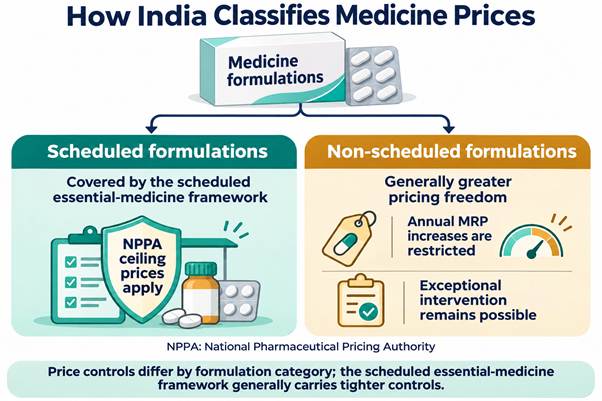
The framework divides medicines into two broad groups:
- Scheduled formulations are medicines included in Schedule I of DPCO, broadly linked to the National List of Essential Medicines (NLEM).
- Non-scheduled formulations are medicines outside that list and generally do not face the same routine ceiling-price mechanism.
Role of the NLEM
The National List of Essential Medicines identifies medicines considered important for meeting priority health needs.
The NLEM 2022 contains 388 medicines across 29 therapeutic categories, including medicines for infections, diabetes, cardiovascular diseases and cancer.
When a formulation is included under the scheduled framework, NPPA can determine its ceiling price.
How Are Ceiling Prices Fixed?
India currently follows a market-based pricing approach for scheduled formulations.
NPPA identifies qualifying brands and generic versions with at least 1% market turnover for a particular formulation.
Their prices to retailers are averaged, and a permitted retailer margin is then added to determine the ceiling price.
For example, if qualifying brands are supplied to retailers at ₹80, ₹100 and ₹120, their average price is ₹100. Adding a 16% retailer margin gives a ceiling price of ₹116, excluding applicable taxes.
This replaced the earlier cost-based pricing model, which directly examined manufacturing costs and permissible profit margins.
Strength and Limitation of Market-Based Pricing
Market-based pricing is administratively simpler and reflects prevailing market prices.
However, it can also inherit distortions already present in the market. If prevailing prices are themselves high, averaging them may produce a high legal ceiling.
The system therefore does not automatically establish whether the regulated price is proportionate to manufacturing cost or therapeutic value.
This creates an important distinction between price compliance and affordability.
What About Non-Scheduled Medicines?
Non-scheduled medicines generally do not have routine NPPA ceiling prices.
However, manufacturers ordinarily cannot increase their MRP by more than 10% over the preceding 12 months.
The government can also intervene in exceptional circumstances in the public interest.
How Trade Margin Rationalisation Works
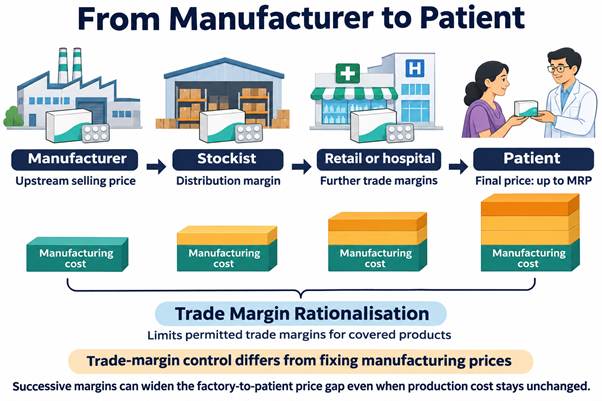
For some medicines, especially high-cost drugs, the government may regulate the trade margin rather than the manufacturing price itself.
Trade margin broadly refers to the difference between the price at which a manufacturer sells to the distribution chain and the final retail price.
For the 137 identified anti-cancer drugs, NPPA has capped this margin at 30% of the MRP excluding GST.
The mechanism operates differently from ordinary ceiling-price regulation because it controls the mark-up between the manufacturer or stockist level and the patient-facing price.
Why Cancer Drugs Receive Special Attention
Cancer treatment increasingly uses expensive targeted therapies, biologics and immunotherapies.
High distribution margins can make already costly medicines even less affordable.
A similar trade-margin intervention in 2019 covered 42 anti-cancer drugs and reduced MRPs across hundreds of brands.
However, a 30% trade-margin cap does not mean that every medicine becomes 30% cheaper. The effect depends on the previous margin structure.
Enforcement Mechanism
NPPA works with State Drug Controllers and Price Monitoring and Resource Units (PMRUs).
These bodies monitor prices, collect market intelligence and support enforcement against overcharging.
Manufacturers and retailers must comply with notified prices, while consumers can check official prices through platforms such as Pharma Sahi Daam and report suspected violations.
NPPA also regulates selected medical devices, including coronary stents and knee implants.
The Bigger Policy Challenge
India separates drug approval and drug pricing institutionally.
CDSCO and related regulators focus primarily on safety, quality and efficacy, while NPPA focuses on price.
This division creates a policy gap because a medicine may be approved, legally priced and still offer poor value relative to its therapeutic benefit or remain unaffordable.
Countries using Health Technology Assessment (HTA) increasingly examine whether a medicine provides sufficient clinical benefit relative to its cost.
Core Policy Lesson
Drug-price regulation must balance three objectives: affordability, availability and innovation.
India's current framework combines ceiling prices, restrictions on MRP increases and trade-margin controls.
The deeper challenge is to move beyond simply asking whether a medicine's price complies with regulation and towards asking whether patients can actually access it without severe financial hardship.
Probable Mains Question
“Drug-price regulation in India addresses excessive pricing, but legal price compliance does not necessarily ensure affordability.” Discuss with reference to NPPA, DPCO 2013 and Trade Margin Rationalisation.
Prelims Drill
MCQ 1
With reference to drug-price regulation in India, consider the following statements:
- NPPA functions under the Department of Pharmaceuticals.
- Scheduled formulations under DPCO 2013 are broadly linked to medicines included in the National List of Essential Medicines.
- Every medicine sold in India is subject to the same ceiling-price mechanism.
Which of the statements given above are correct?
A. 1 only
B. 1 and 2 only
C. 2 and 3 only
D. 1, 2 and 3
Correct Answer: B
Explanation: NPPA regulates pharmaceutical prices under the Department of Pharmaceuticals. Scheduled formulations are broadly based on the NLEM, while non-scheduled medicines do not face the same routine ceiling-price framework.
MCQ 2
Consider the following statements regarding Trade Margin Rationalisation:
- It regulates the mark-up between upstream selling prices and the final retail price.
- It is identical to directly fixing the manufacturer's production cost.
- It can be used to reduce excessive distribution margins on high-cost medicines.
Which of the statements given above are correct?
A. 1 only
B. 1 and 3 only
C. 2 and 3 only
D. 1, 2 and 3
Correct Answer: B
Explanation: Trade Margin Rationalisation limits the margin added through the distribution chain. It does not directly determine manufacturing cost and can be used to reduce excessive mark-ups before the medicine reaches patients.
More Current Affairs - Daily
- India’s State Capacity Stagnation: The Missing Link in Reform 21 Nov 2026
- Holding Two Offices: What Does the Constitution Say About an Office of Profit? 21 Nov 2026
- The Price of War: West Asia Crisis Is Raising India’s Energy Import Bill 21 Nov 2026
- Surveillance Pricing : How Is Personal Data Used to Set Prices? 21 Nov 2026