
Current Affairs - Daily
26 November 2026
Who Pays for Climate Disasters? The Federal Question
Why in News
The US Supreme Court heard a case involving the City and County of Boulder in Colorado. The question was whether local authorities could sue fossil fuel companies under state law to recover damages for harm caused by climate change. In India, the Sikkim High Court took suo motu cognisance of the state’s preparedness for climate-related disasters in September 2026.
- At a hearing in November, the court considered the monitoring of Sikkim’s 40 high-risk glacial lakes and the provision of early warning systems.
Powers of the Union and the States
- Article 253 of the Constitution empowers Parliament to legislate to implement international treaties, agreements and decisions taken at international conferences. This power extends to subjects in the State List.
- The preamble to the Environment (Protection) Act, 1986 refers to the decisions taken at the United Nations Conference on the Human Environment, held in Stockholm in June 1972.
- Under Article 270, cesses levied by Parliament for specific purposes and surcharges levied under Article 271 are excluded from the divisible pool of taxes shared between the Union and the States.
Financing disaster relief and reconstruction
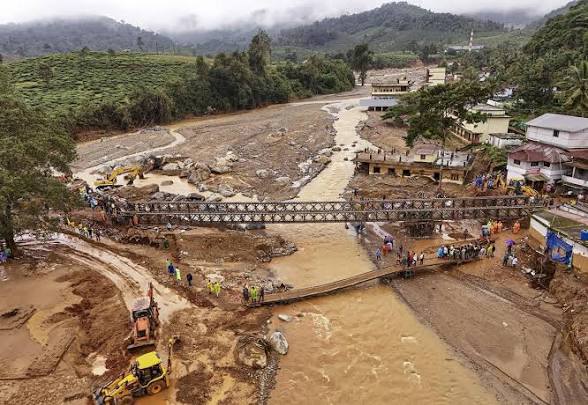
- Section 46 of the Disaster Management Act, 2005 provides for the National Disaster Response Fund. Section 48 deals with funds at the state and district levels. Immediate relief and subsequent reconstruction receive assistance through separate funding provisions. Following the landslides in Wayanad, केरलम, on 30 July 2024, the Union government approved ₹260.56 crore for recovery and reconstruction.
- केरलम also received ₹529.50 crore under the Special Assistance to States for Capital Investment scheme. In Himachal Pradesh, the reconstruction plan approved after the 2023 monsoon disasters totalled ₹2,006.40 crore. The Union’s share, payable from the National Disaster Response Fund, was ₹1,504.80 crore.
Polluter liability and citizens’ rights
- In Vellore Citizens’ Welfare Forum v. Union of India (1996), the Supreme Court recognised the precautionary principle and the polluter pays principle as part of Indian environmental law. A polluter’s liability includes compensating affected people and meeting the cost of restoring the damaged environment.
- Section 15 of the National Green Tribunal Act, 2010 empowers the Tribunal to award compensation and order environmental restoration. In M.K. Ranjitsinh v. Union of India (2024), the Supreme Court recognised the right to protection against the adverse effects of climate change under Articles 14 and 21 of the Constitution.
Practice Question
Question : Consider the following statements:
- Under Article 253, Parliament may legislate on a subject in the State List to implement an international agreement.
- A cess levied by Parliament for a specific purpose is shared between the Union and the States under Article 270.
- The Supreme Court has recognised the right to protection against the adverse effects of climate change under Articles 14 and 21.
Which of the statements given above are correct?
(a) 1 and 2 only
(b) 2 and 3 only
(c) 1 and 3 only
(d) 1, 2 and 3
Answer : (c)