
Constitution Day : Constitutional Morality and Accountability
Constitution Day: A Test of Civic Conduct and Public Accountability
When a citizen is denied a benefit under a government scheme, are they told why? When someone disagrees with a government policy, are their views heard with the same respect as those of its supporters?
- These everyday questions show what constitutional morality means in practice. It offers a way to assess how citizens behave and how public institutions make decisions against the principles of equality, liberty, dignity and the rule of law.
Why Is Constitution Day Observed?
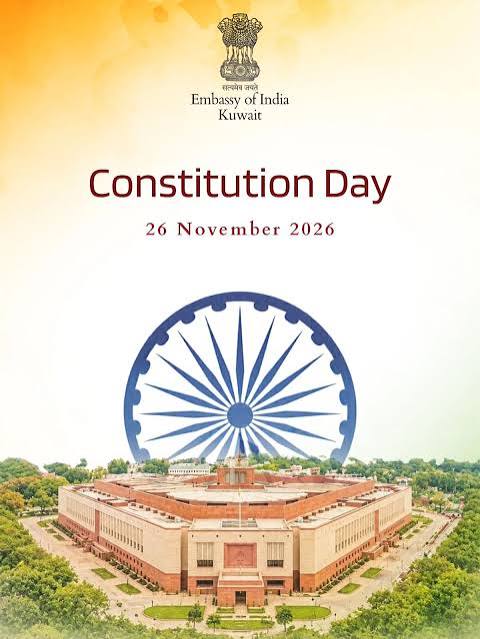
- The Constituent Assembly adopted the Constitution of India on 26 November 1949. Most of its provisions came into force on 26 January 1950. Since 2015, 26 November has been observed as Constitution Day.
- It is an occasion to reflect on the ideals of justice, liberty, equality and fraternity set out in the Preamble and to ask how far they are reflected in citizens’ everyday lives.
What Does Constitutional Morality Mean?
- While presenting the Draft Constitution on 4 November 1948, Dr B. R. Ambedkar said that constitutional morality has to be cultivated. In practice, this means exercising public power within constitutional limits and giving citizens the freedom to criticise public decisions openly.
- In a democracy, a majority can form a government. That government also has a duty to protect the rights of those who disagree with it and of minority groups.
- The Supreme Court clarified this principle in Navtej Singh Johar (2018). In decriminalising consensual same-sex relations between adults, the Court emphasised dignity, privacy and equality.
- The judgment showed that the protection of a group’s fundamental rights cannot depend on whether society accepts that group.
Constitutional Values in Civic Conduct
- Exercising one’s freedom of expression while respecting others’ right to disagree is part of constitutional conduct. Citizens put these values into practice when they protest peacefully against a policy, challenge discrimination based on caste or religion, and verify information before sharing it.
- Article 51A places a duty on citizens to respect the ideals of the Constitution and promote harmony across religious, linguistic and regional differences.
How Can Public Institutions Be Held Accountable?
- If an eligible family is removed from a list of beneficiaries, the department concerned should explain its decision, give the family an opportunity to correct any error in the records and hear its grievance.
- Knowing the reasons for a decision helps citizens understand how the rules were applied to their case. Section 4 of the Right to Information Act, 2005 requires public authorities to give affected persons the reasons for their administrative or quasi-judicial decisions.
- The significance of Constitution Day can be judged by how freely an ordinary citizen can ask questions, whether they receive a fair hearing, and whether a public institution acknowledges and corrects its mistakes. Through such experiences, constitutional values become part of everyday civic life.
Question: Consider the following statements regarding Constitution Day and constitutional morality.
- Constitution Day is observed on 26 November because the Constituent Assembly adopted the Constitution of India on that date in 1949.
- While presenting the Draft Constitution on 4 November 1948, Dr B. R. Ambedkar said that constitutional morality has to be cultivated.
- In the Navtej Singh Johar case, the Supreme Court upheld the criminalisation of consensual same-sex relations between adults.
Which of the statements given above are correct?
(A) 1 and 2 only (B) 2 and 3 only (C) 1 and 3 only (D) 1, 2 and 3
Answer: (A)
Explanation: The Constitution was adopted on 26 November 1949, and most of its provisions came into force on 26 January 1950. The observance of 26 November as Constitution Day began in 2015. Ambedkar stressed the need to cultivate constitutional morality on 4 November 1948. Statement 3 is incorrect because the Supreme Court decriminalised consensual same-sex relations between adults in its 2018 Navtej Singh Johar judgment.