
Caste Census 2027: Why the Method of Counting Matters
Census 2027 will collect caste names, but their accurate classification remains a major challenge. Recording administrative categories alongside caste identities could improve data quality for reservation policy, sub-categorisation and inequality assessment.
- Syllabus Mapping: GS Paper II — Social Justice, Constitutional Provisions, Reservation Policies, Welfare of Vulnerable Sections and Government Data.
- Source & Date: The Hindu,
Why in News?
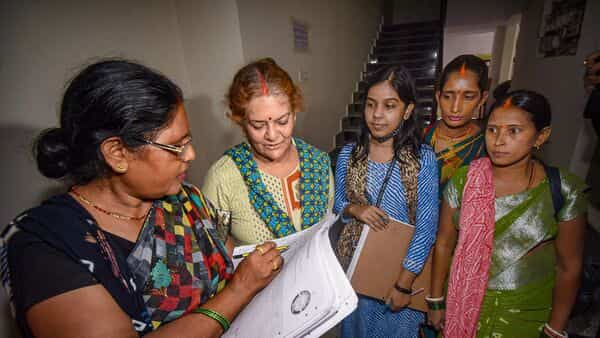
The 2027 Census will collect caste information across all communities, marking the first comprehensive caste enumeration of this kind since 1931.
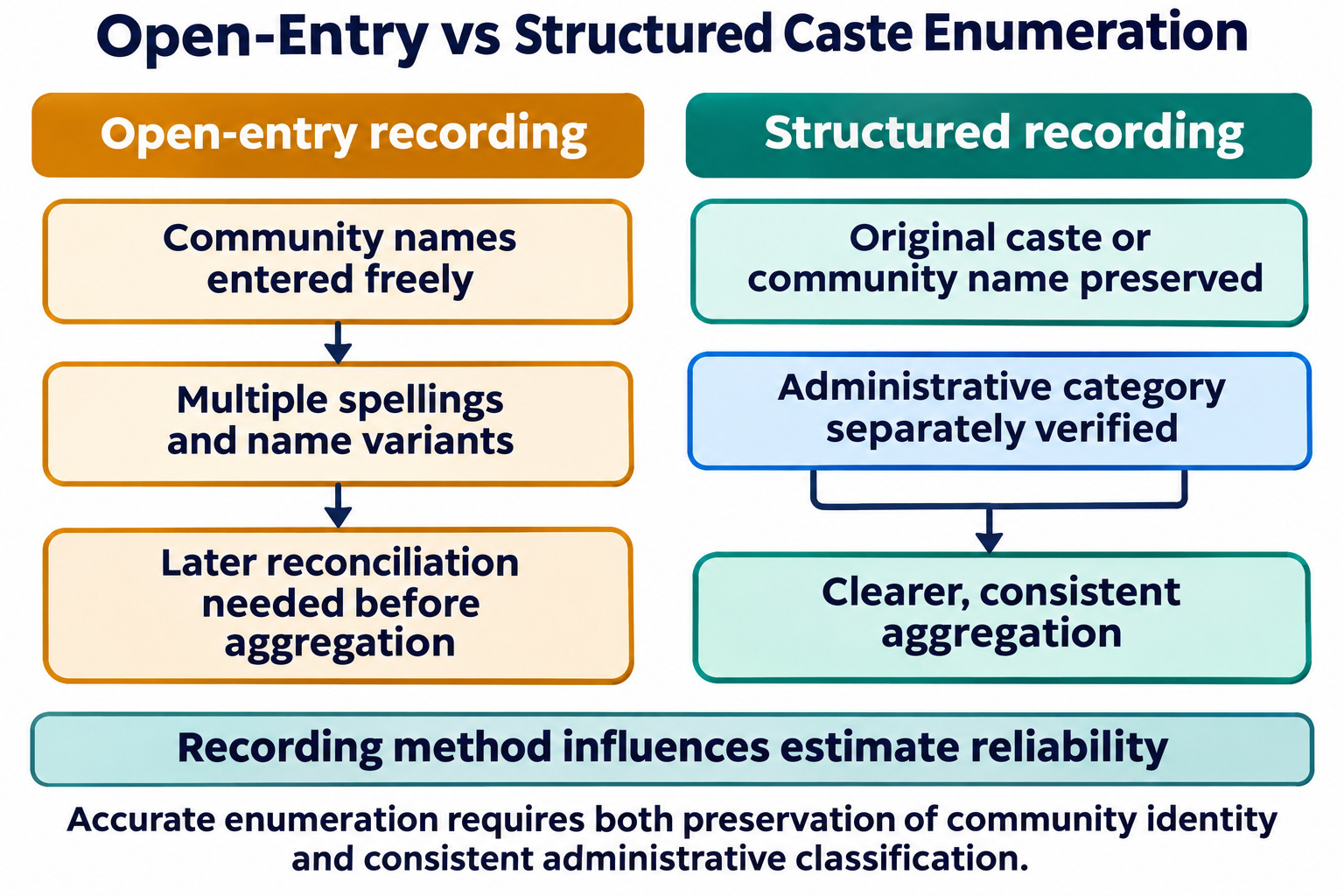
- The proposed approach uses open-entry caste names for communities outside the notified SC/ST lists.
- Enumerators will record names as respondents provide them, without a pre-coded caste menu.
- The central concern is whether millions of entries can subsequently be classified accurately.
Why Is Open-Entry Enumeration Challenging?
India's Socio-Economic and Caste Census (SECC), 2011, recorded approximately 46.7 lakh distinct caste-name entries, including spelling variations, surnames and sub-castes.
- Names such as Yadav, Yadava and Yaduvanshi could appear separately.
- One caste may have different regional names.
- A surname may be shared by several communities.
Consequently, the 2011 caste tables were not publicly released.
The 2027 approach proposes post-enumeration coding and validation, but classification errors could remain difficult to resolve.
Why Are Caste and Administrative Category Different?
A caste name does not automatically determine a person's reservation category.
- SC/ST: Communities are identified through constitutionally notified lists under Articles 341 and 342.
- OBC: Central and State lists can differ; a community recognised as OBC in one jurisdiction may not receive identical recognition elsewhere.
- General: Administrative classification cannot always be inferred from the name alone.
The proposed improvement is to record two distinct fields: self-reported caste name and verified administrative category.
This would preserve detailed caste identities while improving aggregation into broader categories.
What Is the Historical Ambedkar Connection?
In 1932, debates over identifying the population then described as the Depressed Classes influenced questions of political representation.
B.R. Ambedkar argued that rigid, uniform definitions could exclude communities experiencing different forms of untouchability across regions.
The underlying problem remains relevant:
- Different classification rules can produce different population totals.
- Administrative definitions may affect representation and access to benefits.
- Local social conditions are important when identifying disadvantage.
Thus, classification is not merely a technical exercise; it can have distributive consequences.
Why Does Accurate Caste Data Matter?
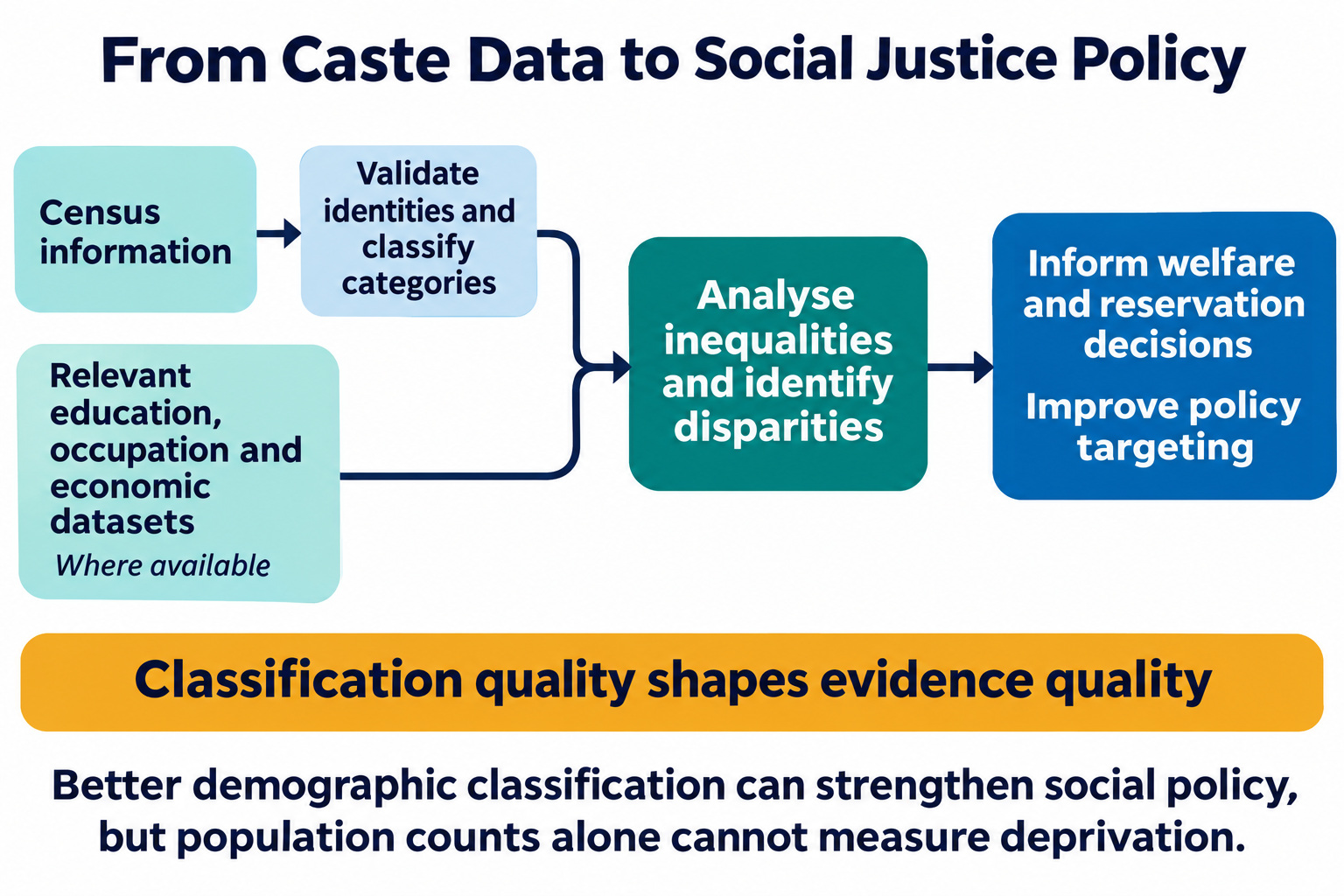
Reliable caste-wise information could support:
- evaluation of educational, occupational and asset inequalities;
- examination of the creamy layer within OBC reservation policy;
- OBC sub-categorisation, examined by the Rohini Commission;
- evidence-based SC sub-classification, permitted by the Supreme Court in State of Punjab v. Davinder Singh (2024).
However, caste counting also raises concerns about privacy, political mobilisation and reinforcing social identities.
Core Policy Lesson
The credibility of caste enumeration depends on how the data are classified, not merely how many people are counted.
Recording caste names alongside verified administrative categories could improve consistency and reduce post-enumeration disputes.
A successful Census must combine statistical accuracy, regional sensitivity, transparency and privacy safeguards to support evidence-based social justice.
---
Probable Mains Question
“The challenge of caste enumeration lies as much in classification as in counting.” Discuss with reference to Census 2027, the limitations of SECC 2011 and the implications for evidence-based social justice policies.
---
Prelims Drill
With reference to the constitutional framework for caste and community classification, consider the following statements:
1. Article 341 deals with the specification of Scheduled Castes.
2. Article 342 deals with the specification of Scheduled Tribes.
3. The Central and State OBC lists must necessarily contain identical communities.
Which of the statements given above are correct?
A. 1 only
B. 1 and 2 only
C. 2 and 3 only
D. 1, 2 and 3
Correct Answer: B
Explanation: Articles 341 and 342 concern SCs and STs respectively. Central and State OBC lists can differ.