
जल शासन: गुजरात के अनुभव से वैश्विक दक्षिण के लिए सबक
India’s water-governance experience shows that sustainable water security requires not only physical infrastructure but also institutions, community participation, financing, resource management and service sustainability.
Water Governance: From Gujarat’s Experience to Lessons for the Global South
- Syllabus Mapping: GS Paper II — Governance, Decentralisation and Public Service Delivery; GS Paper III — Water Resources, Climate Resilience, Agriculture and Sustainable Development.
- Source & Date: The Indian Express, 6 October 2026, based on the case study From Gujarat to India: Water Lessons for the World.
Why Is Water Governance in Focus?
India International Water Week highlighted the growing importance of climate-resilient water management, sustainable supply, efficient water use and reuse of treated wastewater as both an environmental and economic resource.
The larger lesson emerging from India’s experience is that water insecurity cannot be solved by constructing infrastructure alone.
The governance chain is:
Political priority → institutions → financing → infrastructure → community participation → sustainable service delivery
India’s recent experience across programmes related to tap-water supply, groundwater, river rejuvenation, sanitation and conservation illustrates an increasingly integrated approach to water governance.
Lesson 1: Lead with Governance, Not Only Hardware
Pipes, reservoirs and treatment plants are necessary, but their effectiveness depends on institutions capable of financing, maintaining and managing them.
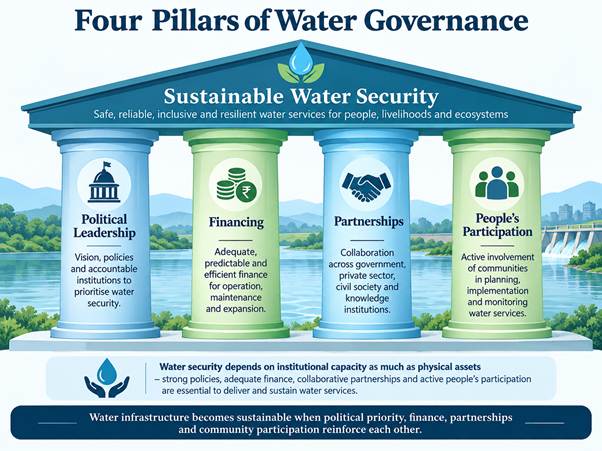
The source identifies a “4 Ps” framework:
- Political leadership to prioritise water security.
- Public and private financing for capital as well as recurring expenditure.
- Partnerships across Union, State and local governments, communities and knowledge institutions.
- People’s participation in local decision-making and water-security planning.
The principle is:
Infrastructure without institutions → weak sustainability
Infrastructure + governance → durable water service
Lesson 2: Manage the Resource and the Service Together
Providing a household tap connection does not guarantee water security if the underlying source becomes depleted or polluted.
Water policy must therefore integrate resource sustainability with service delivery.
This means planning groundwater, surface water, storage, treatment, distribution and future demand together.
The central principle is:
Water source sustainability + service infrastructure = reliable water access
The source also highlights treated wastewater reuse, particularly for non-potable industrial purposes such as data centres and semiconductor fabrication, reducing pressure on freshwater resources.
Lesson 3: Community Ownership Matters
Local institutions such as Pani Samitis can improve the sustainability of rural water systems by involving communities in planning, operation and local water-security decisions.
Community participation is particularly relevant for:
water conservation + rainwater harvesting + groundwater recharge + operation and maintenance
Local ownership can also improve accountability because users are directly involved in monitoring the quality and reliability of services.
This is consistent with the broader principle of decentralised governance, where public services become more responsive when local institutions participate in decision-making.
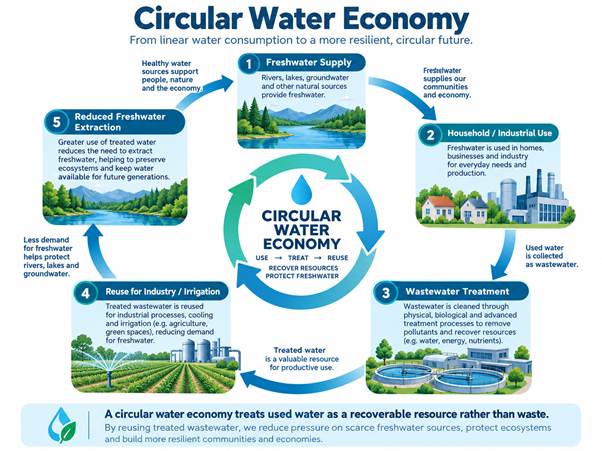
Lesson 4: Treat Used Water as a Resource
Urbanisation, industrialisation and climate stress will increase competition for freshwater.
Treated wastewater can substitute freshwater for several non-potable uses, including industry, landscaping, construction and selected irrigation applications.
The policy shift is:
Wastewater → treatment → reuse → reduced freshwater demand → circular water economy
The source estimates significant future economic potential from the sale of treated used water in India, making reuse both a sustainability strategy and an emerging economic opportunity.
Why Does Scale Matter?
The world remains off track on SDG 6, which seeks universal access to safe water and sanitation and sustainable management of water resources.
Meeting this goal requires not just isolated projects but large-scale systems for infrastructure, financing, data collection, operation and maintenance. The source notes that the additional global annual investment requirement is estimated at around $500 billion.
India’s experience suggests that programmes designed from the beginning for large-scale implementation may reduce fragmentation and accelerate service expansion.
Relevance for the Global South
Many developing countries face the same structural pressures:
rapid urbanisation + groundwater depletion + climate variability + rising industrial demand + limited municipal capacity
The Indian experience therefore offers transferable principles rather than a one-size-fits-all model.
The most durable lessons are:
Govern first → secure the resource → involve communities → reuse water → plan for scale
These principles need to be adapted to local institutions, hydrology and fiscal capacity.
The Core Policy Lesson
Water security is not simply a question of building more dams, pipelines or treatment plants.
It requires integration of resource management, service delivery, institutions, financing, local participation and climate resilience.
The most important conceptual shift is:
Water infrastructure → water governance ecosystem
For India and the wider Global South, sustainable water security will depend on ensuring that the institutions managing water are as resilient as the infrastructure carrying it.
Probable Mains Question
“Water security is fundamentally a governance challenge as much as an infrastructure challenge.” Discuss with reference to community participation, integrated resource management and wastewater reuse in India.
Prelims Drill
MCQ 1
With reference to Sustainable Development Goal 6 (SDG 6), consider the following statements:
- It relates to ensuring availability and sustainable management of water and sanitation for all.
- It includes concerns relating to water quality, wastewater treatment and water-use efficiency.
- It is confined only to provision of household drinking-water connections.
Which of the statements given above are correct?
A. 1 only
B. 1 and 2 only
C. 2 and 3 only
D. 1, 2 and 3
Correct Answer: B
Explanation: SDG 6 covers safe water and sanitation as well as broader issues such as water quality, wastewater management, water-use efficiency, ecosystems and sustainable resource management. It is therefore much broader than household tap-water provision alone.
MCQ 2
With reference to India’s water-governance initiatives, consider the following statements:
- Jal Jeevan Mission focuses on rural household tap-water supply.
- Atal Bhujal Yojana is associated with community-based groundwater management.
- Per Drop More Crop promotes improvement in water-use efficiency in agriculture.
- Pani Samitis are institutions created exclusively for interstate river-water dispute adjudication.
Which of the statements given above are correct?
A. 1 and 2 only
B. 1, 2 and 3 only
C. 2, 3 and 4 only
D. 1, 2, 3 and 4
Correct Answer: B
Explanation: Jal Jeevan Mission addresses rural tap-water supply, Atal Bhujal Yojana promotes participatory groundwater management, and Per Drop More Crop is linked to efficient irrigation. Pani Samitis are local community institutions associated with village-level water management, not interstate river-dispute adjudication.

More Current Affairs - Daily
- Election Commission of India: Constitutional Design and Evolution into a Three-Member Body 12 Oct 2026
- Loknayak Jayaprakash Narayan: Total Revolution and Contribution to Democracy 12 Oct 2026
- India’s Russia-Ukraine Initiative: From Black Sea Security to Strategic Autonomy 12 Oct 2026
- Jayaprakash Narayan: Architect of Total Revolution and Defender of Democracy 12 Oct 2026