
Election Commission of India: Constitutional Design and Evolution into a Three-Member Body
India’s Election Commission evolved from a single-member body into a permanent three-member commission through constitutional flexibility, statutory reform and Supreme Court interpretation.
Election Commission of India: Constitutional Design and Evolution into a Three-Member Body
- Syllabus Mapping: GS Paper II — Constitution, Constitutional Bodies, Election Laws and Democratic Institutions.
- Source & Date: The Indian Express, 11 October 2026.
Why in News?
The institutional design of the Election Commission of India (ECI) has returned to focus amid renewed scrutiny of how India’s election-management body is structured and how its independence is protected.
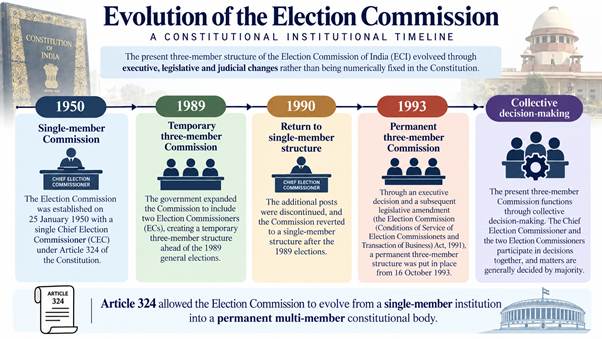
The ECI was established on 25 January 1950 as a permanent constitutional body. For most of its early history, it functioned with only a Chief Election Commissioner (CEC). It became a three-member body briefly in 1989 and permanently from 1993 onwards.
The evolution raises an important constitutional question:
How can an election-management body remain independent while also functioning collectively and institutionally?
Article 324 Provides the Constitutional Foundation
Article 324 vests the Election Commission with the superintendence, direction and control of:
- preparation of electoral rolls;
- elections to Parliament;
- elections to State Legislatures;
- elections to the offices of President and Vice-President.
The Constitution does not permanently fix the number of Election Commissioners.
Article 324(2) provides for:
Chief Election Commissioner + such number of other Election Commissioners as the President may from time to time fix
This constitutional flexibility made both a single-member and a multi-member Commission possible.
The Commission Was Originally a Single-Member Body
For nearly four decades after its establishment, the ECI consisted only of the Chief Election Commissioner.
This meant that the institutional powers vested in the Election Commission were effectively exercised through a single constitutional office-holder.
The first major departure came in 1989, when two Election Commissioners were appointed before the ninth Lok Sabha election.
The Commission thus became:
CEC → CEC + 2 Election Commissioners
The First Three-Member Experiment Was Short-Lived
Two Election Commissioners were appointed in October 1989.
However, after a change of government, the notification creating the additional positions was rescinded, and the ECI returned to a single-member structure in 1990.
The episode demonstrated that Article 324 allowed changes in the number of Election Commissioners without altering the Constitution itself.
The Three-Member Structure Returned Permanently in 1993
A decisive institutional change occurred on 1 October 1993, when two Election Commissioners were again appointed alongside then CEC T.N. Seshan.
The 1991 law governing service conditions was simultaneously amended to provide rules for the transaction of business by the Commission.
The three members were placed on an equal footing in decision-making.
The basic framework became:
Attempt unanimity → if disagreement persists → majority decision
T.N. Seshan Challenged the Multi-Member Arrangement
Then CEC T.N. Seshan challenged the 1993 changes before the Supreme Court, arguing that the arrangement diminished the authority of the Chief Election Commissioner.
In T.N. Seshan v. Union of India (1995), a Constitution Bench upheld the multi-member structure.
The Court rejected the idea that the other Election Commissioners were merely subordinate or ornamental members.
It held that the constitutional scheme permits a multi-member body in which all members participate meaningfully in decision-making. Where unanimity is not possible, decisions may be taken by majority.
The CEC Is Chairperson, Not an Absolute Superior
Article 324 provides that when other Election Commissioners are appointed, the CEC acts as the Chairman of the Election Commission.
However, chairmanship does not mean unilateral control over collective decisions.
The institutional principle is:
CEC as Chairperson + ECs as participating members → collective Election Commission
This distinction is critical because Article 324 vests powers in the Election Commission as an institution, not merely in the CEC personally.
Current Appointments Are Governed by the 2023 Act
The Chief Election Commissioner and Other Election Commissioners (Appointment, Conditions of Service and Term of Office) Act, 2023 now governs the appointment framework.
Under the Act, the President appoints the CEC and ECs on the recommendation of a Selection Committee consisting of:
- the Prime Minister as Chairperson;
- the Leader of Opposition in the Lok Sabha, or leader of the largest opposition party where no recognised LoP exists;
- a Union Cabinet Minister nominated by the Prime Minister.
A Search Committee prepares a panel for consideration.
The Act requires appointees to be persons who hold or have held a post equivalent to Secretary to the Government of India, and to possess integrity and experience in the management and conduct of elections.
Tenure Is Six Years or Until Age 65
Under the current law, the CEC and Election Commissioners hold office for:
six years from assumption of office OR until age 65, whichever is earlier
They are not eligible for reappointment.
If an Election Commissioner later becomes CEC, the combined tenure in both positions cannot exceed six years.
Removal Safeguards Are Not Identical
Article 324 gives the CEC strong protection from removal.
The CEC can be removed only in the same manner and on the same grounds as a judge of the Supreme Court.
Other Election Commissioners do not enjoy identical constitutional protection. They cannot be removed except on the recommendation of the CEC.
The distinction can be expressed as:
- CEC → constitutionally protected removal procedure
- ECs → removal requires recommendation of CEC
This asymmetry is frequently discussed in debates over institutional independence.
Free and Fair Elections Require Institutional Independence
The Supreme Court has repeatedly treated free and fair elections as central to constitutional democracy.
In the T.N. Seshan case, the Court emphasised that the institution responsible for elections must be insulated from external political or executive pressure.
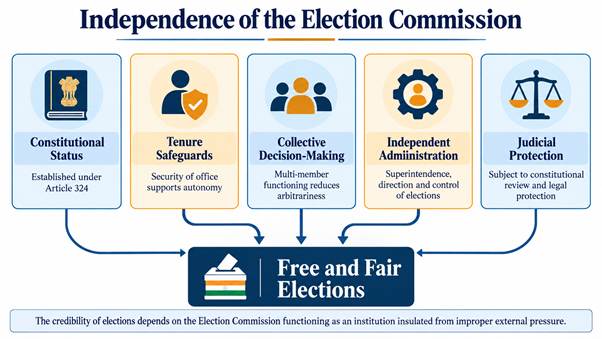
Institutional independence depends on several elements:
secure tenure + protected decision-making + transparent appointments + administrative capacity + financial autonomy
Independence therefore concerns the design of the institution as a whole, not merely the personality of an individual Commissioner.
ECI Functions Extend Beyond Conducting Polls
The Election Commission’s role extends beyond organising polling.
It performs advisory and quasi-judicial functions, including matters relating to the post-election disqualification of sitting MPs and MLAs.
It also deals with questions arising from corrupt electoral practices and can exercise statutory powers regarding failure to submit election-expense accounts.
The ECI also supervises:
electoral rolls + election schedules + political-party compliance + Model Code of Conduct + election expenditure + polling machinery
Funding Raises a Separate Independence Question
The ECI Secretariat has its own budgetary requirements, which are discussed with the Union Finance Ministry.
However, the Commission’s expenditure does not enjoy the same constitutional arrangement as institutions whose entire expenditure is automatically charged on the Consolidated Fund of India.
This has led periodically to proposals for greater financial autonomy for the institution.
The wider principle is:
Operational independence requires adequate and predictable institutional resources
The Core Policy Lesson
The Election Commission’s evolution demonstrates that constitutional independence does not necessarily require concentrating power in a single office-holder.
India moved from:
Single-member authority → multi-member institution → collective decision-making
Article 324 deliberately provides structural flexibility, while legislation and judicial interpretation have developed the detailed framework.
The most important institutional principle is therefore:
Independent elections require an independent Election Commission, but institutional independence must be combined with collective responsibility, clear procedures and constitutional safeguards.
Probable Mains Question
“The evolution of the Election Commission of India from a single-member to a multi-member body reflects a shift from individual authority towards institutional decision-making.” Discuss with reference to Article 324 and the T.N. Seshan judgment.
Prelims Drill
MCQ 1
With reference to the Election Commission of India, consider the following statements:
- Article 324 vests the superintendence, direction and control of elections in the Election Commission.
- The Constitution itself permanently fixes the Election Commission as a three-member body.
- The Election Commission conducts elections to the offices of President and Vice-President of India.
- When other Election Commissioners are appointed, the Chief Election Commissioner acts as Chairman of the Commission.
Which of the statements given above are correct?
A. 1 and 3 only
B. 1, 3 and 4 only
C. 2, 3 and 4 only
D. 1, 2, 3 and 4
Correct Answer: B
Explanation: Article 324 gives the ECI control over elections to Parliament, State Legislatures and the offices of President and Vice-President. The Constitution does not fix the number of Election Commissioners at three; the President may determine the number subject to law. The CEC acts as Chairman when other ECs are appointed.
MCQ 2
With reference to constitutional safeguards relating to the Election Commission, consider the following statements:
- The Chief Election Commissioner can be removed in the same manner and on the same grounds as a judge of the Supreme Court.
- An Election Commissioner can be removed only on the recommendation of the Chief Election Commissioner.
- Differences of opinion in a multi-member Election Commission must necessarily result in the matter being referred to Parliament.
Which of the statements given above are correct?
A. 1 only
B. 1 and 2 only
C. 2 and 3 only
D. 1, 2 and 3
Correct Answer: B
Explanation: Article 324 provides special removal protection for the CEC and requires the CEC’s recommendation for removal of another Election Commissioner. In a multi-member Commission, disagreements can be resolved through majority decision-making; they do not have to be referred to Parliament.
More Current Affairs - Daily
- Loknayak Jayaprakash Narayan: Total Revolution and Contribution to Democracy 12 Oct 2026
- Jayaprakash Narayan: Architect of Total Revolution and Defender of Democracy 12 Oct 2026
- India’s Russia-Ukraine Initiative: From Black Sea Security to Strategic Autonomy 12 Oct 2026
- From PARAM to PARAM Rudra: India's Progress in Supercomputing 12 Oct 2026