
India’s Russia-Ukraine Initiative: From Black Sea Security to Strategic Autonomy
India’s initiative focuses not on a comprehensive peace settlement but on limited non-attack arrangements covering Black Sea shipping, grain exports and energy infrastructure.
India’s Russia-Ukraine Initiative: From Black Sea Security to Strategic Autonomy
- Syllabus Mapping: GS Paper II — International Relations, India-Russia Relations, India-U.S. Relations and Global Diplomacy; GS Paper III — Food Security, Energy Security and Maritime Security.
- Source & Date: The Indian Express, 11 October 2026.
Why in News?
India has moved beyond general appeals for dialogue and put forward a broader proposal aimed at reducing hostilities between Russia and Ukraine, especially in the Black Sea region.
The proposal reportedly focuses on:
- reducing attacks on energy infrastructure;
- protecting commercial shipping;
- keeping grain and energy exports moving;
- and exploring limited non-attack arrangements.
Ukraine has described India’s proposal as among the most comprehensive of the recent ceasefire ideas under discussion. However, these proposals are still limited ceasefire mechanisms, not a full settlement of the war.
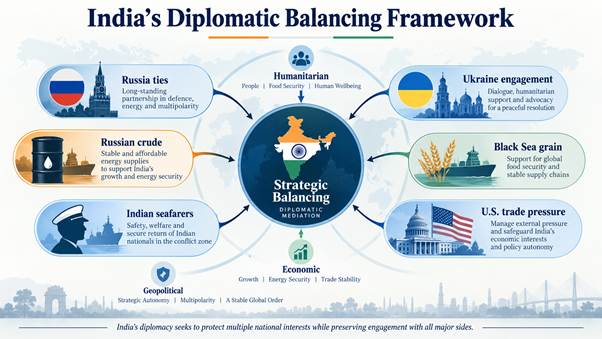
India’s growing involvement reflects a combination of:
food security + maritime safety + energy interests + diplomatic credibility + strategic autonomy
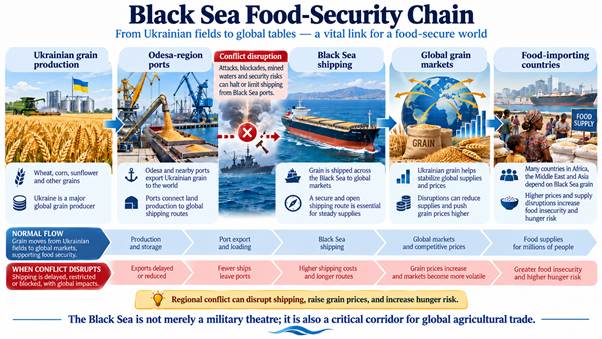
Black Sea Is Central to Global Food Security
Ukraine is a major exporter of wheat, maize, sunflower products and other agricultural commodities.
Its deep-water ports around Odesa, Chornomorsk and Pivdennyi handle a very large share of its agricultural exports.
When port infrastructure, merchant vessels or shipping lanes are attacked, the impact extends far beyond Ukraine.
The chain is:
Black Sea disruption → lower grain exports → tighter global supply → higher food prices → greater food insecurity
This is especially important for import-dependent regions in Africa, West Asia and parts of Asia.
A Partial Ceasefire Could Protect Critical Infrastructure
The Indian initiative appears to focus on a limited reciprocal arrangement rather than an immediate comprehensive peace agreement.
One possible structure is:
Russia reduces attacks on Ukrainian energy and port infrastructure ↔ Ukraine reduces attacks on Russian energy and related targets
Ukraine has publicly indicated willingness to stop strikes on Russian refineries if Russia reciprocates by halting attacks on Ukrainian energy infrastructure.
This demonstrates the logic of a sectoral ceasefire:
limit specific categories of attacks → reduce civilian and economic damage → build confidence → create space for wider negotiations
Merchant Shipping Has Become an Indian Security Concern
India has a major stake in global merchant shipping because Indian nationals form a significant share of the international seafaring workforce.
Attacks on civilian vessels in the Black Sea have therefore created a direct consular and security concern for New Delhi.
The diplomatic objective is no longer limited to abstract peace advocacy.
It includes:
safe navigation + protection of Indian seafarers + uninterrupted maritime commerce
This helps explain why the safety of Black Sea shipping has become an important part of India’s engagement with both Moscow and Kyiv.
India Has Maintained Communication With Both Sides
Since 2022, India has maintained high-level contact with both Russia and Ukraine.
Its position has combined:
opposition to prolonged conflict + support for dialogue + continued ties with Russia + engagement with Ukraine
This approach has allowed India to retain channels that many states aligned closely with either side do not possess.
The diplomatic progression has been:
Advocacy for dialogue → engagement with both sides → sector-specific proposals → possible facilitation
India is therefore seeking a role based on access and credibility rather than formal alliance politics.
Russian Crude Creates an Important Strategic Interest
Energy remains a central part of India-Russia relations.
After Western restrictions on Russian energy expanded, India became a major purchaser of discounted Russian crude.
These imports have helped India diversify supply and moderate domestic energy costs, but they have also generated criticism and tariff pressure from the United States.
The strategic dilemma is:
Affordable energy from Russia ↔ pressure from Western partners
India’s diplomatic engagement over Ukraine can therefore also be viewed through the lens of protecting its broader economic room for manoeuvre.
U.S. Pressure Adds Another Layer
The United States has intensified pressure on major buyers of Russian energy while simultaneously pursuing its own energy arrangements with Russia.
Recent U.S.-India trade negotiations have also been constrained by disagreements connected to Russian oil purchases.
This creates a wider strategic context for India:
Russian energy relationship + U.S. trade relationship + war diplomacy → need for strategic balance
India’s peace initiative consequently serves both humanitarian and national-interest objectives.
Strategic Autonomy Shapes India’s Approach
India’s traditional foreign-policy preference is to avoid rigid alignment where national interests require engagement with competing powers.
In the Ukraine conflict, this has translated into maintaining ties with Russia while also strengthening engagement with Ukraine and Western states.
The approach can be understood as:
Issue-based cooperation + independent decision-making + multiple partnerships = strategic autonomy
Strategic autonomy does not imply neutrality on every issue. It means retaining sufficient policy space to take decisions based on India’s own assessment of interests.
Food and Energy Security Link the Global South to the War
For many developing countries, the Russia-Ukraine conflict is not primarily a European security issue.
Its effects are transmitted through:
grain prices + fertiliser supply + crude oil + shipping costs + insurance + exchange rates
This explains why countries outside Europe increasingly have incentives to support limited arrangements protecting trade and infrastructure.
India’s initiative therefore reflects a broader Global South concern with reducing the economic spillovers of prolonged conflict.
Limited Ceasefires Face Major Constraints
A sector-specific ceasefire is easier to negotiate than a comprehensive settlement, but implementation remains difficult.
Major challenges include:
- lack of trust between Russia and Ukraine;
- disagreement over territory and security guarantees;
- monitoring violations;
- identifying which infrastructure is protected;
- and ensuring reciprocity.
Russia has welcomed India’s willingness to contribute diplomatically but has not publicly committed to the Indian proposal.
Thus:
Proposal → agreement → verification → compliance
Each stage presents a separate diplomatic challenge.
The Core Policy Lesson
India’s initiative should not be interpreted simply as an attempt to broker a final settlement to the Russia-Ukraine war.
Its immediate logic is more limited and pragmatic:
protect shipping → secure grain flows → reduce energy attacks → limit economic spillovers → create diplomatic space
For India, the initiative simultaneously protects food security, energy security, maritime interests and diplomatic autonomy.
The broader foreign-policy shift is:
From calling for peace → to facilitating specific conditions for de-escalation
Whether this develops into a larger mediation role will depend primarily on whether Russia and Ukraine themselves see value in reciprocal restraint.
Probable Mains Question
“India’s engagement in the Russia-Ukraine conflict reflects the evolution of strategic autonomy from diplomatic non-alignment to issue-based conflict management.” Discuss with reference to the Black Sea, energy security and India’s relations with major powers.
Prelims Drill
MCQ 1
Consider the following statements regarding the Black Sea:
- The Black Sea is connected to the Mediterranean Sea through the Turkish Straits system.
- The Sea of Azov is connected to the Black Sea through the Kerch Strait.
- Ukraine and Russia both have coastlines on the Black Sea.
Which of the statements given above are correct?
A. 1 only
B. 1 and 2 only
C. 2 and 3 only
D. 1, 2 and 3
Correct Answer: D
Explanation: The Black Sea connects to the Mediterranean through the Bosporus, Sea of Marmara and Dardanelles. The Kerch Strait connects the Black Sea with the Sea of Azov, while both Russia and Ukraine are Black Sea littoral states.
MCQ 2
With reference to strategic autonomy in Indian foreign policy, consider the following statements:
- It seeks to preserve independent decision-making in external relations.
- It necessarily requires India to remain equidistant from all major powers on every international issue.
- It allows India to cooperate with different countries on different issues according to national interests.
Which of the statements given above are correct?
A. 1 only
B. 1 and 3 only
C. 2 and 3 only
D. 1, 2 and 3
Correct Answer: B
Explanation: Strategic autonomy refers to retaining independent policy choices rather than maintaining mechanical equidistance between competing powers. It permits issue-based partnerships with different states while preserving national decision-making.
More Current Affairs - Daily
- Loknayak Jayaprakash Narayan: Total Revolution and Contribution to Democracy 12 Oct 2026
- Jayaprakash Narayan: Architect of Total Revolution and Defender of Democracy 12 Oct 2026
- Election Commission of India: Constitutional Design and Evolution into a Three-Member Body 12 Oct 2026
- From PARAM to PARAM Rudra: India's Progress in Supercomputing 12 Oct 2026