
Demand to Divide Uttar Pradesh into Four States: Constitution, Administration and Regional Politics
The demand to divide Uttar Pradesh into four states has once again entered the political debate. Uttar Pradesh Minister and SBSP chief Om Prakash Rajbhar has claimed that the state could soon be divided into four parts. He has also spoken of a Chief Minister from the Rajbhar community in Purvanchal. The demand is not new. In 2011, the then Mayawati government passed a resolution in the Uttar Pradesh Assembly proposing four states—Purvanchal, Bundelkhand, Awadh Pradesh and Paschim Pradesh. However, the proposal did not move forward. The current debate involves important questions concerning Article 3, administrative efficiency, regional aspirations, economic viability and political representation.
Demand to Divide Uttar Pradesh into Four States: Administration, Federalism and Regional Politics
Uttar Pradesh Minister and Suheldev Bharatiya Samaj Party (SBSP) chief Om Prakash Rajbhar has recently claimed that Uttar Pradesh could soon be divided into four parts and that Purvanchal could get a “Rajbhar Chief Minister”. He has referred to discussions with Prime Minister Narendra Modi and the possibility of such a reorganisation after the caste census. However, this remains a political claim by Rajbhar; no official decision to divide Uttar Pradesh has been taken by the Union Government or Parliament.
What is the Four-State Proposal?
- The current debate over the division of Uttar Pradesh broadly revolves around four regions—Western Uttar Pradesh/West Pradesh, Awadh Pradesh, Bundelkhand and Purvanchal. These are proposed regions and do not currently constitute officially recognised states.
- The idea received a clear political expression in 2011, when the then Mayawati-led Uttar Pradesh government passed a resolution in the state Assembly proposing that Uttar Pradesh be divided into Purvanchal, Bundelkhand, Awadh Pradesh and West Pradesh. The argument was that the state's enormous geographical size and regional developmental disparities could make administration and development more effective if smaller states were created. The proposal was sent to the Union Government but did not move forward.
Constitutional Provisions for the Creation of New States
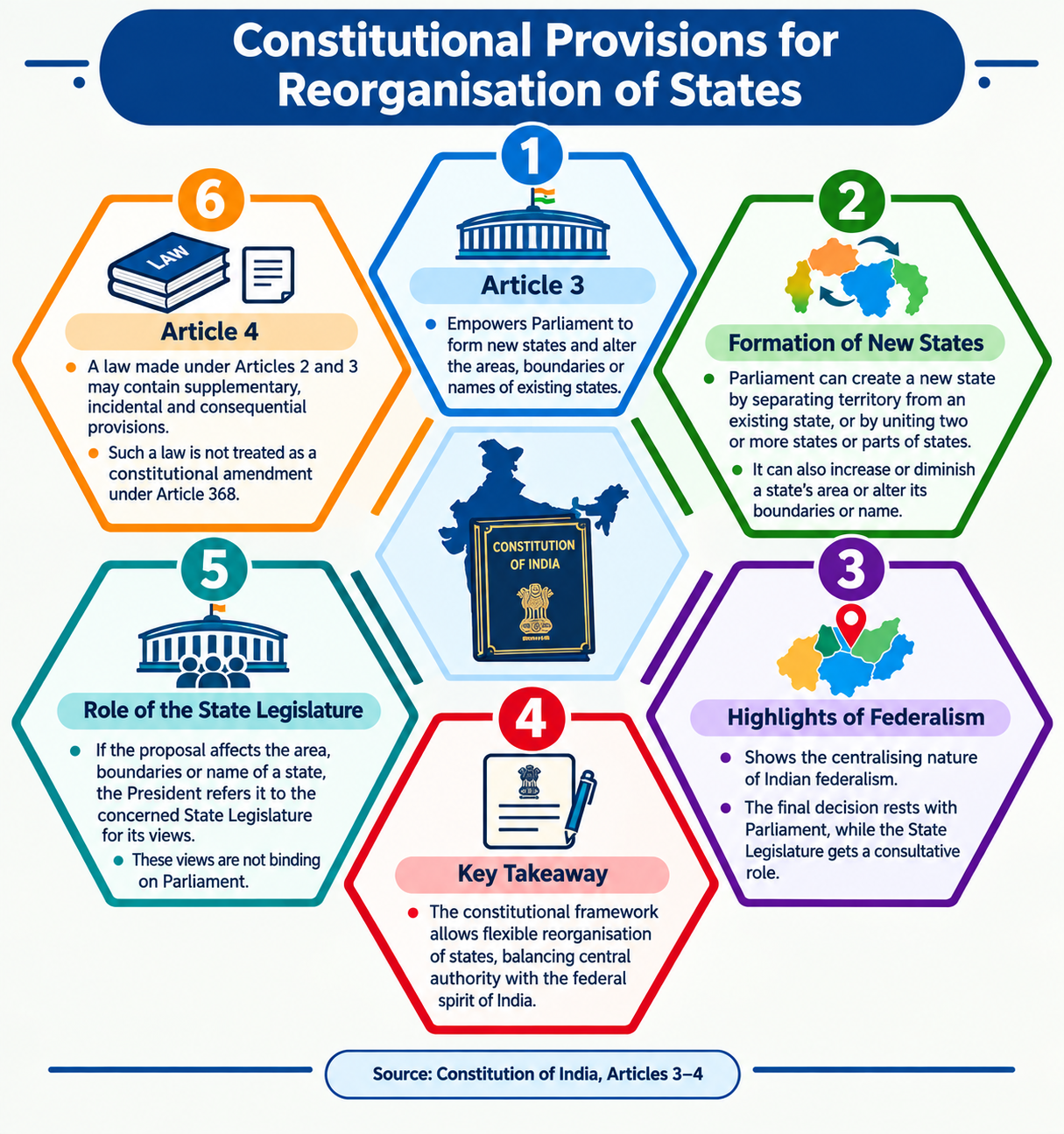
- Article 3 of the Constitution of India empowers Parliament to form new states and alter the areas, boundaries or names of existing states. Parliament can create a new state by separating territory from an existing state, unite two or more states or parts of states, increase or diminish the area of a state, or alter its boundaries or name.
- The process requires the recommendation of the President. If a proposal affects the area, boundaries or name of a state, the President refers it to the concerned State Legislature for expressing its views.
- Importantly, the views of the State Legislature are not binding on Parliament. The final authority rests with Parliament.
- Under Article 4, a law made under Articles 2 and 3 may contain supplementary, incidental and consequential provisions necessary to implement the reorganisation. Such a law is not treated as a constitutional amendment under Article 368.
What Does Article 3 Tell Us About Indian Federalism?
- Article 3 reflects the centralising character of Indian federalism. The power to alter state boundaries ultimately rests with Parliament, and the consent of the concerned State Legislature is not constitutionally mandatory.
- At the same time, the State Legislature is given an opportunity to express its views. Thus, Indian federalism combines central authority with a consultative mechanism in matters of territorial reorganisation.
- Unlike federations where state boundaries may have stronger constitutional protection, India's constitutional framework permits relatively flexible territorial reorganisation.
Factors Behind the Creation of New States
- The creation and reorganisation of states in India have historically been influenced by several factors, including language, regional identity, cultural distinctiveness, economic disparities, administrative convenience and political representation.
- The States Reorganisation Act, 1956 was a major milestone, with linguistic considerations playing a significant role in reorganising India's states.
- Later, states such as Uttarakhand, Jharkhand and Chhattisgarh were created amid demands related to regional identity, administrative convenience and perceived developmental disparities.
- Thus, the history of Indian state formation demonstrates that no single criterion has universally determined the boundaries of states.
Can Smaller States Improve Governance?
- Smaller states can potentially improve administrative accessibility, local representation and the targeting of development policies according to regional needs.
- However, smaller size alone does not guarantee better governance. Governance outcomes also depend on institutional capacity, financial resources, administrative quality, infrastructure, accountability and effective public service delivery.
- For a state as large as Uttar Pradesh, division would involve substantial administrative and institutional restructuring.
Administrative, Economic and Infrastructure Challenges
- Dividing Uttar Pradesh into multiple states would raise several complex issues.
- Administrative challenges could include the creation and distribution of new capitals, state secretariats, legislative institutions, administrative departments, police structures and other government institutions.
- Economic challenges would include the division of government assets and liabilities, revenue-sharing arrangements, allocation of public-sector institutions and determining the fiscal viability of the proposed states.
- Infrastructure-related challenges could involve the redistribution and development of transport networks, electricity systems, irrigation infrastructure, educational institutions, healthcare facilities and communication networks.
- Other contentious issues could include the sharing of water resources, electricity, government employees, natural resources, public debt and existing infrastructure.
Advantages of Smaller States
Smaller states may provide several potential advantages:
- Greater administrative accessibility.
- Better understanding of region-specific developmental needs.
- Greater political representation of local communities.
- More focused implementation of welfare and development programmes.
- Potentially quicker administrative decision-making.
- Greater visibility of regional issues in policy-making.
However, these potential benefits depend on institutional and financial capacity and cannot be assumed merely from territorial size.
Regional Aspirations and National Integration
- India's experience suggests that accommodating legitimate regional aspirations through constitutional and democratic mechanisms does not necessarily conflict with national integration.
- The reorganisation of states has historically provided a constitutional mechanism for addressing linguistic, cultural and regional demands while maintaining the integrity of the Union.
- Therefore, regional aspirations can be incorporated into the federal framework through constitutional processes, democratic representation and institutional dialogue.
What Should State Boundaries Reflect?
There is no single universally applicable criterion for determining state boundaries.
- Administrative efficiency can help ensure effective governance and service delivery.
Regional identity can accommodate linguistic, cultural and historical aspirations.
Economic viability is necessary to ensure that a proposed state can finance essential public services and institutions.
Political representation can provide greater voice to regions and communities. - In the case of Uttar Pradesh, any future proposal for reorganisation would therefore require a comprehensive assessment of administrative efficiency, regional identity, fiscal sustainability, resource distribution, infrastructure, institutional capacity and democratic aspirations.
- The central issue is not simply whether Uttar Pradesh should be divided, but whether any proposed reorganisation would create administratively viable and financially sustainable units while addressing regional aspirations within India's constitutional and federal framework.
MCQ ENGLISH
Q. With reference to the proposed division of Uttar Pradesh into four states, consider the following statements:
1. Article 3 of the Constitution empowers Parliament to form new states and alter the areas, boundaries or names of existing states.
2. The views of the concerned State Legislature on a Bill under Article 3 are binding on Parliament.
3. In 2011, the Uttar Pradesh Assembly passed a resolution proposing the division of the state into four regions.
Which of the statements given above is/are correct?
(A) 1 and 3 only
(B) 2 and 3 only
(C) 1 and 2 only
(D) 1, 2 and 3
Answer: (A) 1 and 3 only
Explanation:
- Article 3 empowers Parliament to create new states and alter the area, boundaries or names of existing states.
- The concerned State Legislature is given an opportunity to express its views, but its views are not binding on Parliament.
- In November 2011, the Mayawati government passed a resolution proposing four states—Purvanchal, Bundelkhand, Awadh Pradesh and Paschim Pradesh.
- The resolution was subsequently sent to the Centre but did not result in the creation of the proposed states.
More Current Affairs - Daily
- Election Commission of India: Constitutional Design and Evolution into a Three-Member Body 12 Oct 2026
- Loknayak Jayaprakash Narayan: Total Revolution and Contribution to Democracy 12 Oct 2026
- India’s Russia-Ukraine Initiative: From Black Sea Security to Strategic Autonomy 12 Oct 2026
- Jayaprakash Narayan: Architect of Total Revolution and Defender of Democracy 12 Oct 2026