
US PERM Suspension and Its Impact on Indian IT Workers
The U.S. suspension of major technology and IT companies from the PERM labour-certification programme could delay employer-sponsored Green Card pathways, especially for Indian professionals already facing long employment-based immigration backlogs.
US PERM Suspension and Its Impact on Indian IT Workers
- Syllabus Mapping: GS Paper II — India-U.S. Relations, Indian Diaspora and Migration; GS Paper III — IT Sector, Employment, Human Capital and Globalisation.
- Source & Date: The Indian Express, 8 October 2026, with current U.S. Department of Labor and State Department framework.
Why in News?
The U.S. administration has suspended major technology and IT firms — including Cognizant, Infosys, Tata Consultancy Services, Wipro, HCL, Capgemini, Microsoft and Adobe — from the Permanent Labor Certification programme, or PERM. U.S. authorities have linked the action to investigations and allegations concerning misuse of foreign-labour programmes and displacement of American workers.
The move does not mean that H-1B visas themselves have been suspended. Rather, it affects an important employer-led step through which many foreign professionals move towards employment-based permanent residence.
The distinction is:
- H-1B → temporary non-immigrant employment
- PERM → labour-certification stage in many employment-based Green Card cases
For Indian technology professionals, this distinction is important because many workers begin in the U.S. on H-1B status and later depend on employer sponsorship for permanent residency.
PERM Protects the Domestic Labour Market
PERM stands for Program Electronic Review Management and is administered through the U.S. Department of Labor’s permanent labour-certification system.
Before sponsoring a foreign worker for permanent employment in many Green Card categories, the employer must demonstrate that there are not sufficient U.S. workers who are able, willing, qualified and available for the position and that employing the foreign worker will not adversely affect the wages and working conditions of comparable U.S. workers.
The policy logic is:
Foreign recruitment + domestic labour-market test → protection of local wages and job opportunities
PERM is therefore not simply an immigration formality; it is also a labour-market safeguard.
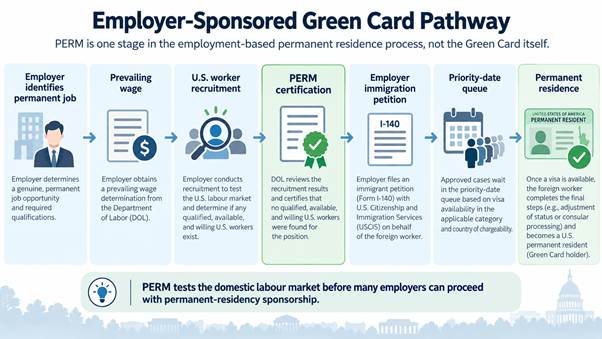
PERM Begins With the Prevailing Wage
An employer must obtain a Prevailing Wage Determination for the proposed job before filing a PERM application.
The prevailing wage broadly represents the wage normally paid to similarly employed workers in the relevant occupation and geographical area.
The employer then conducts prescribed recruitment to test whether qualified U.S. workers are available.
The basic process is:
Permanent job opportunity → prevailing wage determination → recruitment of U.S. workers → PERM application → labour certification → immigration petition → Green Card process
The U.S. Department of Labor requires a valid prevailing-wage determination before a PERM application can be filed.
H-1B and PERM Serve Different Purposes
The H-1B visa is a temporary non-immigrant visa used by employers to hire foreign professionals in speciality occupations.
PERM, in contrast, is connected with permanent immigration.
Therefore:
H-1B = permission for temporary skilled employment
PERM = labour certification for a potential permanent job
Green Card = lawful permanent residence
A worker can consequently remain on an H-1B while encountering difficulty or delay in beginning the PERM process.
Suspension Delays the Start of New Green Card Cases
For employees whose employer-sponsored immigration case has not yet reached the PERM filing stage, suspension prevents the affected employer from proceeding through that route while the restriction applies.
The consequence is:
No PERM filing → no labour certification → later Green Card stages cannot begin through that filing
This can be particularly serious because filing the labour-certification application generally establishes the worker’s priority date, which determines their place in the employment-based immigrant-visa queue.
Priority Date Determines the Worker’s Place in the Queue
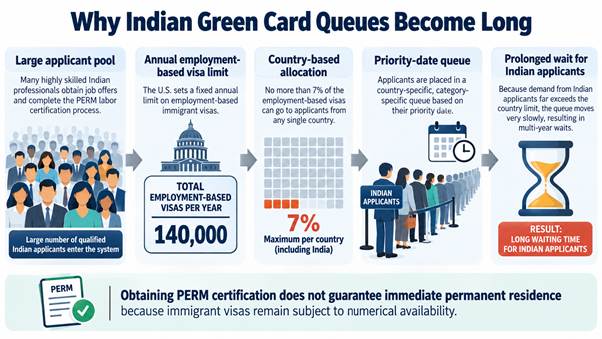
Employment-based immigrant visas are numerically limited.
When demand exceeds the number of available visas, applicants must wait until their priority date becomes eligible under the State Department’s Visa Bulletin.
For many PERM-based cases, the filing date of the labour certification becomes the priority date.
Thus:
Earlier priority date → earlier position in immigration queue
For Indian applicants, this becomes especially important because demand substantially exceeds available employment-based visa numbers.
India Faces a Deep Employment-Based Visa Backlog
The U.S. system applies annual numerical restrictions to employment-based immigrant visas, along with country-based limits.
This produces particularly long queues for applicants chargeable to heavily represented countries such as India.
The October 2026 U.S. Visa Bulletin illustrates the backlog: the final-action date for India in both EB-2 and EB-3 was January 15, 2015, meaning many applicants with later priority dates could not yet receive final approval.
The underlying chain is:
High demand + annual visa ceilings + country limits → visa backlog → long wait for permanent residence
EB-2 and EB-3 Are Employment-Based Preference Categories
Employment-based Green Cards are organised into preference categories.
EB-2 broadly covers certain professionals with advanced degrees and persons of exceptional ability, while EB-3 covers specified skilled workers, professionals and other workers.
PERM labour certification is commonly relevant to cases in these categories, although U.S. immigration law contains exceptions and alternative pathways.
The important distinction is:
- Visa category → determines immigration classification
- Priority date → determines position in queue
- Visa Bulletin → determines when final action can occur
PERM Delays Can Also Affect Some H-1B Extensions
H-1B status normally has a limited duration, but U.S. immigration rules allow certain workers pursuing employment-based permanent residence to extend H-1B status beyond the ordinary limit when statutory conditions are satisfied.
Because labour certification can be an early part of that process, inability to begin PERM sufficiently early may create additional uncertainty for workers approaching the normal H-1B limit.
However, employees who have already progressed to later approved stages may be situated differently from workers whose employers have not yet filed PERM.
Labour Mobility Has Become an Economic Policy Issue
The episode illustrates how skilled migration sits at the intersection of several policy objectives:
domestic employment protection ↔ access to global talent ↔ corporate competitiveness ↔ migration policy
Countries seek high-skilled workers to support innovation and productivity, while governments also face political and economic pressure to protect domestic employment and wages.
For Indian IT firms, regulatory restrictions can affect:
- workforce deployment,
- employee retention,
- onsite staffing models,
- immigration costs,
- and long-term talent mobility.
Implications for India’s IT Workforce
Indian professionals constitute a significant part of the skilled foreign-worker ecosystem in the United States, making changes to H-1B and employment-based immigration rules particularly consequential.
The broader strategic lesson for India is the vulnerability created when professional mobility depends heavily on immigration policies of destination countries.
A longer-term response involves:
domestic high-value employment + global delivery models + diversified overseas markets + stronger innovation ecosystem + reduced dependence on onsite staffing
The Core Policy Lesson
The PERM suspension should not be confused with cancellation of the H-1B programme or an automatic cancellation of Green Cards already granted.
It targets a particular stage in the employer-sponsored permanent-residency pathway.
The immigration architecture can be summarised as:
Temporary work visa ≠ labour certification ≠ immigrant petition ≠ Green Card
For Indian workers, however, disruption at an early stage can have long-term effects because the employment-based immigration system already contains substantial numerical and country-specific queues.
The episode therefore highlights how labour-market regulation, immigration policy and the global mobility of skilled professionals are increasingly interconnected.
Probable Mains Question
“Restrictions on skilled migration increasingly affect not only labour mobility but also the competitiveness and global business models of technology firms.” Discuss in the context of employment-based immigration and India’s IT sector.
Prelims Drill
MCQ 1
With reference to the U.S. PERM labour-certification system, consider the following statements:
- It is associated with employer sponsorship for permanent employment of foreign workers.
- The employer is generally required to obtain a prevailing-wage determination.
- Its labour-market test seeks to protect job opportunities and working conditions of U.S. workers.
- Approval of PERM itself automatically grants lawful permanent residence to the foreign worker.
Which of the statements given above are correct?
A. 1 and 2 only
B. 1, 2 and 3 only
C. 2, 3 and 4 only
D. 1, 2, 3 and 4
Correct Answer: B
Explanation: PERM is a labour-certification step used in many employer-sponsored permanent-residence cases. It involves prevailing-wage and recruitment requirements, but certification itself does not confer a Green Card; further immigration processing is required.
MCQ 2
Consider the following statements regarding U.S. employment-based immigration:
- H-1B is a non-immigrant classification for temporary employment in speciality occupations.
- A Green Card confers lawful permanent resident status.
- A priority date can determine an applicant’s position in an employment-based immigrant-visa queue.
- H-1B status and permanent resident status are legally identical.
Which of the statements given above are correct?
A. 1 and 2 only
B. 1, 2 and 3 only
C. 2, 3 and 4 only
D. 1, 2, 3 and 4
Correct Answer: B
Explanation: H-1B is a temporary non-immigrant status, whereas a Green Card provides lawful permanent residence. Priority dates are important where employment-based immigrant-visa demand exceeds available numbers; the two immigration statuses are therefore not legally identical.
More Current Affairs - Daily
- Election Commission of India: Constitutional Design and Evolution into a Three-Member Body 12 Oct 2026
- Loknayak Jayaprakash Narayan: Total Revolution and Contribution to Democracy 12 Oct 2026
- India’s Russia-Ukraine Initiative: From Black Sea Security to Strategic Autonomy 12 Oct 2026
- Jayaprakash Narayan: Architect of Total Revolution and Defender of Democracy 12 Oct 2026