
Measles Returns in the U.S.: Why Elimination Status Was Lost
The U.S. lost its measles elimination status after sustained domestic transmission continued for at least 12 months. Falling MMR coverage, immunity gaps and weakened outbreak control allowed imported infections to develop into continuous community transmission.
- Syllabus Mapping: GS Paper II — Health, Government Policies, Immunisation, International Health Institutions and Human Development.
- Source & Date: The Hindu, 18 November 2026.
Why in News?
The United States has lost its measles elimination status after more than two decades.
The Pan American Health Organization concluded that the same measles virus lineage had circulated continuously in the U.S. for at least 12 months, meaning endemic transmission had been re-established.
More than 5,400 confirmed measles cases were reported in the U.S. in 2026, with the majority occurring among people who were unvaccinated or whose vaccination status was unknown.
What Is Measles?
Measles is an extremely contagious viral disease transmitted primarily through respiratory droplets and airborne particles released by an infected person.
Early symptoms include:
- high fever;
- runny nose;
- red or watery eyes;
- small white spots inside the mouth.
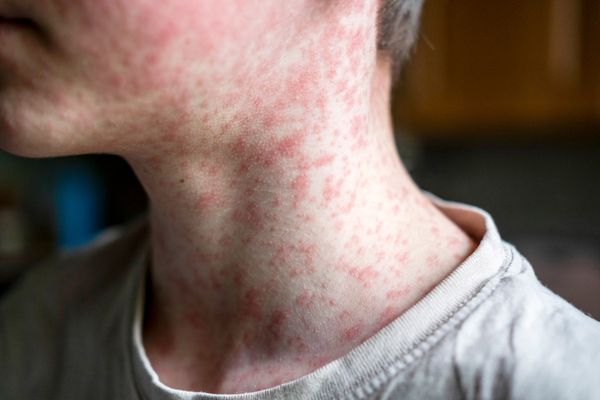
A characteristic rash appears later and usually spreads from the face and neck downwards.
Measles can cause pneumonia, diarrhoea, encephalitis, blindness and death, particularly among malnourished children and people with weakened immunity.
Why Is Measles So Difficult to Control?
Measles is among the most transmissible human infections.
One infected person can potentially infect 12–18 susceptible individuals.
This very high transmissibility means that even relatively small gaps in vaccination coverage can permit outbreaks.
The virus therefore demands exceptionally high levels of population immunity.
Why Is About 95% Vaccination Coverage Needed?
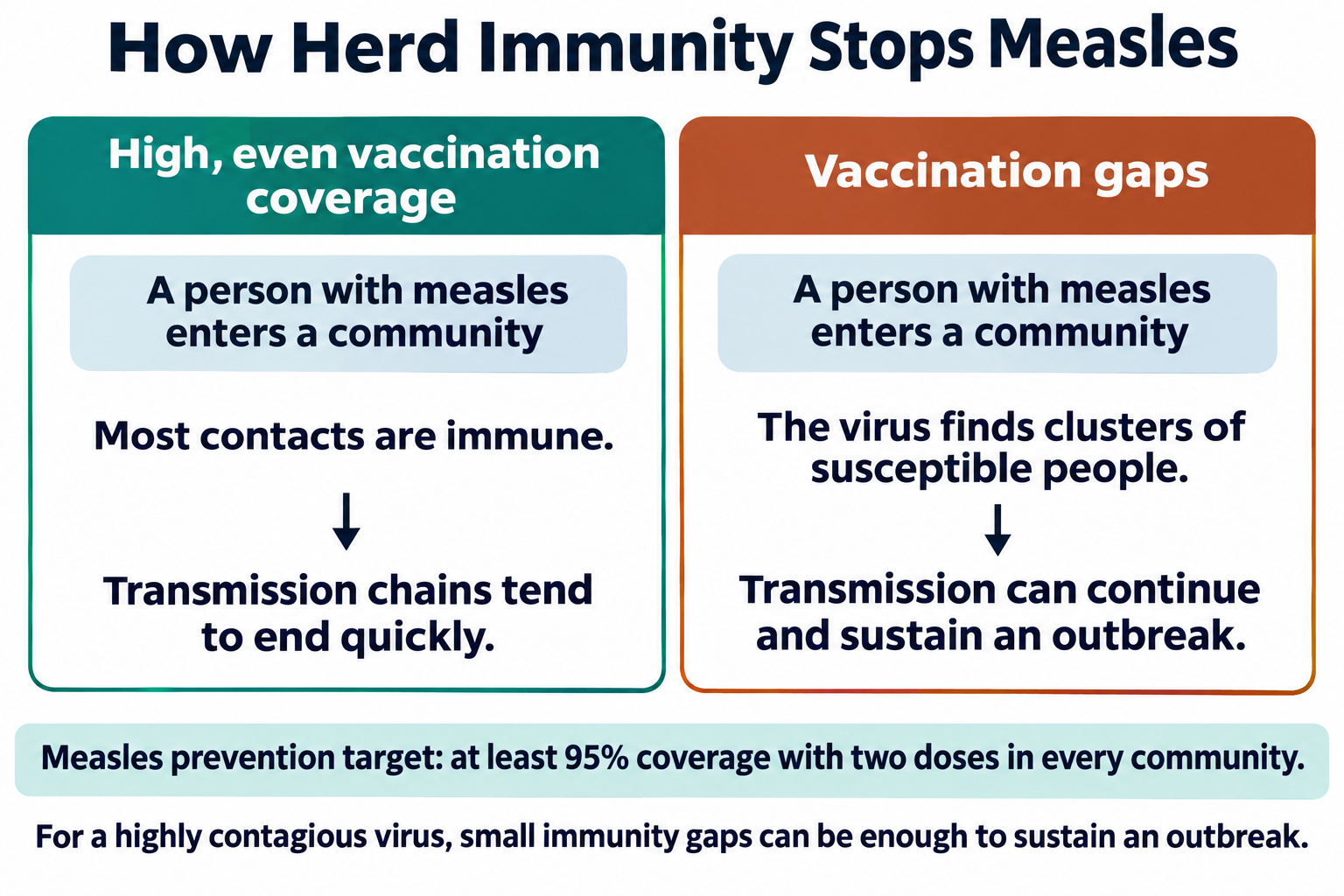
Because measles spreads so efficiently, about 95% population immunity with two vaccine doses is needed to interrupt sustained transmission.
This is an example of herd or community immunity.
When almost everyone is immune, the virus struggles to find susceptible people and transmission chains break.
If vaccination coverage falls below this level, clusters of susceptible children can accumulate even if the national average still appears relatively high.
What Does “Measles Elimination” Actually Mean?
Elimination does not mean that a country records zero measles cases forever.
Imported cases may still occur when infected travellers enter from another country.
A country retains elimination status if these imported cases do not lead to sustained endemic transmission.
Under the PAHO framework, elimination is lost when the same viral genotype and lineage circulates continuously within the country for 12 months or more.
Thus, elimination refers to interruption of continuous domestic transmission, not permanent disappearance of the virus worldwide.
Why Did the U.S. Lose Its Status?
The outbreak linked to continuous transmission began in January 2025.
When transmission continued beyond January 2026, the 12-month threshold for re-establishment of endemic transmission was crossed.
By November 2026, the outbreak had expanded substantially.
The core epidemiological problem was not simply repeated introduction of measles from abroad, but that domestic immunity was no longer sufficient to stop those introductions from spreading continuously.
Falling MMR Coverage Created Immunity Gaps
The measles component is commonly delivered through the MMR vaccine, which protects against measles, mumps and rubella.
Vaccination coverage among U.S. kindergarten children declined from around 95.2% in 2019–20 to below 93% in subsequent years.
A fall of only a few percentage points is particularly important for measles because the immunity threshold is so high.
National averages also conceal local clusters where vaccination may be substantially lower.
Imported Cases vs Endemic Transmission
International travel regularly introduces measles into countries where the disease has been eliminated.
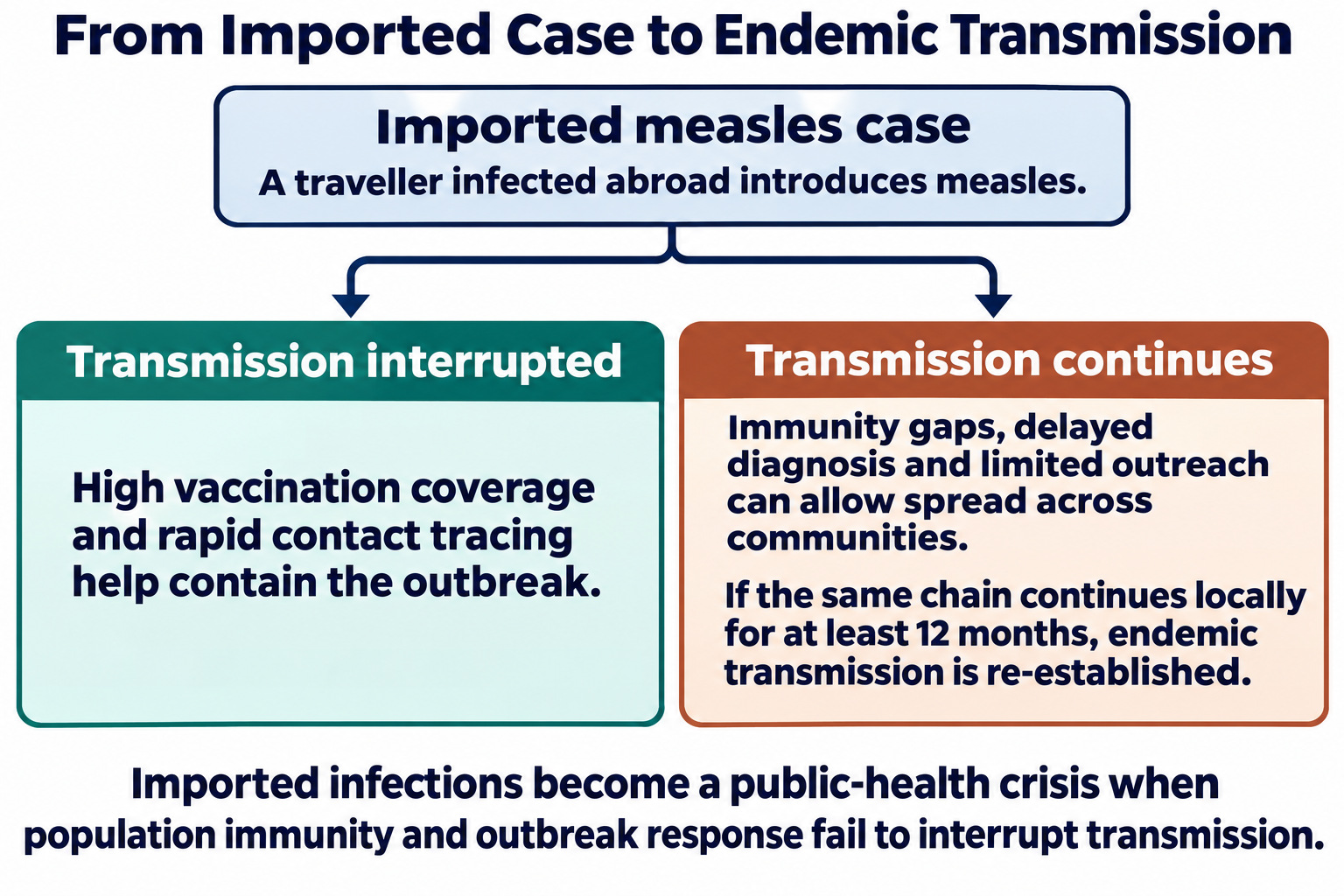
An imported infection alone does not mean elimination has failed.
The critical distinction is:
- Imported case → limited secondary spread → transmission stops: elimination maintained.
- Imported case → repeated transmission through susceptible groups → chain continues for 12 months: endemic transmission re-established.
This distinction is important for understanding disease-elimination programmes more broadly.
Role of COVID-Era Disruptions
The COVID-19 pandemic disrupted routine childhood vaccination in many countries.
Missed vaccine appointments created cohorts of children who were incompletely vaccinated.
Even after health services normalised, these immunity gaps did not disappear automatically.
Catch-up vaccination is therefore essential after major disruptions to routine immunisation.
Vaccine Hesitancy Also Matters
Vaccination coverage depends not only on availability but also on public trust.
Misinformation and vaccine scepticism can lead parents to postpone or refuse vaccination.
For diseases such as measles, individual decisions have wider consequences because declining coverage weakens community protection.
Public-health communication is therefore part of disease control, not merely an optional awareness activity.
Why Public-Health Infrastructure Matters?
Vaccination alone is not sufficient during an outbreak.
Health systems also need the capacity to:
- identify suspected cases rapidly;
- confirm infection through laboratories;
- trace contacts;
- isolate infectious individuals where necessary;
- conduct targeted vaccination campaigns;
- communicate risks clearly.
Weak surveillance or inadequate staffing allows transmission chains to continue for longer.
Elimination, Eradication and Control Are Different
These terms should not be confused.
- Control means reducing disease incidence to an acceptable level, while continued interventions remain necessary.
- Elimination means interruption of transmission within a defined geographic area, while measures must continue because cases can still be imported.
- Eradication means permanent reduction of worldwide incidence to zero, after which routine control measures may no longer be necessary.
Measles has not been eradicated globally.
What Does This Mean for India?
India also faces a substantial measles burden.
The lesson is especially important because national vaccination averages can conceal districts and communities with low coverage.
India's immunisation strategy therefore needs:
- high two-dose measles-containing vaccine coverage;
- district-level identification of immunity gaps;
- catch-up vaccination;
- strong disease surveillance;
- rapid outbreak response;
- communication to counter vaccine hesitancy.
The goal must be uniformly high coverage, not merely a satisfactory national average.
Why Measles Is a Test of Health-System Capacity?
Because measles is extraordinarily contagious, it quickly exposes weaknesses in immunisation systems.
Outbreaks can reveal:
- missed children;
- weak primary healthcare;
- poor surveillance;
- low public trust;
- uneven access to vaccination.
Measles incidence can therefore function as an indicator of the strength of routine immunisation programmes.
Core Policy Lesson
The U.S. did not lose measles elimination status simply because the virus entered the country.
Imported measles cases can occur even in countries with strong health systems.
The status was lost because immunity gaps allowed the virus to circulate continuously for at least 12 months.
The broader lesson is that successful disease elimination is not a one-time achievement.
It must be continuously defended through high and equitable vaccination coverage, catch-up immunisation, surveillance, rapid outbreak response and sustained public trust in vaccines.
---
Probable Mains Question
“Disease elimination is not a permanent achievement but a condition that must be continuously maintained.” Discuss with reference to the resurgence of measles in the United States and draw lessons for India’s immunisation programme.
---
Prelims Drill
MCQ 1
With reference to measles elimination, consider the following statements:
1. A country with elimination status can still experience imported measles cases.
2. Elimination necessarily means that the disease has been eradicated worldwide.
3. Sustained domestic transmission for a prolonged period can result in the loss of elimination status.
Which of the statements given above are correct?
A. 1 only
B. 1 and 3 only
C. 2 and 3 only
D. 1, 2 and 3
Correct Answer: B
Explanation: Elimination refers to interruption of endemic transmission in a defined geographic area. Imported cases can still occur, while eradication refers to permanent worldwide interruption.
MCQ 2
Consider the following statements regarding measles:
1. Measles is highly contagious and therefore requires very high population immunity to interrupt transmission.
2. WHO recommends two doses of measles-containing vaccine in routine immunisation schedules.
3. A national vaccination average above a particular threshold guarantees that no local measles outbreak can occur.
Which of the statements given above are correct?
A. 1 only
B. 1 and 2 only
C. 2 and 3 only
D. 1, 2 and 3
Correct Answer: B
Explanation: High national coverage can conceal local clusters of under-vaccinated people. Measles prevention therefore requires high and relatively uniform two-dose coverage across communities.
More Current Affairs - Daily
- India’s State Capacity Stagnation: The Missing Link in Reform 21 Nov 2026
- Holding Two Offices: What Does the Constitution Say About an Office of Profit? 21 Nov 2026
- The Price of War: West Asia Crisis Is Raising India’s Energy Import Bill 21 Nov 2026
- Surveillance Pricing : How Is Personal Data Used to Set Prices? 21 Nov 2026