
No Bank Charges on UPI Transactions Up to ₹2,000, Government Issues Notification
The Ministry of Finance has notified that banks and payment system providers cannot directly or indirectly charge fees on UPI transactions up to ₹2,000 and RuPay debit-card transactions under provisions related to the Payment and Settlement Systems Act, 2007. The move is significant amid the ongoing debate over UPI charges and Merchant Discount Rate (MDR). In 2026, UPI completed a decade and has become an important component of India's Digital Public Infrastructure.
Government Bars Bank Charges on UPI Transactions up to ₹2,000
GS-III – Indian Economy, Digital Payments, Financial Inclusion & Digital Public Infrastructure | GS-II – Governance & Technology
Why It Matters?
The Ministry of Finance has notified that UPI transactions up to ₹2,000 and payments made through RuPay debit cards cannot attract charges from banks or payment system providers.
Banks and system providers have been prohibited from directly or indirectly charging customers for making or receiving payments through these specified electronic modes.
The development is important amid the wider debate over whether Merchant Discount Rate (MDR) or other charges could eventually be introduced on selected UPI transactions.
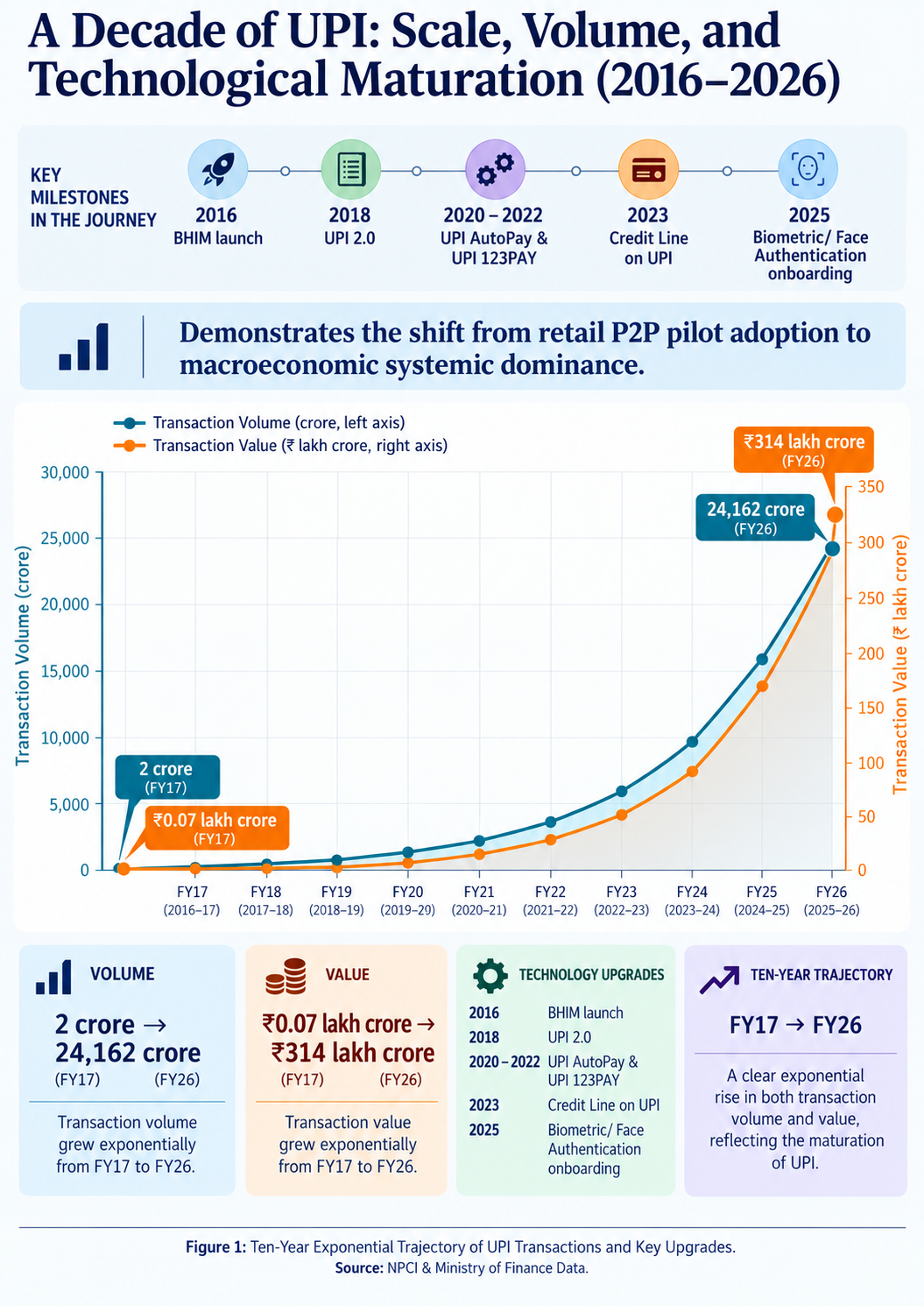
The issue assumes additional significance as UPI completed a decade in 2026, having evolved from a domestic payment platform into a major component of India’s Digital Public Infrastructure (DPI).
What Has the Government Notified?
Under changes relating to the Payment and Settlement Systems Act, 2007, the Ministry of Finance has specified two electronic modes of payment:
RuPay debit-card transactions
UPI transactions up to ₹2,000
For these specified modes:
Banks cannot directly charge customers.
Payment system providers cannot directly charge customers.
Charges cannot be imposed indirectly on persons making or receiving such payments.
UPSC Core Point
UPI transactions up to ₹2,000 → specifically protected from bank/system-provider charges under the notified framework.
What is the UPI Fee Debate?
The government had earlier clarified that consumers making UPI payments would not face transaction charges and that person-to-person (P2P) transactions would continue to remain free.
However, the possibility of introducing MDR on a limited category of merchant transactions has remained under discussion.
According to the government’s stated position:
Any future MDR would apply only above a specified transaction threshold.
It would cover only a limited set of merchant transactions.
The rate would be nominal.
It would remain substantially below prevailing debit- and credit-card MDR levels.
The debate intensified following the introduction of the Taxation and Other Laws (Amendment) Bill, 2026, which proposed changes to the Payment and Settlement Systems Act, 2007 that could enable banks and payment system providers to levy charges in certain circumstances.
Static Concept: What is MDR?
Merchant Discount Rate (MDR) is the fee charged to a merchant for processing digital payment transactions.
It helps meet costs relating to:
Transaction processing
Settlement
Payment infrastructure
Banking/payment-network services
Indicative MDR Levels
Credit cards: Around 1–3% of transaction value
Debit cards: Up to around 0.9%
Important Distinction
MDR is primarily associated with the merchant side of a transaction.
It should not automatically be confused with a direct transaction fee charged to the consumer.
Unified Payments Interface (UPI)
About UPI
The Unified Payments Interface (UPI) is a real-time payment system developed by the National Payments Corporation of India (NPCI).
It enables users to:
Access multiple bank accounts through a single mobile application
Transfer funds instantly
Make merchant payments
Use banking and payment services on a unified platform
Carry out transactions on a 24×7 basis
UPI uses security mechanisms such as two-factor authentication and secure transaction authorisation.
 |
UPI's Global Footprint
Global Real-Time Payments Leadership
As of 2024, UPI accounted for around 49% of global real-time payment transaction volume, according to the IMF report Growing Retail Digital Payments: The Value of Interoperability released in June 2025.
International Presence
UPI is operational through acceptance and/or cross-border remittance arrangements in 11 foreign countries:
Bhutan
Nepal
Singapore
UAE
France
Sri Lanka
Mauritius
Qatar
Cambodia
Greece
Maldives
Recent Expansion
Cambodia – June 2026
NPCI International Payments Limited partnered with ACLEDA Bank Plc. for UPI acceptance.
Greece – June 2026
UPI-enabled cross-border remittances between Greece and India became operational through Eurobank.
Maldives – 30 July 2026
Cross-border remittances between Maldives' Favara instant-payment system and India's UPI became operational.
Why Has UPI Been Transformative?
UPI combines several characteristics that distinguish it from conventional digital-payment mechanisms:
Interoperability: Users can transact across participating banks and applications.
Instant settlement experience: Payments can be initiated in real time.
Low entry barriers: QR-code-based payments reduce the need for expensive merchant infrastructure.
Financial inclusion: UPI 123PAY, UPI Lite and delegated-payment mechanisms broaden accessibility.
Platform approach: Banking, merchant payments, recurring payments and credit facilities can operate through a common ecosystem.
Scalability: Rapidly rising transaction volumes demonstrate the ability of digital public infrastructure to operate at population scale.
UPI and Digital Public Infrastructure
UPI is an important component of India's broader Digital Public Infrastructure (DPI) model.
Its evolution demonstrates how interoperable digital platforms can support:
Financial inclusion
Lower transaction friction
Formalisation of economic activity
Digital commerce
Innovation by private payment applications
Public-service delivery
Cross-border payment connectivity
The international expansion of UPI also strengthens India's role in debates surrounding the development of interoperable global digital-payment infrastructure.
Critical Analysis
The debate over UPI charges involves a policy trade-off between two objectives.
Maintaining Low-Cost Digital Payments
Zero or very low transaction costs encourage:
Consumer adoption
Small-merchant acceptance
Financial inclusion
Cashless transactions
Growth of the digital economy
Ensuring Sustainable Payment Infrastructure
Payment systems also involve costs relating to:
Banking infrastructure
Cybersecurity
Settlement
Technology maintenance
Fraud prevention
Customer grievance redressal
Therefore, the long-term policy challenge is to ensure:
Affordability for users + viability for banks and payment providers + incentives for innovation + protection of small merchants.
A differentiated approach based on transaction size and merchant category may attempt to balance these objectives.
Key Facts for Prelims
Fact | Remember |
UPI developed by | NPCI |
UPI pilot launch | April 2016 |
Public availability | August 2016 |
BHIM launch | December 2016 |
UPI 2.0 | 2018 |
1 billion monthly transactions | October 2019 |
UPI 123PAY | Feature-phone payments |
UPI Lite | Low-value payments |
Credit Line on UPI | Pre-sanctioned bank credit |
UPI Circle | Delegated payments |
Live banks, July 2026 | 741 |
July 2026 volume | 2,365.8 crore transactions |
July 2026 value | ₹29.87 lakh crore |
Foreign countries with UPI presence | 11 |
UPI global real-time payment share | Around 49% |
Payment law | Payment and Settlement Systems Act, 2007 |
Protected UPI threshold in notification | Up to ₹2,000 |
Mains Value Addition
Possible Question
“UPI represents the transition of India's digital payment ecosystem from financial innovation to Digital Public Infrastructure.” Discuss its contribution to financial inclusion and examine the challenges involved in ensuring the long-term sustainability of a low-cost digital-payment ecosystem.
Prelims Practice
MCQ 1
With reference to the Unified Payments Interface (UPI), consider the following statements:
UPI was developed by the National Payments Corporation of India.
UPI enables access to multiple bank accounts through a single compatible application.
UPI can be used only for person-to-person fund transfers and not for merchant payments.
Which of the statements given above is/are correct?
(A) 1 only
(B) 1 and 2 only
(C) 2 and 3 only
(D) 1, 2 and 3
Answer: (B)
Explanation: UPI was developed by NPCI and supports interoperable access to participating bank accounts. It facilitates both person-to-person and merchant payments.
Trap: UPI is not merely a bank-to-bank P2P transfer mechanism.
MCQ 2
With reference to digital payments in India, consider the following statements:
Merchant Discount Rate refers to a fee associated with the processing of merchant payment transactions.
A transaction charge imposed on a consumer and Merchant Discount Rate necessarily refer to the same charge.
UPI 123PAY was introduced to improve digital-payment access for feature-phone users.
Which of the statements given above is/are correct?
(A) 1 only
(B) 1 and 3 only
(C) 2 and 3 only
(D) 1, 2 and 3
Answer: (B)
Explanation: MDR is associated with merchant-payment processing, whereas a direct consumer transaction fee is conceptually distinct. UPI 123PAY expands UPI access to feature-phone users.
More Current Affairs - Daily
- Election Commission of India: Constitutional Design and Evolution into a Three-Member Body 12 Oct 2026
- Loknayak Jayaprakash Narayan: Total Revolution and Contribution to Democracy 12 Oct 2026
- India’s Russia-Ukraine Initiative: From Black Sea Security to Strategic Autonomy 12 Oct 2026
- Jayaprakash Narayan: Architect of Total Revolution and Defender of Democracy 12 Oct 2026