
Could the United Kingdom Break Apart? Union, Devolution and Independence Referendums
Renewed independence demands in Scotland, Wales and Northern Ireland have revived debate over the UK’s constitutional future, but the legal route to constitutional change differs significantly across the three nations.
Could the United Kingdom Break Apart?
- Syllabus Mapping: GS Paper II — Comparison of the Indian Constitutional Scheme with Other Countries; Federalism; Devolution; Constitutional Change; International Relations.
- Source & Date: UK Parliament, UK Supreme Court, Welsh Government and contemporary reporting on the Cardiff summit of 14 September 2026.
Why the Debate Has Returned
On 14 September 2026, pro-independence political leaders from Scotland, Wales and Northern Ireland met in Cardiff and signed a memorandum calling for constitutional change and the ability of their populations to determine their political future. Importantly, the signatories acted in their party-political capacities, not simply as heads of devolved governments.
The episode revived a basic constitutional question:
Can Scotland, Wales or Northern Ireland unilaterally organise a referendum to leave the UK?
The answer is not uniform across the three territories.
The Acts of Union 1707 created a single Kingdom of Great Britain and a common Parliament at Westminster, while Scotland retained distinctive institutions including its legal system.
Ireland formally joined the union in 1801. Most of the island later left following the Anglo-Irish settlement, while six counties remained within Northern Ireland.
Devolution Is Not Sovereignty
Modern devolution transferred important legislative and executive powers to Scotland, Wales and Northern Ireland.
However:
Devolution ≠ federal sovereignty ≠ automatic right of secession
The UK Parliament remains constitutionally central, and matters relating to the Union may remain legally reserved.
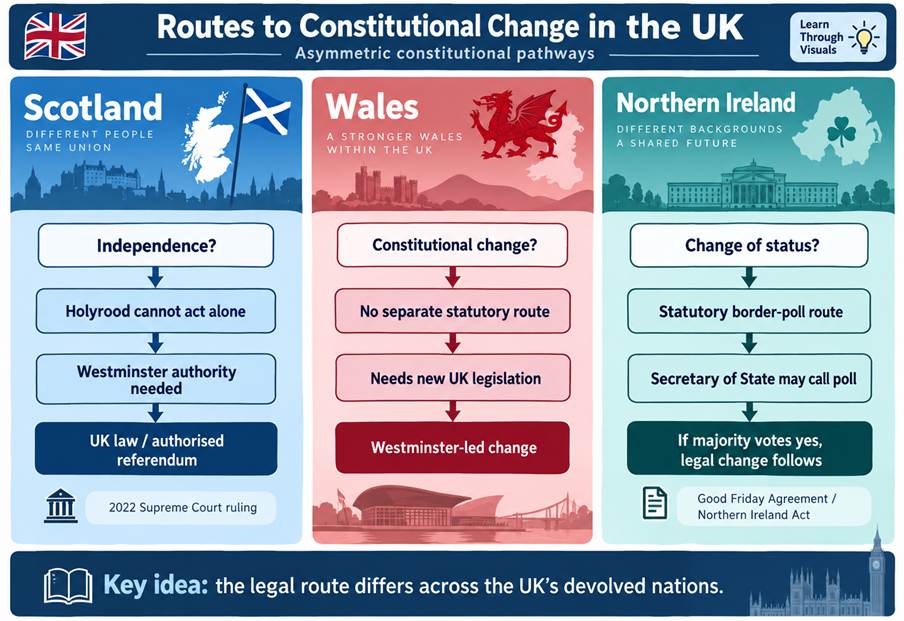
Scotland: Why Westminster Consent Matters
Scotland held an independence referendum on 18 September 2014 after a Section 30 Order temporarily altered the reserved-matters framework under the Scotland Act 1998.
The result was:
No: 55.3% | Yes: 44.7%
In 2022, the UK Supreme Court unanimously held that the Scottish Parliament could not legislate unilaterally for another independence referendum because such a referendum relates to reserved matters concerning the Union and the UK Parliament.
Thus, under the current framework:
Scottish referendum → requires Westminster-enabled legal authority
Northern Ireland: A Different Constitutional Route
Northern Ireland is distinct because the Belfast/Good Friday Agreement framework provides a legal route for a referendum on whether it should remain in the UK or form part of a united Ireland.
The decision to call such a border poll rests with the UK Secretary of State under statutory conditions.
Therefore, Northern Ireland already possesses a defined constitutional mechanism that Scotland and Wales do not have in equivalent form.
Wales: No Equivalent Referendum Mechanism
Wales has a devolved legislature and government, but there is currently no statutory mechanism equivalent to Northern Ireland’s border poll.
Any legally effective route to Welsh independence would therefore require major constitutional and legislative change at Westminster.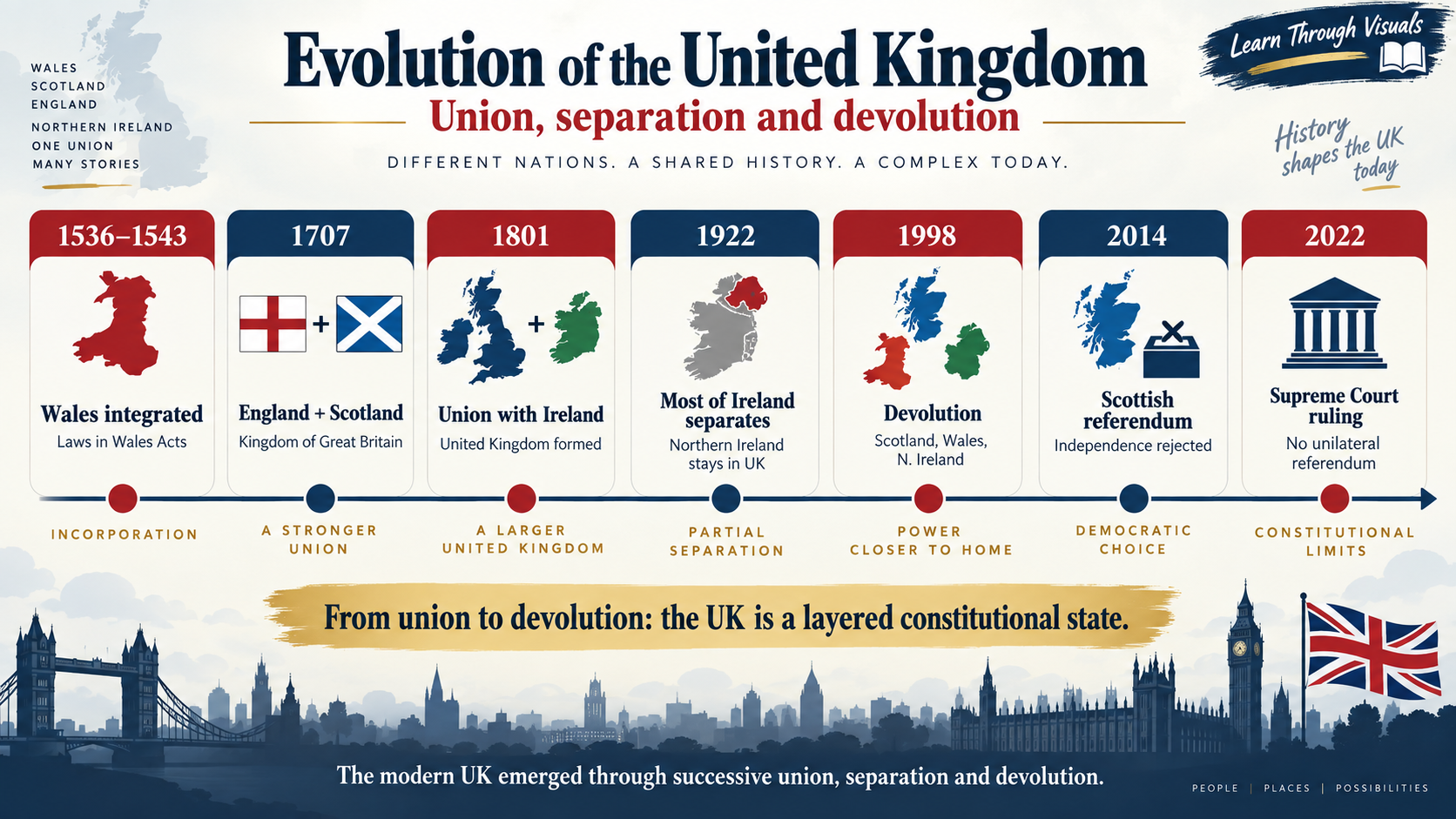
Why the Issue Matters
The debate illustrates a fundamental tension between:
Political claims to self-determination
and
the legal distribution of constitutional authority
It also shows that the UK is a highly devolved but constitutionally asymmetric union.
The immediate political significance of the 2026 memorandum lies in coordinated pressure for constitutional change; legally, however, the present pathways remain different across Scotland, Wales and Northern Ireland.
Probable Mains Question
“The United Kingdom demonstrates that extensive devolution need not amount to a federal right of secession.” Examine with reference to Scotland, Wales and Northern Ireland.
Prelims MCQ
MCQ 1
With reference to the constitutional history of the United Kingdom, consider the following statements:
- The Acts of Union of 1707 united England and Scotland into Great Britain.
- Ireland became part of the political union with Great Britain in 1801.
- Northern Ireland left the United Kingdom following the Anglo-Irish settlement.
Which of the statements given above are correct?
A. 1 only
B. 1 and 2 only
C. 2 and 3 only
D. 1, 2 and 3
Correct Answer: B
Explanation: The first two statements are correct. Most of Ireland left the UK, while Northern Ireland remained within it.
MCQ 2
Consider the following statements:
- The Scottish Parliament currently has an unrestricted power to legislate for an independence referendum.
- The 2014 Scottish referendum followed a temporary modification of the reserved-matters framework.
- Northern Ireland has a statutory mechanism for a referendum on its constitutional status.
Which of the statements given above are correct?
A. 1 only
B. 2 only
C. 2 and 3 only
D. 1, 2 and 3
Correct Answer: C
Explanation: In 2022, the UK Supreme Court held that the Scottish Parliament could not legislate unilaterally for such a referendum because the Union is a reserved matter. The 2014 vote was enabled through a Section 30 mechanism. Northern Ireland has a distinct statutory border-poll route.
Trap Identified: Scotland and Northern Ireland do not have identical constitutional routes to separation.
More Current Affairs - Daily
- Election Commission of India: Constitutional Design and Evolution into a Three-Member Body 12 Oct 2026
- Loknayak Jayaprakash Narayan: Total Revolution and Contribution to Democracy 12 Oct 2026
- India’s Russia-Ukraine Initiative: From Black Sea Security to Strategic Autonomy 12 Oct 2026
- Jayaprakash Narayan: Architect of Total Revolution and Defender of Democracy 12 Oct 2026