
Tropical Cyclones: Formation, Intensity and Risk
Tropical cyclones develop over warm oceans under favourable moisture, pressure and wind conditions. Their destructive potential depends not only on wind speed but also on rainfall, storm surge and coastal vulnerability.
Tropical Cyclones: Formation, Intensity and Risk
- Syllabus Mapping: GS Paper I — Climatology and Physical Geography; GS Paper III — Disaster Management and Climate Change.
- Source & Date: The Indian Express, 2 November 2026.
Why in News?
The severe cyclonic storm Murasu moved across the west-central Bay of Bengal towards the South Andhra Pradesh coast on November 2.
The India Meteorological Department forecast that it would cross the coast between Nellore and Narsapur, south of Ongole, with sustained winds of around 100–110 kmph and gusts up to 120 kmph around midnight on November 2 or the early hours of November 3.
How Does a Tropical Cyclone Form?
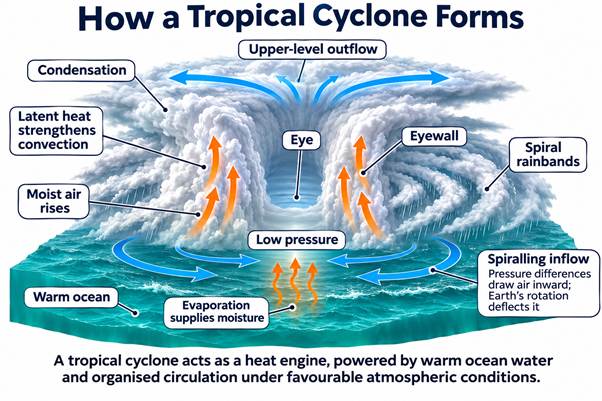
A tropical cyclone is a rotating low-pressure weather system that develops over warm tropical oceans.
Its formation generally requires warm sea-surface temperatures, abundant atmospheric moisture, sufficient Coriolis force, pre-existing atmospheric disturbance and relatively low vertical wind shear.
Warm ocean water increases evaporation. Moist air rises and cools, releasing latent heat as water vapour condenses. This further warms the surrounding air column, lowers surface pressure and draws in more moisture.
The result is a self-reinforcing circulation around the low-pressure centre.
Why Cyclones Do Not Form at the Equator
Cyclonic rotation depends partly on the Coriolis force, produced by Earth's rotation.
This force is extremely weak near the equator, making it difficult for a large organised rotating storm to develop there.
Tropical cyclones therefore usually form some distance away from the equator where Coriolis force is strong enough to help organise circulation.
How Are Cyclones Named?
Cyclones over the Bay of Bengal and Arabian Sea are named under the WMO/ESCAP Panel on Tropical Cyclones.
The panel currently has 13 member countries, each of which contributes names to a predetermined list. The Regional Specialised Meteorological Centre in New Delhi assigns these names sequentially when qualifying cyclones develop over the North Indian Ocean.
Murasu was a name contributed by India. Once a name from this North Indian Ocean list is used, it is not used again.
Naming improves warning communication, reduces confusion when multiple systems exist and helps disaster agencies and the public track individual storms.
What Does Landfall Mean?
Landfall occurs when the centre, or eye, of a tropical cyclone crosses the coastline.
It does not mean that hazardous weather begins only at that moment.
A cyclone's outer rainbands, strong winds and storm surge may affect coastal regions many hours before the centre reaches land.
Likewise, the place where the eye crosses the coast is not necessarily the location that suffers the greatest damage.
How Is Cyclone Intensity Determined?
Cyclone intensity is primarily classified using maximum sustained surface wind speed.
As wind speeds increase, a system progresses through categories such as depression, deep depression, cyclonic storm, severe cyclonic storm and still stronger categories under IMD classification.
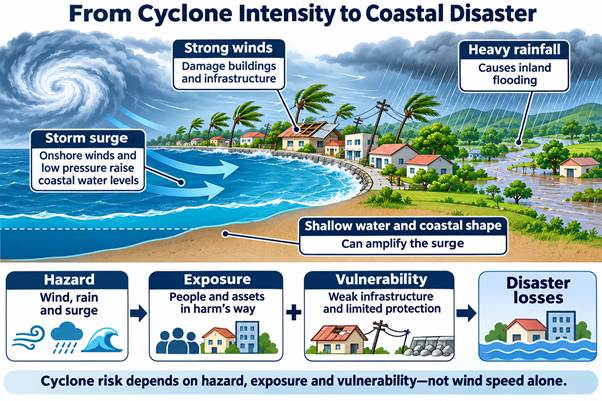
Intensity and impact are not identical. A weaker cyclone producing extreme rainfall or a large storm surge in a densely populated coastal region can sometimes cause greater damage than a stronger cyclone passing over a less exposed area.
Why the Bay of Bengal Is Particularly Vulnerable
The Bay of Bengal is one of the world's major cyclone-prone regions.
Warm ocean waters provide energy for cyclone formation, while high moisture availability supports powerful convection.
Its northern funnel-shaped coastline can also amplify storm surge as seawater is pushed towards shallow and densely populated coastal areas.
Large river deltas, low-lying terrain and high population density further increase human vulnerability.
What is Rapid Intensification?
A cyclone undergoes rapid intensification when its maximum sustained winds increase very quickly over a relatively short period.
Very warm ocean water and high ocean heat content can supply large amounts of energy. Low wind shear and a moist atmosphere can further allow the storm's structure to remain organised.
Rapid intensification is especially dangerous near the coast because it reduces the time available for authorities and communities to respond to a much stronger storm than initially expected.
Role of El Niño
El Niño refers to unusually warm surface waters in the central and eastern equatorial Pacific Ocean.
It alters atmospheric circulation across the tropics and can affect rainfall, wind shear and cyclone behaviour in different ocean basins.
However, El Niño does not simply make every North Indian Ocean cyclone stronger. Its influence depends on the season, basin and interaction with local conditions such as sea temperature, moisture and winds.
Cyclone intensity therefore results from the interaction of global climate patterns and local ocean-atmosphere conditions.
Why Storm Surge Is Dangerous
A storm surge is an abnormal rise in sea level caused primarily by strong cyclone winds pushing seawater towards the coast, aided by low atmospheric pressure.
When storm surge coincides with high tide, coastal flooding can become much more severe.
Low-lying deltas and densely populated coastal regions are therefore particularly vulnerable even when the cyclone's centre does not directly pass over them.
Core Policy Lesson
Cyclone disasters cannot be understood only by tracking the storm's category or landfall point.
Effective risk management requires accurate forecasting of wind, rainfall, storm surge, rapid intensification and local exposure, combined with evacuation plans and resilient coastal infrastructure.
As India's coastal population and infrastructure expand, improvements in forecasting must be matched by land-use planning, early warning and stronger disaster preparedness.
Probable Mains Question
“The destructive impact of a tropical cyclone depends on much more than its maximum wind speed.” Explain the physical processes governing cyclone formation and discuss the factors that determine disaster risk along India's eastern coast.
Prelims Drill
MCQ 1
Consider the following statements regarding tropical cyclones:
- Warm ocean water provides energy for tropical cyclone development.
- Very high vertical wind shear generally favours the organisation of a tropical cyclone.
- Coriolis force contributes to the rotation of tropical cyclones.
Which of the statements given above are correct?
A. 1 only
B. 1 and 3 only
C. 2 and 3 only
D. 1, 2 and 3
Correct Answer: B
Explanation: Warm water and Coriolis force favour cyclone development, whereas strong vertical wind shear can disrupt the storm's vertical structure and inhibit intensification.
MCQ 2
With reference to tropical cyclones, consider the following statements:
- Landfall occurs when the centre of a tropical cyclone crosses the coastline.
- Storm surge is caused exclusively by heavy rainfall over coastal areas.
- A cyclone can affect coastal regions before its formal landfall.
Which of the statements given above are correct?
A. 1 only
B. 1 and 3 only
C. 2 and 3 only
D. 1, 2 and 3
Correct Answer: B
Explanation: Landfall refers to the cyclone centre crossing the coastline. Storm surge primarily results from strong winds and low pressure acting on seawater, while cyclone rainbands, winds and surge can reach the coast well before landfall.
More Current Affairs - Daily
- India’s State Capacity Stagnation: The Missing Link in Reform 21 Nov 2026
- Holding Two Offices: What Does the Constitution Say About an Office of Profit? 21 Nov 2026
- The Price of War: West Asia Crisis Is Raising India’s Energy Import Bill 21 Nov 2026
- Surveillance Pricing : How Is Personal Data Used to Set Prices? 21 Nov 2026