
Supreme Court on Forceful Vehicle Repossession: Borrower Rights and NBFC Accountability
The Supreme Court has held that banks and NBFCs may exercise contractual repossession rights only through lawful and fair procedures, not force, stealth or coercive recovery.
Supreme Court on Forceful Vehicle Repossession: Borrower Rights and NBFC Accountability
- Syllabus Mapping: GS Paper II — Fundamental Rights, Judiciary, Rule of Law, Regulatory Institutions; GS Paper III — Banking, NBFCs, Financial Inclusion and Financial Regulation.
- Source & Date: Supreme Court judgment in Hari Dutta Sharma v. State of U.P. & Ors., 16 September 2026, and The Indian Express, 17 September 2026.
What Did the Supreme Court Hold?
The Supreme Court reiterated that banks and Non-Banking Financial Companies (NBFCs) cannot use force to repossess financed vehicles after loan default.
The Court accepted that a financier may have a contractual right of repossession, especially where the financed asset itself serves as security. However, such self-help recovery operates initially outside judicial supervision and therefore must be exercised with strict procedural safeguards.
The governing principle is:
Loan default gives a right to recover debt — not a licence to use force.
What Happened in the Case?
- The borrower, Hari Dutta Sharma, had taken a commercial vehicle loan from Cholamandalam Investment and Finance Company.
- After repeated defaults, the vehicle was allegedly taken at around 1 a.m. on 9 April 2023 after its steering lock was broken. The Supreme Court found that the mandatory seven-day prior notice required under the agreement had not been given.
- The Court held that this mode of repossession was neither peaceful nor lawful and violated both the contractual safeguards and RBI guidelines.
RBI Rules and Due Process
The Court relied on RBI’s Fair Practices Code for Lenders and subsequent guidelines, which prohibit:
Undue harassment + recovery at odd hours + muscle power + coercive recovery agents
It also relied on Manager, ICICI Bank Ltd. v. Prakash Kaur (2007), where the Supreme Court had rejected the use of strong-arm methods for loan recovery.
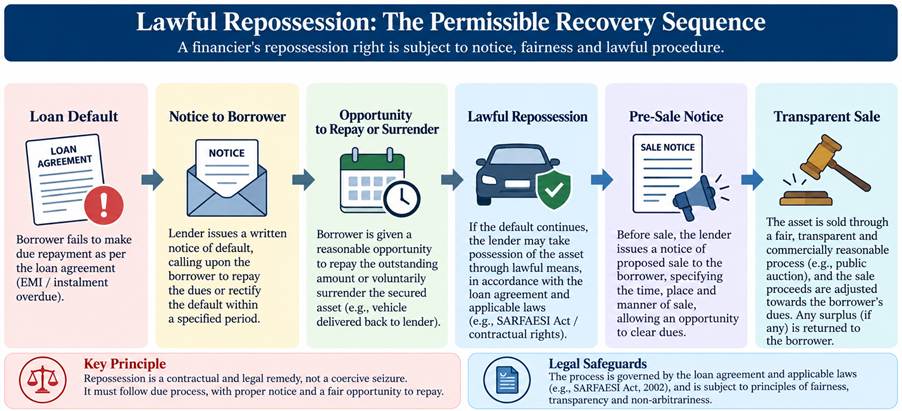
The latest judgment clarified that a valid repossession process should ordinarily include:
Notice → opportunity to cure default → lawful repossession → transparent sale procedure
The Court held that repossession clauses must comply with the Indian Contract Act, 1872 and RBI regulatory safeguards.
Constitutional Dimension
The Court found that arbitrary deprivation of the borrower’s livelihood violated Articles 14 and 21 of the Constitution.
Because the truck was the borrower’s source of livelihood, the Court treated the unlawful seizure as more than a contractual dispute. It awarded ₹10 lakh compensation, directed refund of the ₹4.5 lakh sale price with 6% interest, and ordered closure of the loan accounts.
Why the RBI Was Pulled Up
- The Court observed that RBI guidelines and master circulars had effectively “existed only on paper” and directed the RBI to take effective steps to ensure genuine compliance by NBFCs and Scheduled Commercial Banks.
- This transforms the case from an individual borrower dispute into a broader issue of regulatory enforcement.
NBFCs: Why They Matter Here
NBFCs provide loans, vehicle finance, leasing, microfinance and investment services. RBI’s principal-business test generally treats a company as an NBFC when:
Financial assets > 50% of total assets
and
Income from financial assets > 50% of gross income
Both conditions must be satisfied—the 50-50 test.
Unlike banks, NBFCs cannot accept demand deposits, cannot issue cheques drawn on themselves, and their deposits are not covered by DICGC deposit insurance.
The Core Policy Balance
The judgment does not eliminate asset-backed lending or contractual repossession.
Instead, it balances:
Efficient credit recovery
with
Borrower dignity, notice and due process
This is especially important because vehicle finance supports small transporters and borrowers who may lack conventional collateral.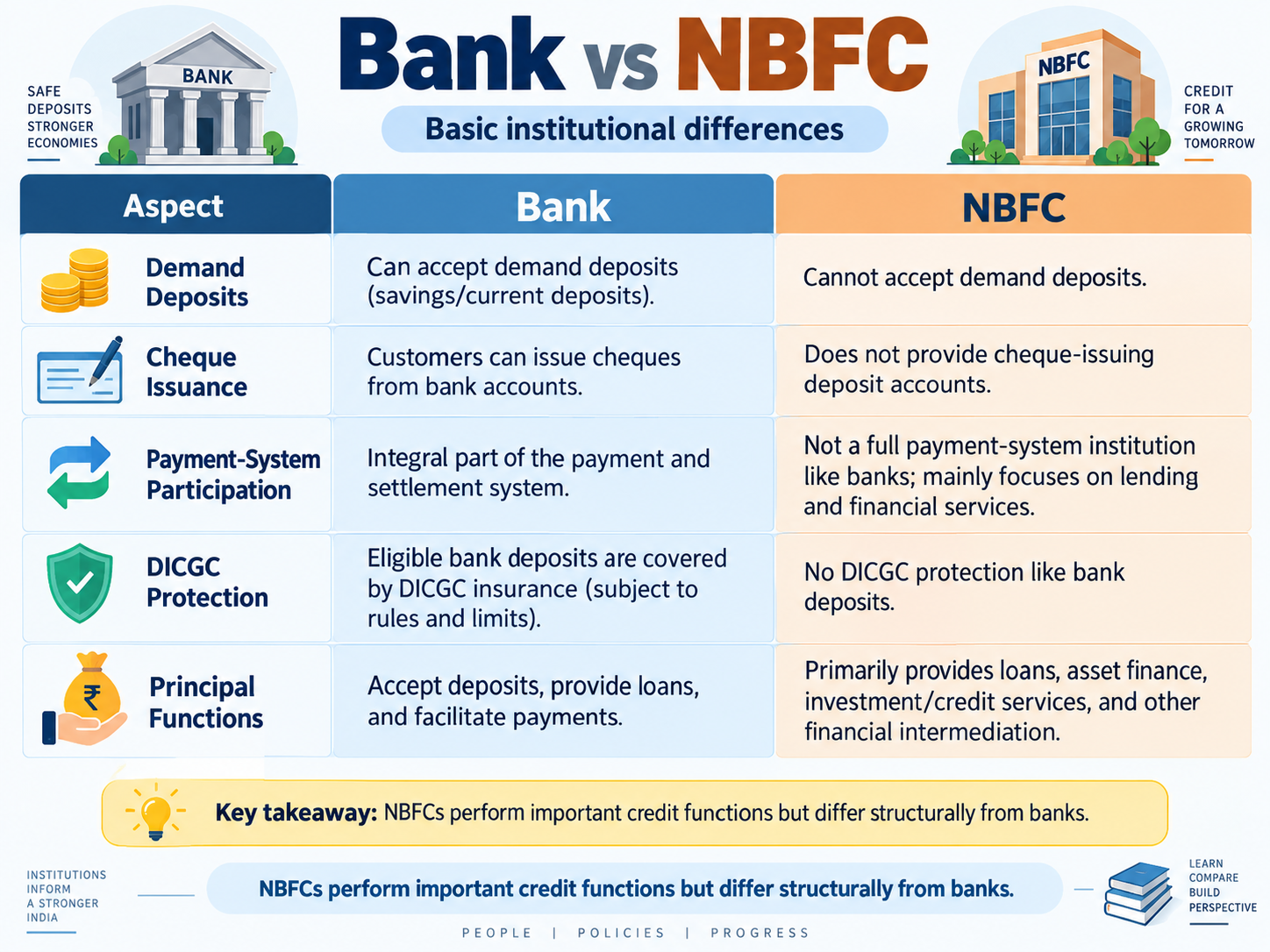
Probable Mains Question
“Efficient loan recovery is essential for financial stability, but contractual rights cannot override the rule of law.” Examine in light of the Supreme Court’s 2026 ruling on forcible repossession of financed vehicles.
Prelims MCQ
MCQ 1
With reference to the Supreme Court’s ruling on repossession of financed vehicles, consider the following statements:
- Loan default automatically permits a financier to seize a vehicle by force.
- A contractual repossession clause must conform to RBI guidelines and the Indian Contract Act, 1872.
- The Supreme Court found violation of Articles 14 and 21 in the case.
Which of the statements given above are correct?
A. 1 only
B. 2 and 3 only
C. 1 and 3 only
D. 1, 2 and 3
Correct Answer: B
Explanation: Default does not authorise forcible seizure. Contractual repossession rights remain subject to RBI norms, fairness and due process. The Court expressly found violations of Articles 14 and 21.
MCQ 2
With reference to NBFCs in India, consider the following statements:
- NBFCs can generally accept demand deposits in the same manner as commercial banks.
- Both financial assets and income from financial assets must exceed 50%.
- Deposits placed with NBFCs are not covered by DICGC deposit insurance.
Which of the statements given above are correct?
A. 1 and 2 only
B. 2 and 3 only
C. 1 and 3 only
D. 1, 2 and 3
Correct Answer: B
Explanation: NBFCs cannot accept demand deposits and DICGC protection does not extend to NBFC deposits.
More Current Affairs - Daily
- Election Commission of India: Constitutional Design and Evolution into a Three-Member Body 12 Oct 2026
- Loknayak Jayaprakash Narayan: Total Revolution and Contribution to Democracy 12 Oct 2026
- India’s Russia-Ukraine Initiative: From Black Sea Security to Strategic Autonomy 12 Oct 2026
- Jayaprakash Narayan: Architect of Total Revolution and Defender of Democracy 12 Oct 2026