
Students with Disabilities in Higher Education: The Digital and Remedial Learning Gap
For students with disabilities, inclusion in higher education depends not only on admission and physical accessibility but also on accessible digital systems, academic support and monitoring of participation and completion.
Students with Disabilities in Higher Education: The Digital and Remedial Learning Gap
- Syllabus Mapping: GS Paper II — Education, Social Justice, Vulnerable Sections, Government Policies and Institutional Mechanisms; GS Paper III — Digital Inclusion and Technology.
- Source & Date: The Hindu, 22 September 2026; UGC Accessibility Guidelines; Rights of Persons with Disabilities Act, 2016; AISHE 2023–24 data.
What Is the Core Problem?
India’s disability-inclusion framework increasingly addresses admission, reservation and physical accessibility, but students with disabilities may still face exclusion after entering higher education.
The article identifies two major gaps:
Digital-access gap + Remedial/academic-support gap
A student may technically be enrolled but still struggle to participate if learning platforms, PDFs, lectures, assessments or academic-support systems are inaccessible.
What Does the RPwD Act Require?
The Rights of Persons with Disabilities Act, 2016 treats inclusive education as more than admission.
Section 16 requires recognised or government-funded educational institutions, among other things, to provide:
- reasonable accommodation,
- necessary individualised support,
- accessible facilities,
- appropriate communication modes, and
- monitoring of participation, academic progress and completion.
Thus:
Formal access ≠ substantive inclusion
Reasonable accommodation means modifying systems according to individual needs without imposing a disproportionate burden.
What Has UGC Required?
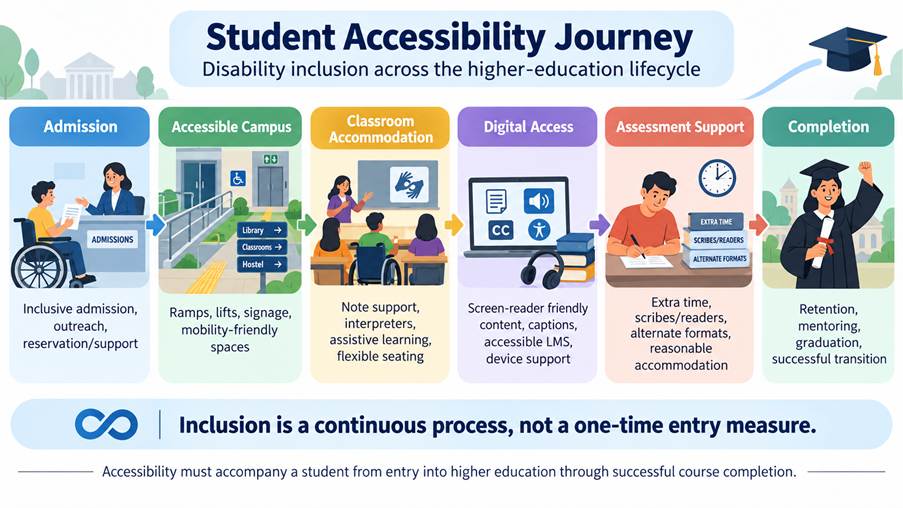
UGC’s accessibility framework says every Higher Educational Institution should develop an effective accessibility mechanism covering the entire journey:
Admission → learning → assessment → completion
The guidelines are intended to ensure barrier-free participation of persons with disabilities in HEIs.
The Hindu article also notes that universities were asked to furnish information on PwD admissions, recruitment and scholarships and to establish internal mechanisms for day-to-day disability-related needs.
Why Remedial Support Matters
Students with disabilities are not a homogeneous category.
Some may require:
- additional academic support,
- note-taking assistance,
- flexible deadlines,
- accessible study material,
- assistive technology,
- mentoring, or
- targeted remediation.
The RPwD Act recognises 21 categories of specified disabilities, and educational needs can vary substantially between blindness, deafness, dyslexia, autism, cerebral palsy or psychosocial disability.
Inclusive education therefore does not mean identical treatment.
It requires:
Common curriculum + differentiated support where necessary
The Digital Accessibility Gap
Modern higher education increasingly depends on:
LMS platforms + university portals + e-books + digital libraries + recorded lectures + online assignments + examination portals
For students with disabilities, these systems can become barriers when they lack:
- screen-reader compatibility,
- keyboard navigation,
- captions,
- transcripts,
- alternative text,
- accessible PDFs, or
- Indian Sign Language support.
A physically accessible campus can therefore still produce digital exclusion.
What Do the Numbers Show?
According to AISHE 2023–24, 54,080 students with benchmark disabilities were enrolled in higher education, including 34,080 males and 20,000 females.
The article notes that these students constituted only around 0.12% of total higher-education enrolment and that available data does not sufficiently capture disability type or actual access to accessible digital resources.
This creates a major governance problem:
Enrolment data tells us who entered; it does not tell us who could fully participate.
The Data and Accountability Deficit
Current national indicators do not systematically show how many students with disabilities receive:
accessible LMS + screen-reader-compatible material + captions + ISL interpretation + accessible e-books
Without such outcome indicators, institutions may demonstrate compliance through ramps or enrolment statistics while students continue facing barriers in actual learning.
What Should Change?
A rights-based model should move from infrastructure compliance to learning accessibility through:
Accessible-by-design digital platforms + trained faculty + disability-support cells + assistive technology + mentoring + remedial support + outcome tracking
The ultimate test of inclusion should therefore be:
Can the student access, participate, learn and complete the course on equal terms?
Probable Mains Question
“Inclusive higher education cannot be measured merely by admission and reservation; it must be judged by participation, learning and completion.” Discuss with reference to students with disabilities in India.
Prelims Drill
MCQ 1
With reference to the Rights of Persons with Disabilities Act, 2016, consider the following statements:
- Educational institutions are expected to provide reasonable accommodation according to individual requirements.
- Inclusive education under the Act is concerned only with physical accessibility of buildings.
- The Act provides for monitoring participation, academic progress and completion of education of students with disabilities.
Which of the statements given above are correct?
A. 1 only
B. 1 and 3 only
C. 2 and 3 only
D. 1, 2 and 3
Correct Answer: B
Explanation: Section 16 extends beyond physical accessibility to reasonable accommodation, individualised support and monitoring of educational progress and completion.
MCQ 2
Which of the following can improve digital accessibility for students with disabilities?
- Screen-reader-compatible documents
- Captions and transcripts
- Keyboard-accessible websites
- Alternative text for images
Select the correct answer using the code below:
A. 1 and 2 only
B. 2, 3 and 4 only
C. 1, 3 and 4 only
D. 1, 2, 3 and 4
Correct Answer: D
Explanation: Accessible digital learning requires multiple design features because disability-related needs differ across students. The article specifically highlights screen readers, captions, transcripts, keyboard navigation and alternative text as important accessibility tools.
More Current Affairs - Daily
- Election Commission of India: Constitutional Design and Evolution into a Three-Member Body 12 Oct 2026
- Loknayak Jayaprakash Narayan: Total Revolution and Contribution to Democracy 12 Oct 2026
- India’s Russia-Ukraine Initiative: From Black Sea Security to Strategic Autonomy 12 Oct 2026
- Jayaprakash Narayan: Architect of Total Revolution and Defender of Democracy 12 Oct 2026