
Stampedes in India
Most stampedes in India occur during religious gatherings. They are often driven by crowd behaviour, weak infrastructure, administrative lapses and poor implementation of safety guidelines.
Stampedes in India
- Syllabus Mapping: GS Paper III — Disaster Management, Public Safety and Governance.
- Source & Date: The Indian Express, 18 October 2026
Why in News?
A tragic crowd surge at a Durga Puja pandal in Kolkata on Saturday evening reportedly claimed at least 19 lives and left around 25 people injured, once again highlighting the urgent need for effective crowd management and public safety measures at mass gatherings.
The incident follows a series of deadly crowd disasters in India, including the Prayagraj Maha Kumbh tragedy in January 2025, the New Delhi Railway Station crush in February 2025, and the Bengaluru IPL victory celebrations tragedy in June 2025, these recurring incidents have raised serious concerns about crowd control, emergency preparedness, infrastructure planning, and the enforcement of safety protocols at large public events.
What is a Stampede?
A stampede, or crowd crush, occurs when people move suddenly and uncontrollably in a confined or overloaded space. Deaths usually occur not only because of trampling but also because of compressive asphyxia, when bodies are pressed so tightly that breathing becomes impossible.
The NDMA treats stampedes as man-made disasters under the Disaster Management Act, 2005. Broadly, crowd crushes may be unidirectional, when movement in one direction gets blocked, or turbulent, when chaotic movement begins in multiple directions.
Scale of the Problem
India has witnessed several major tragedies, including the 1954 Allahabad Kumbh stampede, the 2005 Mandhardevi temple disaster, and the 2024 Hathras tragedy, where 121 people died. NCRB data show 3,074 deaths between 2000 and 2022, while nearly 4,000 incidents have reportedly occurred over the last three decades. Religious gatherings account for the vast majority of such events.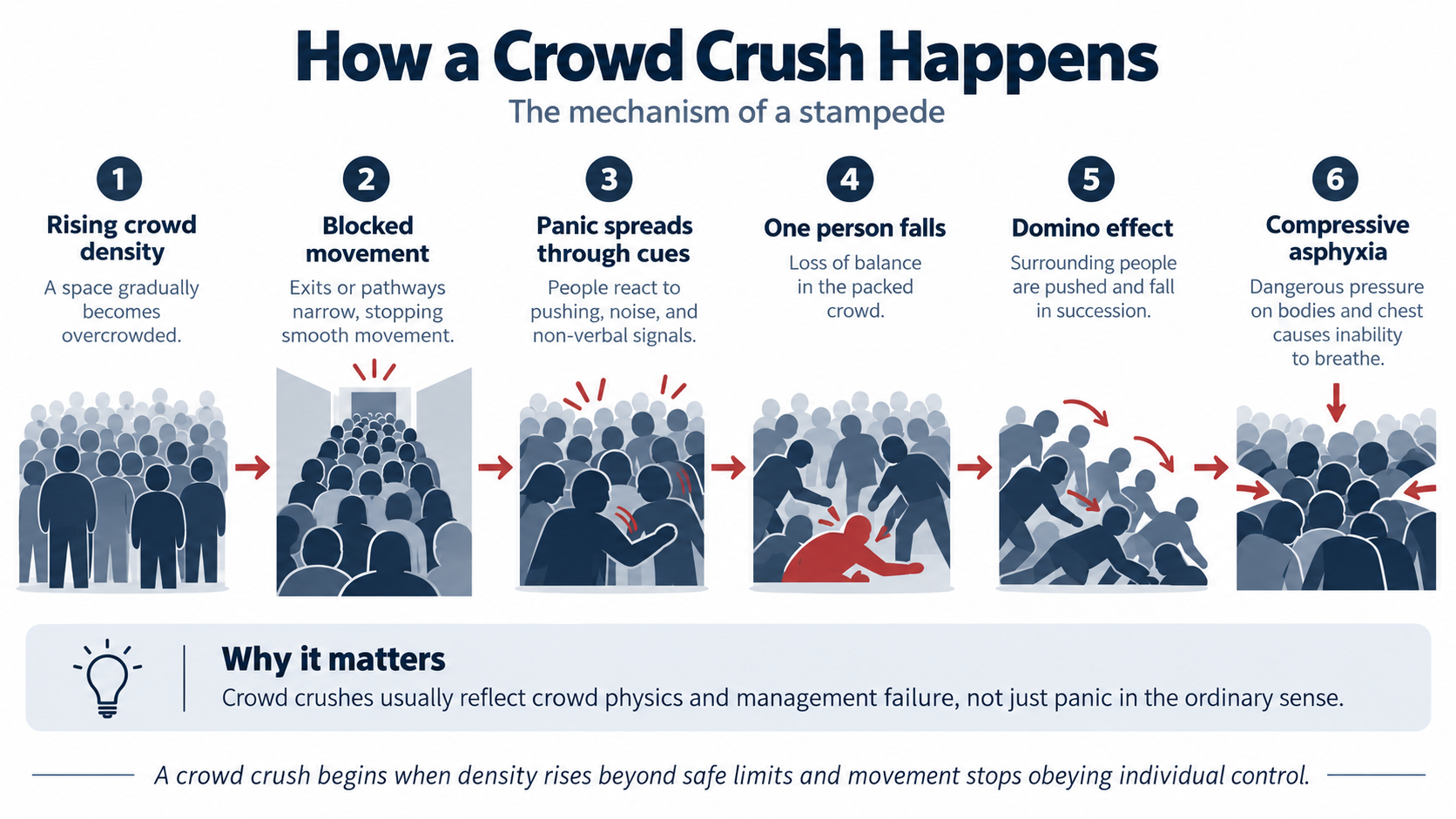
Why Do They Keep Recurring?
The immediate triggers differ, but the structural failures are familiar. Many events suffer from poor site planning, narrow pathways, combined entry and exit routes, weak barricading and serious overcrowding. In several cases, permissions are granted without proper verification of crowd capacity or safety compliance.
Coordination failures make matters worse. District authorities, police and organizers often work without an integrated command system. Technology such as CCTV, drones and real-time density monitoring remains underused. Social behaviour also matters. Many people do not treat overcrowding as a serious risk until conditions become critical.
Why Guidelines Fail
India already has NDMA crowd-management guidelines, yet implementation remains weak. Local authorities often lack trained manpower, enforcement capacity and a safety-first culture. Infrastructure is also inadequate. A 2017 Ministry of Home Affairs report found that only 43% of major gathering sites had basic crowd safety infrastructure.
Rapid urbanisation adds another challenge by increasing pressure on public spaces, transport nodes and pilgrimage routes.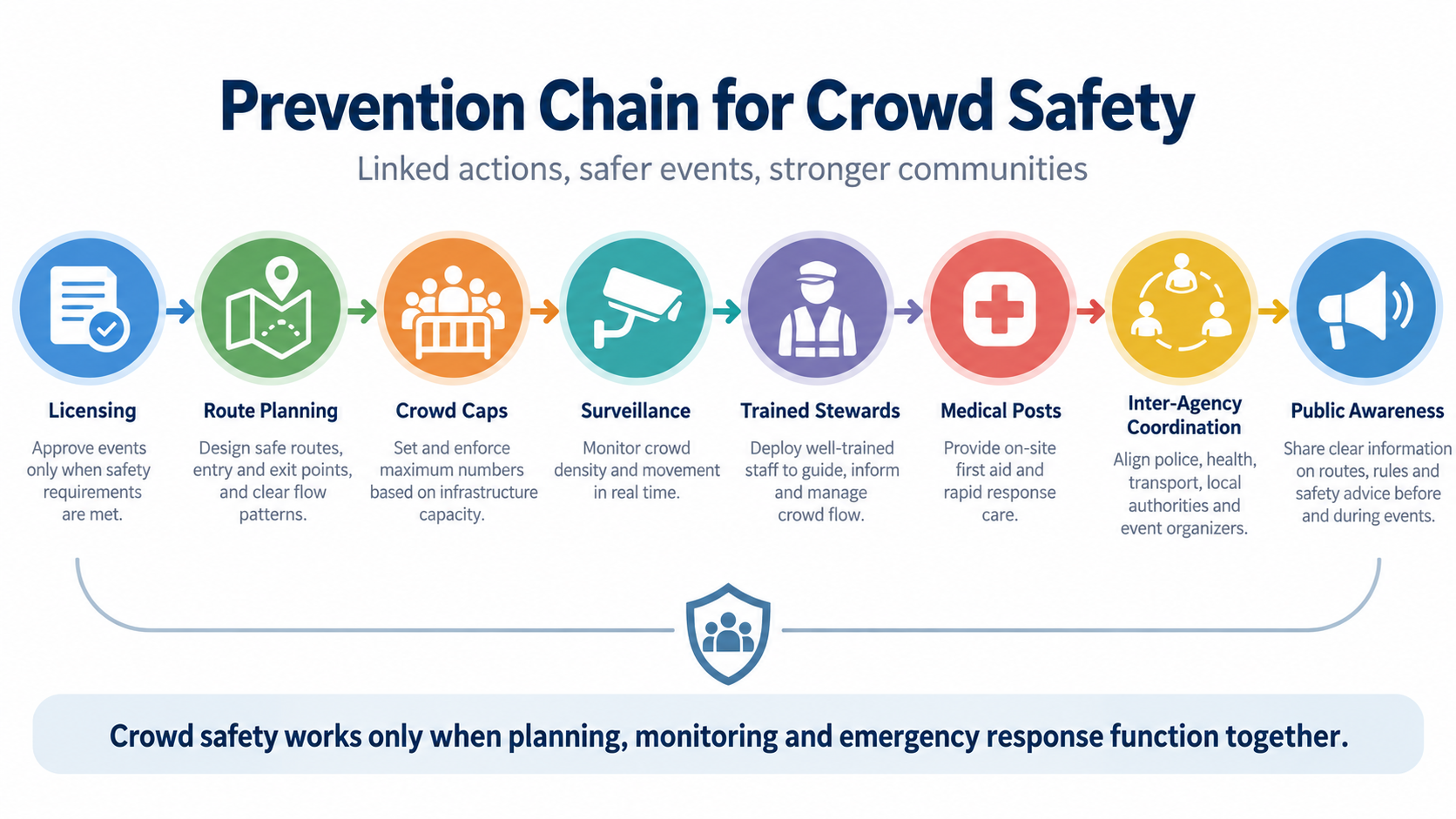
Way Forward
India needs mandatory licensing, clear accountability for organizers, real-time crowd monitoring, wider pathways, separate entry and exit routes, and trained stewards. Safety audits before major events should be compulsory, and public awareness campaigns must encourage orderly movement and respect for crowd discipline.
Core Policy Lesson
Stampedes are rarely “accidents” in the narrow sense. They usually arise from predictable failures of planning, infrastructure, coordination and risk perception. The real policy challenge is not issuing more guidelines, but ensuring that crowd safety becomes a non-negotiable part of governance.
Probable Mains Question
Why do stampedes recur in India despite repeated disasters and detailed safety guidelines? Discuss the role of crowd behaviour, governance failures and infrastructure in preventing crowd crushes.
Prelims Drill
MCQ
With reference to crowd crushes, consider the following statements:
- Fatalities in stampedes can occur even without large-scale trampling.
- A crowd crush may arise when density becomes so high that individual movement is no longer freely controllable.
- All stampedes are classified as natural disasters under the Disaster Management Act, 2005.
Which of the statements given above are correct?
A. 1 and 2 only
B. 2 and 3 only
C. 1 and 3 only
D. 1, 2 and 3
Correct Answer: A
Explanation: Many deaths occur because of compressive asphyxia rather than trampling alone. Crowd density can itself create crushing forces. NDMA treats stampedes as man-made disasters, not natural disasters.