How Rising Debt in Advanced Economies Can Affect India
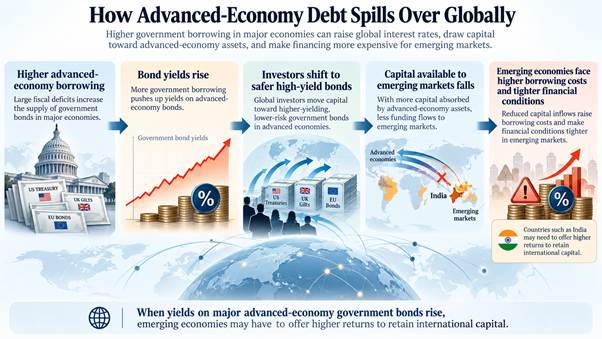
Rising public debt in advanced economies can keep global bond yields elevated, raise borrowing costs for emerging economies and reduce the fiscal space available for development and public services.
Impact of Rising Debt in Rich Countries on India’s Economy
- Syllabus Mapping: GS Paper III — Indian Economy, Fiscal Policy, Public Debt, Taxation, Capital Flows and Global Economic Developments.
- Source & Date: The Indian Express, 15 October 2026.
Why in News?
The International Monetary Fund has warned that rising public debt in advanced economies can create risks for the wider global financial system and increase borrowing costs for poorer and developing countries.
Global public debt is projected to exceed 100% of global GDP before 2030.
The IMF has also projected global economic growth at 3.1% in 2026. For India, it has raised its FY 2026-27 growth forecast to 7%, citing strong domestic demand and services activity.
The IMF has not identified India as facing a specific fiscal crisis. However, India can still be affected when large advanced economies borrow heavily and their government bond yields remain high.
Government Debt Rises When Spending Exceeds Revenue
Governments usually borrow when their expenditure is greater than their revenue.
Persistent fiscal deficits cause public debt to accumulate over time.
Borrowing itself is not necessarily harmful. Governments may borrow to finance infrastructure, welfare programmes or economic stabilisation.
The problem becomes more serious when debt rises rapidly while interest rates are also high.
Governments must then spend a larger share of their revenue on interest payments.
This reduces the amount available for other purposes.
High Interest Payments Reduce Fiscal Space
Fiscal space refers to the ability of a government to increase spending or reduce taxes without threatening the sustainability of public finances.
When debt-servicing costs increase, governments have less flexibility.
More money spent on interest payments can mean less money available for:
- healthcare;
- education;
- infrastructure;
- social protection;
- climate adaptation;
- and responses to future economic crises.
The interest payments already absorb more than 15% of tax revenues in low-income countries.
This shows why the cost of debt matters as much as the amount of debt.
Advanced-Economy Debt Can Raise Global Borrowing Costs
Government bonds issued by large economies, especially the United States, play an important role in global financial markets.
U.S. government bonds are often treated as relatively safe assets.
If U.S. bond yields rise, international investors may find them more attractive.
Investors may then move some of their money away from emerging markets and towards U.S. securities.
This can make borrowing more expensive for developing economies.
Capital Flows Are an Important Transmission Channel
Foreign investors compare returns available across countries.
Suppose U.S. government bonds begin offering higher yields.
An investor may prefer those securities instead of taking greater risks in an emerging economy.
This can lead to capital moving out of emerging markets.
For countries such as India, sustained capital outflows can create pressure on:
- government bond yields;
- corporate borrowing costs;
- equity markets;
- and the exchange rate.
Domestic financial conditions can therefore tighten even when the original increase in borrowing occurred in another country.
Higher Global Yields Can Raise India’s Cost of Capital
Indian borrowers do not operate in isolation from global financial markets.
When global interest rates and benchmark bond yields rise, Indian companies and governments may also face higher financing costs.
A higher cost of capital can reduce investment because some projects that were financially viable at lower interest rates may become unattractive.
This can weaken:
business investment, infrastructure creation and economic growth.
The effect is especially important for sectors that depend heavily on borrowed funds.
Exchange-Rate Pressure Can Add Another Risk
Capital outflows can also weaken the domestic currency.
If the rupee depreciates significantly, imports priced in foreign currencies become more expensive.
This can affect the cost of:
- crude oil;
- machinery;
- electronic components;
- and other imported inputs.
A weaker currency can therefore add to inflationary pressure.
The RBI may then face a difficult balance between supporting growth and maintaining price and financial stability.
Rising Debt Can Create a Global Crowding-Out Effect
The idea of crowding out usually refers to government borrowing competing with private borrowers for available savings.
A similar effect can occur internationally.
When large advanced economies issue large quantities of attractive government debt, global savings can be drawn towards those markets.
Developing countries may then have to pay higher returns to attract the same capital.
The global effect is therefore similar to competition for a limited pool of investible funds.
IMF Wants Better Tax Design, Not Simply Higher Taxes
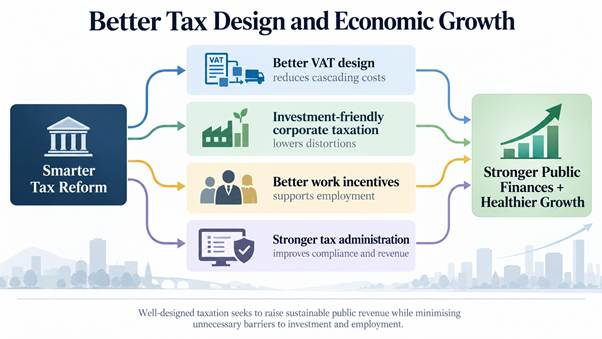
The IMF does not suggest that governments should respond to fiscal pressure only by raising tax rates.
It argues that the structure of taxation is also important.
Poorly designed taxes can raise revenue while simultaneously discouraging investment and employment.
The policy objective should be to raise sufficient revenue with as little economic distortion as possible.
VAT Distortions Can Increase Business Costs
Value-Added Tax systems are designed so that firms can generally claim credit for taxes paid on their business inputs.
This prevents taxation from repeatedly accumulating at different stages of production.
However, exemptions, registration gaps and restrictions on input credits can interrupt this process.
Such distortions can increase firms’ input costs by as much as 9% in emerging and developing economies.
These higher costs can then move through supply chains and ultimately reach consumers.
The basic principle is simple.
A well-designed value-added tax should tax final consumption without unnecessarily taxing intermediate business inputs multiple times.
Corporate Taxes Can Discourage Productive Investment
The IMF also highlights the way corporate tax systems affect the cost of investment.
If firms cannot fully deduct legitimate investment expenses, the effective cost of investing can increase.
Some projects that would otherwise have generated economic value may then become unprofitable.
The conventional corporate income-tax systems can increase the cost of capital by around 15% to 20% on average across different country groups.
Tax design therefore influences both government revenue and private investment.
Rent-Based Profit Taxes Could Reduce Investment Distortions
One reform discussed by the IMF is a rent-based profit tax.
Under such an approach, businesses could receive more immediate deductions for investment expenditure while taxation would focus more strongly on profits above the normal return on investment.
The objective is to avoid penalising productive capital formation.
IMF modelling suggests that such reforms could increase the long-term capital stock by around 6.4% in advanced economies and 8.2% in low-income developing countries.
These figures are model estimates. They are not guaranteed outcomes.
Tax and Welfare Systems Can Affect Employment Decisions
Taxes can also influence whether people choose to work more hours or enter employment.
A problem can arise when an increase in earnings causes both higher taxes and a sharp withdrawal of welfare benefits.
The worker may then keep only a small part of the additional income earned.
This can weaken the financial incentive to work more.
The IMF therefore recommends tax and benefit systems that maintain revenue while avoiding excessive penalties on additional employment or earnings.
Its modelling suggests that such reforms could increase employment rates by 1.2 percentage points in emerging and developing economies and by 0.8 percentage points in advanced economies.
Again, these are estimated long-term effects rather than guaranteed outcomes.
Better Tax Administration Can Raise Revenue Without Higher Rates
The IMF also emphasises tax administration.
Governments can strengthen revenue collection by improving:
- compliance systems;
- digital administration;
- filing procedures;
- tax refunds;
- and enforcement against genuine evasion.
Simpler procedures can reduce the cost of compliance for honest businesses.
At the same time, better information systems can improve the government’s ability to detect non-compliance.
This can increase revenue without necessarily increasing statutory tax rates.
The Lesson for India Is Fiscal Resilience
India is currently projected to remain one of the faster-growing major economies.
However, strong domestic growth does not make the economy immune to global financial conditions.
India therefore benefits from maintaining:
- credible fiscal management;
- manageable public debt;
- efficient taxation;
- strong domestic financial markets;
- and stable macroeconomic policies.
A country with stronger public finances is better able to absorb external shocks without sharply cutting development expenditure.
The Core Policy Lesson
High public debt in advanced economies is not only a domestic problem for those countries.
Large economies influence global bond yields, capital allocation and the international cost of borrowing.
The transmission can be understood in simple terms.
When advanced economies borrow heavily, their bond yields may remain high. Higher yields can attract global capital towards those markets. Developing economies may then have to pay more to borrow. Higher interest costs can reduce the money available for development and public services.
The IMF therefore argues that fiscal adjustment should be combined with better tax design and stronger tax administration.
For India, the central lesson is that domestic fiscal stability and efficient taxation provide protection against financial shocks originating elsewhere in the world.
Probable Mains Question
“High public debt in advanced economies can create significant spillovers for emerging economies even when their domestic growth remains strong.” Explain the channels through which this occurs and discuss the fiscal reforms suggested by the IMF.
Prelims Drill
MCQ 1
With reference to government bond yields and international capital flows, consider the following statements:
- A rise in yields on relatively safe government securities in advanced economies can attract capital away from emerging markets.
- Capital outflows from an emerging economy can place pressure on its currency and domestic borrowing costs.
- Government bond yields in major economies have no influence on financing conditions in developing countries.
Which of the statements given above are correct?
A. 1 only
B. 1 and 2 only
C. 2 and 3 only
D. 1, 2 and 3
Correct Answer: B
Explanation: Higher yields on advanced-economy government bonds can make those assets more attractive to global investors. This can reduce capital flows to emerging markets and increase pressure on their currencies and borrowing costs.
MCQ 2
With reference to taxation, consider the following statements:
- A well-designed value-added tax allows eligible businesses to receive credit for taxes paid on inputs.
- Restrictions on input-tax credits can cause taxes to cascade through the production chain.
- Better tax administration can improve government revenue without necessarily increasing statutory tax rates.
Which of the statements given above are correct?
A. 1 only
B. 1 and 2 only
C. 2 and 3 only
D. 1, 2 and 3
Correct Answer: D
Explanation: Input-tax credits are an important feature of value-added taxation because they reduce cascading taxation. Better compliance systems, simpler procedures and effective administration can also increase tax collection without requiring higher headline tax rates.