
OCI Cardholders and Government Powers
OCI cardholders receive important travel and residence privileges in India, but they remain foreign nationals. Their political rights and legal protection against removal therefore differ from those of Indian citizens.
OCI Cardholders and Government Powers
- Syllabus Mapping: GS Paper II — Citizenship, Fundamental Rights, Immigration, Executive Powers and Judicial Review.
- Source & Date: The Indian Express, 15 October 2026.
Why in News?
Actor Imran Khan, a U.S. citizen and Overseas Citizen of India cardholder, has been asked by the Foreigners Regional Registration Office to leave India by October 28 after he participated in a political protest in Mumbai.
The case has raised an important legal question. An OCI cardholder may have a lifelong visa and several privileges in India, but does that status protect the person from being asked to leave the country?
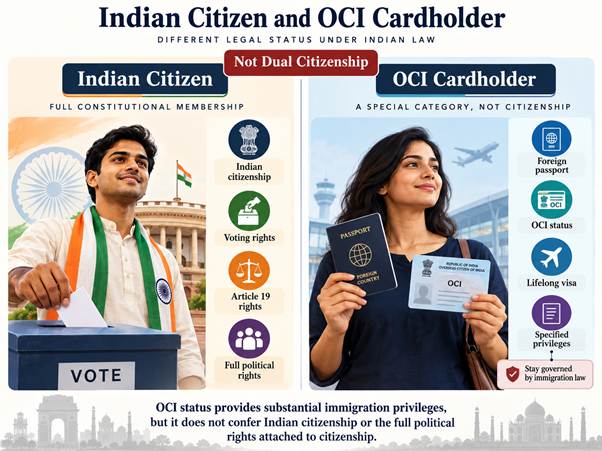
The answer depends on an important distinction. An OCI cardholder is not an Indian citizen. The person remains a foreign national.
This means that OCI privileges are different from the constitutional and political rights attached to Indian citizenship.
OCI Is Not Dual Citizenship
The OCI scheme was introduced in 2005 for specified categories of foreign nationals with connections to India.
India does not recognise OCI status as dual citizenship. An OCI cardholder continues to hold the citizenship and passport of another country.
OCI status provides important benefits. These include a multiple-entry lifelong visa and exemption from routine registration with the Foreigners Regional Registration Officer for the duration of stay in India.
However, these benefits do not convert an OCI cardholder into an Indian citizen.
OCI Cardholders Do Not Have Political Rights of Citizens
Section 7B of the Citizenship Act, 1955, makes clear that OCI cardholders do not enjoy several rights reserved for Indian citizens.
They cannot register as voters or contest elections to Parliament or State Legislatures. They are also excluded from several constitutional offices and ordinary public employment rights reserved for citizens.
There is another important constitutional distinction.
Article 19 rights are guaranteed specifically to citizens.
These include freedom of speech and expression under Article 19(1)(a) and the right to assemble peacefully and without arms under Article 19(1)(b).
Therefore, a foreign national cannot claim these freedoms on exactly the same constitutional basis as an Indian citizen.
OCI Status Still Carries Significant Privileges
The fact that an OCI is a foreign national does not mean the person has the same position as an ordinary short-term visitor.
OCI status provides long-term immigration privileges and parity with Indians or Non-Resident Indians in certain specified fields.
However, Parliament has deliberately kept citizenship and OCI status legally separate.
The basic distinction is simple:
An Indian citizen has a constitutional right to remain in India. An OCI cardholder has permission and statutory privileges to stay in India as a foreign national.
This difference becomes important when immigration authorities exercise removal powers.
Some OCI Activities Require Prior Permission
A March 2021 government notification requires OCI cardholders to obtain prior permission for certain activities.
These include activities such as research, missionary or Tabligh work, mountaineering and journalistic activity, along with entry into protected, restricted or prohibited areas. The notification is part of the current OCI framework maintained by the Ministry of Home Affairs.
The notification does not expressly identify participation in a political protest as an activity for which prior permission is required.
This means the legal issue cannot be resolved simply by pointing to the 2021 list.
The Immigration and Foreigners Act Gives the Government Broad Powers
The Immigration and Foreigners Act, 2025 replaced the Foreigners Act, 1946.
An OCI cardholder continues to be treated as a foreign national for the purpose of immigration control.
Section 7 gives the Central Government broad authority to regulate a foreigner’s presence and conduct in India. It can impose restrictions on movement, association or specified activities and can direct that a foreigner should not remain in India.
The significant point is that the law does not itself state that attending a political demonstration is automatically prohibited.
Instead, it gives the executive broad powers to regulate particular foreigners or particular types of activity.
Removal From India Is a Separate Power
Section 29 of the Immigration and Foreigners Act, 2025, empowers the Central Government to order the removal of a foreigner for violation of the Act, a rule or an order made under it, or on the basis of an adverse security report.
These powers have also been delegated to relevant immigration authorities, including FRROs.
This creates an important legal question in any individual case:
What specific legal condition, order or restriction did the foreign national violate?
Broad statutory power does not eliminate the need for executive action to have a lawful basis.
Participation in a Protest Is Not Expressly Banned by the Act
The 2025 Act does not contain a provision saying that every foreign national is automatically prohibited from attending a political rally.
This distinction matters.
The government may possess broad powers to regulate the conduct of foreigners, but the legality of a specific removal decision can still depend on the precise order, condition or restriction allegedly violated.
A court can therefore examine whether the government has identified a valid legal basis for its action.
Earlier Courts Have Scrutinised Similar Leave India Notices
In 2020, the Calcutta High Court dealt with the case of Polish student Kamil Siedczynski, who had participated in an anti-CAA rally.
The court set aside the Leave India Notice issued under the earlier Foreigners Act. it found that participation in a political rally by itself was not sufficient on the facts and law placed before it.
The legal framework has since changed because the 2025 Act has replaced the Foreigners Act.
Therefore, the earlier judgment remains useful for understanding judicial scrutiny, but it does not automatically decide cases under the new statute.
Leaving India and Cancelling OCI Are Different Actions
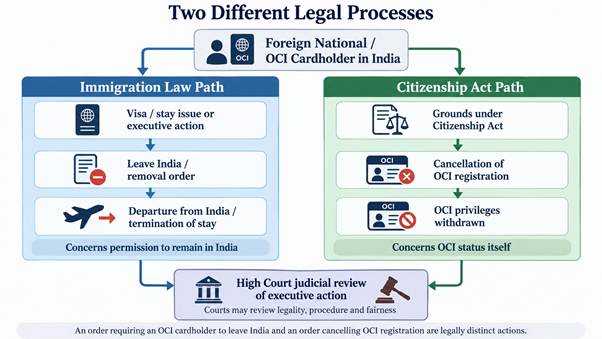
A Leave India Notice and cancellation of OCI registration are legally separate processes.
A Leave India direction concerns whether a foreign national can continue to remain in India.
Cancellation of OCI status is governed separately by Section 7D of the Citizenship Act, 1955.
The government may cancel OCI registration on specified statutory grounds. These include fraud or concealment in obtaining registration, serious criminal circumstances, disaffection towards the Constitution and specified considerations relating to sovereignty, security, foreign relations or the general public.
Therefore:
Removal from India does not automatically mean cancellation of OCI status.
The two actions may involve different legal provisions and procedures.
OCI Cancellation Has a Procedural Safeguard
An important difference between the two processes.
Before OCI registration is cancelled under Section 7D, the cardholder must be given a reasonable opportunity of being heard.
Courts have repeatedly examined OCI cancellation orders where the government relied on broad expressions such as national security, public interest or anti-India activity.
Cases involving individuals such as Ashok Swain, Christo Thomas Philip and Khalid Jahangir Qazi show that courts may require the government to provide sufficiently specific allegations so that the affected person has a meaningful opportunity to respond.
This reflects a basic principle of administrative law.
Wide executive discretion does not mean unlimited or unreviewable discretion.
Judicial Review Remains Available
A person facing a Leave India Notice can approach a High Court under Article 226 of the Constitution.
The High Court can examine whether the action has a lawful statutory basis and whether the authority acted within the powers granted by law.
It may also examine questions of procedural fairness, arbitrariness and whether relevant legal requirements were followed.
Unless the FRRO notice is withdrawn, modified or stayed by the court, the direction to leave India continues to operate.
The Core Policy Lesson
OCI status occupies a distinct position between citizenship and ordinary temporary immigration.
It gives a foreign national extensive privileges to travel to and stay in India, but it does not create Indian citizenship.
Three legal questions must therefore be kept separate.
First, what privileges does OCI status provide?
Second, what restrictions can immigration law impose on a foreign national while that person is in India?
Third, has the government followed the correct legal process when restricting stay or cancelling OCI registration?
The broader principle is clear. India has substantial authority to regulate the entry, stay and conduct of foreign nationals. At the same time, individual executive decisions remain subject to the law and to judicial review by constitutional courts.
Probable Mains Question
“OCI status provides substantial privileges but does not amount to Indian citizenship.” Explain this distinction and examine the scope of executive and judicial powers over OCI cardholders in India.
Prelims Drill
MCQ 1
With reference to Overseas Citizen of India cardholders, consider the following statements:
- An OCI cardholder remains a foreign national.
- OCI status amounts to dual citizenship under Indian law.
- OCI cardholders are not entitled to register as voters in India.
- OCI status can provide a multiple-entry lifelong visa for visiting India.
Which of the statements given above are correct?
A. 1 and 2 only
B. 1, 3 and 4 only
C. 2, 3 and 4 only
D. 1, 2, 3 and 4
Correct Answer: B
Explanation: OCI status does not amount to Indian citizenship or dual citizenship. OCI cardholders remain foreign nationals, although they receive important privileges such as a multiple-entry lifelong visa. They do not possess voting rights reserved for Indian citizens.
MCQ 2
With reference to constitutional rights and OCI cardholders, consider the following statements:
- Article 19 rights are guaranteed by the Constitution specifically to citizens.
- Cancellation of OCI registration is governed by the Citizenship Act, 1955.
- An executive order relating to an OCI cardholder can never be reviewed by a High Court.
Which of the statements given above are correct?
A. 1 only
B. 1 and 2 only
C. 2 and 3 only
D. 1, 2 and 3
Correct Answer: B
Explanation: Article 19 guarantees specified freedoms to citizens. OCI registration and its cancellation are governed by the Citizenship Act. Executive action affecting an OCI cardholder can be challenged before a High Court under its constitutional writ jurisdiction.