
Special Intensive Revision of Electoral Rolls: Accuracy, Inclusion and the Right to Vote
The SIR aims to improve electoral-roll accuracy, but large-scale notices, technical discrepancies and appeals have intensified debate over how to prevent wrongful exclusion while removing ineligible entries.
Special Intensive Revision of Electoral Rolls: Accuracy, Inclusion and the Right to Vote
- Syllabus Mapping: GS Paper II — Election Commission, Representation of the People Acts, Electoral Reforms, Fundamental Democratic Rights and Constitutional Bodies.
- Source & Date: The Indian Express opinion by Shashi Tharoor, 24 September 2026, supplemented by Election Commission material, the Representation of the People Act, 1950, and the Supreme Court’s judgment in Association for Democratic Reforms v. Election Commission of India, 27 May 2026.
What Is the Current Controversy?
The ongoing Special Intensive Revision (SIR) has generated controversy because millions of electors have either been marked under categories such as Absent, Shifted, Dead or Duplicate, or have received notices for technical and “logical” discrepancies.
In Delhi, reporting indicates that about 47.5 lakh electors were marked under deletion-related categories, while another 33.13 lakh were flagged for technical or mapping issues, although receiving a notice does not automatically mean final deletion.
The central policy question is therefore:
How can electoral rolls be cleaned without wrongly excluding eligible citizens?
What Is the Legal Basis of SIR?
The Election Commission derives authority over preparation and revision of electoral rolls from Article 324 of the Constitution.
Under Section 21(3) of the Representation of the People Act, 1950, the Commission may, for recorded reasons, direct a special revision of electoral rolls.
The Supreme Court upheld the Bihar SIR in May 2026 and held that it was legally traceable to Article 324 read with Section 21(3).
Constitutional Position on the Right to Vote
Article 326 provides that elections to the Lok Sabha and State Legislative Assemblies shall be based on adult suffrage for eligible Indian citizens.
The Supreme Court’s 2026 SIR judgment described the right to vote under Article 326 as a constitutional right, though not an absolute one.
It held that verification of identity, residence and eligibility can legitimately form part of electoral-roll maintenance.
Thus:
Right to vote + accurate electoral roll are complementary, not competing, constitutional objectives.
Safeguards Exist Against Wrongful Deletion
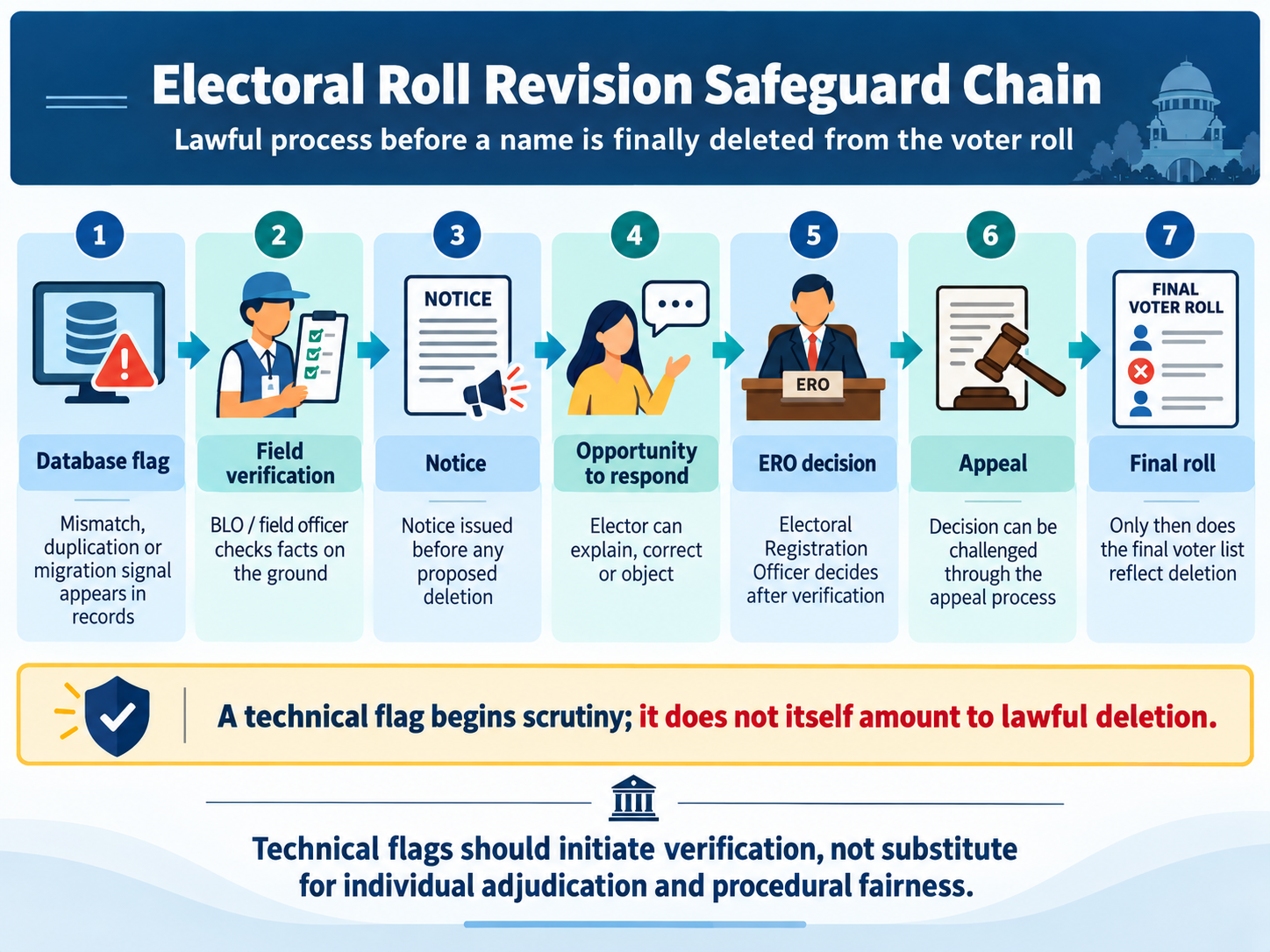
Section 22 of the Representation of the People Act allows correction or deletion of entries only after proper verification of facts.
Where deletion is proposed because an elector is no longer ordinarily resident or otherwise not entitled to registration, the person must be given a reasonable opportunity of being heard.
The SIR framework also provides for notice, reasoned decisions by Electoral Registration Officers and statutory appeals.
Therefore:
Software flag ≠ final deletion
Notice ≠ loss of voting status
Why Have Technical Discrepancies Become Controversial?
A major concern is that database matching can generate discrepancies because of differences in spelling, ages, family links or mapping to older electoral rolls.
The Supreme Court recently questioned whether some Delhi notices based on “logical discrepancies” appeared to have been issued mechanically and sought an explanation from the Election Commission.
The problem becomes more serious where automated flags create large administrative burdens for genuine voters.
Internal Decision-Making Within the Election Commission
An Indian Express investigation reported that Election Commissioners Sukhbir Singh Sandhu and Vivek Joshi recorded objections at least 14 times over ten months concerning matters including changes to Form 6, electoral-roll database access and decisions affecting voter inclusion and deletion.
This is institutionally significant because Section 18 of the 2023 Act provides that Commission business should, as far as possible, be transacted unanimously, and disagreements are to be decided by majority.
The Commission had not publicly responded to the detailed questionnaire reported by Indian Express at the time of publication.
The Core Governance Challenge
Electoral-roll revision serves a legitimate purpose because duplicate, deceased, shifted or otherwise ineligible entries can weaken roll accuracy.
At the same time, mass revision systems must minimise false positives, especially where citizens face documentation, migration, language or digital-access barriers.
A sound revision framework therefore requires:
Individual verification + clear reasons + accessible notices + sufficient response time + human review + effective appeals + transparent software governance
The democratic standard is not merely how many incorrect names are removed.
It is whether the system achieves: Accurate rolls without avoidable disenfranchisement.
Probable Mains Question
“The integrity of an electoral roll depends as much on protecting eligible voters from wrongful exclusion as on removing ineligible entries.” Discuss in the context of the Special Intensive Revision of electoral rolls and the constitutional mandate of the Election Commission.
Prelims Drill
MCQ 1
With reference to revision of electoral rolls in India, consider the following statements:
- Article 324 vests the Election Commission with powers relating to the preparation of electoral rolls.
- Section 21(3) of the Representation of the People Act, 1950 permits the Election Commission to direct a special revision of an electoral roll.
- Any elector flagged by software during a Special Intensive Revision automatically ceases to be a registered voter.
Which of the statements given above are correct?
A. 1 only
B. 1 and 2 only
C. 2 and 3 only
D. 1, 2 and 3
Correct Answer: B
Explanation: Article 324 and Section 21(3) provide the constitutional and statutory basis for electoral-roll revision, but a technical flag or notice does not itself constitute a final lawful deletion.
MCQ 2
Consider the following statements:
- Article 326 provides for adult suffrage in elections to the Lok Sabha and State Legislative Assemblies.
- The Supreme Court in its May 2026 SIR judgment held that the right to vote under Article 326 is a constitutional right but is subject to lawful eligibility and verification requirements.
- Section 22 of the Representation of the People Act permits deletion of an eligible elector without verification or opportunity of hearing whenever a database mismatch occurs.
Which of the statements given above are correct?
A. 1 only
B. 1 and 2 only
C. 2 and 3 only
D. 1, 2 and 3
Correct Answer: B
Explanation: Article 326 establishes adult suffrage, while the Supreme Court recognises lawful verification as compatible with that right; Section 22 preserves verification and hearing safeguards in relevant deletion cases.

More Current Affairs - Daily
- Election Commission of India: Constitutional Design and Evolution into a Three-Member Body 12 Oct 2026
- Loknayak Jayaprakash Narayan: Total Revolution and Contribution to Democracy 12 Oct 2026
- India’s Russia-Ukraine Initiative: From Black Sea Security to Strategic Autonomy 12 Oct 2026
- Jayaprakash Narayan: Architect of Total Revolution and Defender of Democracy 12 Oct 2026