Science’s Social Contract
Publicly funded science increasingly needs to combine scientific autonomy with meaningful citizen participation, community knowledge and transparent engagement over research priorities.
Science’s Social Contract
- Syllabus Mapping: GS Paper III — Science and Technology, Research and Innovation; GS Paper IV — Ethics in Public Institutions, Accountability and Public Trust.
- Source & Date: The Hindu, 13 October 2026.
Why in News?
The traditional social contract between science and society is under pressure. Society finances research through public funds, institutions and infrastructure, while science is expected to generate knowledge, innovation and improvements in human welfare.
However, governments are increasingly seeking measurable returns from research expenditure at a time when public trust in institutions is becoming more fragile.
This has strengthened the case for moving from: Science for society → science with society
The argument is not that citizens should replace scientific expertise, but that people affected by research should increasingly participate in setting priorities, contributing observations, interpreting findings and deciding how socially relevant knowledge is used.
Public Funding Creates Accountability but Not Political Micromanagement
Governments are major patrons of scientific research and legitimately establish broad national priorities because public resources are finite.
Research may therefore be directed towards areas such as:
public health + agriculture + climate resilience + strategic technologies + energy + national development
However, excessive emphasis on immediate economic returns can disadvantage areas whose benefits are difficult to quantify in the short term.
These can include:
- fundamental science;
- climate research;
- social sciences;
- humanities;
- exploratory research.
The challenge is to balance: Public accountability ↔ scientific autonomy
Curiosity-driven research may not have an obvious immediate application, yet historically such research has often generated transformative discoveries.
Scientific Freedom Supports Long-Term Innovation
Scientific progress requires researchers to question accepted ideas and investigate uncertain problems.
If funding is driven solely by short-term political or commercial priorities, researchers may avoid important questions whose benefits emerge only over long periods.
The innovation chain is often:
Basic research → unexpected discovery → applied research → technology → social benefit
This means accountability for public funds should not be reduced to immediate commercial returns.
Citizen Science Complements Professional Expertise
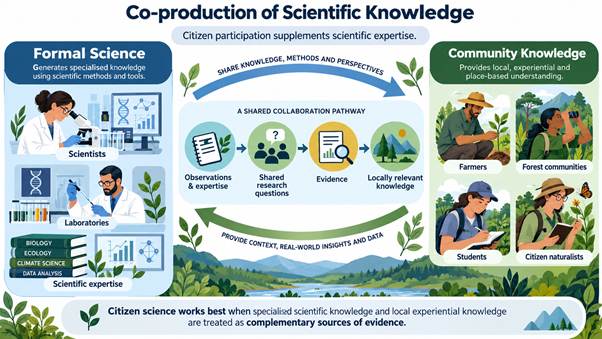
Citizen science broadly involves members of the public contributing to scientific research through observations, data collection, monitoring or other forms of participation.
Professional expertise remains essential.
An epidemiologist, for example, has specialised knowledge of disease transmission that ordinary citizens generally do not possess.
At the same time, communities can hold forms of local and experiential knowledge unavailable in formal datasets.
Examples include:
- Farmer → changing soil behaviour and crop resilience
- Forest community → medicinal plants and ecosystem changes
- Birdwatcher → migration patterns
- School student → local butterfly or biodiversity observations
Scientific and community knowledge can therefore be:
different but complementary
India’s Diversity Makes Citizen Participation Especially Valuable
India’s vast geography and biological diversity make comprehensive observation difficult for professional researchers alone.
Large citizen networks can collect information across:
different regions + seasons + ecosystems + long periods
This is particularly useful in areas such as:
- biodiversity monitoring;
- migration of birds and other species;
- groundwater changes;
- coastal erosion;
- pollution;
- agricultural resilience;
- climate impacts.
Citizen participation can therefore increase the spatial and temporal scale of scientific observation.
Traditional Knowledge Requires Partnership Rather Than Extraction
India also has a long history of community-based ecological knowledge through:
sacred groves + community forests + traditional resource management + germplasm conservation
The article argues against an extractive model in which researchers enter a community, collect traditional knowledge, publish findings and leave.
A partnership-based model would involve communities in:
framing questions → identifying species or practices → interpreting findings → documenting knowledge → deciding its use
This approach can improve research quality while also addressing questions of fairness and ownership.
Citizen Participation Can Shape Research Priorities
Citizens can contribute not only data but also perspectives on which problems deserve research attention.
Under the European Union’s Horizon 2020 programme, citizen involvement in priority-setting showed differences between expert and public emphasis.
Experts tended to emphasise technological advancement, while citizens placed relatively greater emphasis on areas such as:
health and well-being + education + local economies + stronger communities
For India, participatory priority-setting could be particularly relevant for research on:
groundwater + urban pollution + nutrition + public health + coastal erosion + biodiversity + climate adaptation
These are scientific questions whose social consequences are experienced directly by communities.
Participation Can Rebuild Public Trust in Science
Misinformation presents a major challenge for scientific institutions.
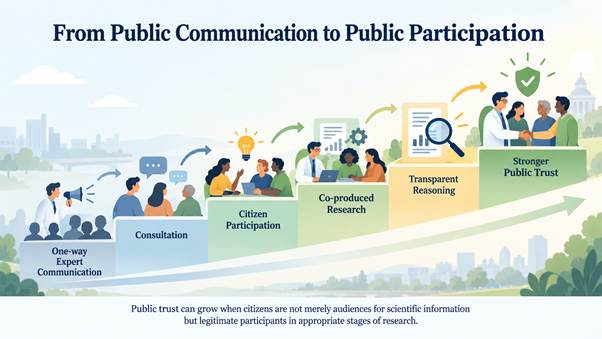
A common response is to improve science communication. But communication alone may not resolve distrust if citizens perceive research institutions as distant from their concerns.
Participation can create greater ownership and procedural trust.
The relationship can be:
Participation → voice → transparency → understanding → greater institutional trust
People need not agree with every scientific conclusion for this process to matter.
The goal is to provide a fair opportunity to question, deliberate and understand how evidence informs decisions.
Participation Matters Most in Socially Contested Technologies
Citizen engagement becomes particularly important where scientific evidence interacts with ethics, risk distribution and social values.
Examples include:
climate change + vaccination + genetic modification + artificial intelligence + biotechnology
Science can provide evidence about likely consequences, but evidence alone cannot always decide questions such as:
- How much risk should society accept?
- How should technological benefits be distributed?
- How much privacy should be traded for convenience?
- Who should bear the costs of climate transition?
These are partly scientific questions and partly normative and political choices.
Participation Should Not Be Mechanically Imposed
Not every research project requires public participation.
A highly specialised laboratory experiment with little immediate social interface may gain little from mandatory citizen involvement.
The more useful principle is:
Greater societal consequence → stronger case for meaningful participation
Participation should therefore be designed according to context rather than treated as a bureaucratic checkbox.
Research Institutions Need New Incentives
Academic reward systems traditionally emphasise: publications + citations + grants
If citizen engagement is considered valuable, research institutions and funding agencies may need to recognise:
community partnerships + public engagement + co-produced knowledge + societal impact
Researchers also require training in communication, listening, participatory methods and long-term relationship-building.
This does not lower scientific standards. Instead, it expands the capabilities expected of researchers working on societally embedded problems.
Scientific Humility Strengthens Public Engagement
Citizen partnership also requires scientific humility.
Scientists must be willing to:
acknowledge uncertainty + listen to local knowledge + answer difficult questions + recognise value judgements
At the same time, public participation cannot mean that established evidence becomes subject simply to majority preference.
The balance is: Expertise without elitism + participation without populism
The Core Policy Lesson
The future relationship between science and society should not force a choice between scientific autonomy and democratic participation.
A more durable model is:
Public funding + scientific freedom + citizen participation + transparency + accountability
Citizens need not become scientists, and scientists should not surrender specialised judgement to public opinion.
Instead, where research has major societal consequences, citizens can become partners in defining problems, supplying observations and deliberating over how knowledge is applied.
This can strengthen both the relevance of science and the legitimacy of institutions that produce it.
Probable Mains Question
“Public participation in science should complement scientific expertise rather than replace it.” Discuss how citizen science and co-produced research can strengthen both scientific knowledge and public trust in India.
Prelims Drill
MCQ 1
Consider the following statements:
- Sacred groves can contribute to in-situ conservation of biodiversity.
- Germplasm conservation helps preserve genetic resources that may be useful for crop improvement and resilience.
- Traditional ecological knowledge and formal scientific knowledge must necessarily be mutually exclusive.
Which of the statements given above are correct?
A. 1 only
B. 1 and 2 only
C. 2 and 3 only
D. 1, 2 and 3
Correct Answer: B
Explanation: Sacred groves can conserve species within their natural ecosystems, while germplasm conservation protects valuable genetic diversity. Traditional ecological knowledge and formal science can be complementary rather than inherently incompatible.