
Right to Protest and Preventive Policing: The Constitutional Balance
Peaceful protest is constitutionally protected but may be regulated in the interests of public order. The key question is when preventive policing crosses the line from legitimate regulation into disproportionate prohibition
Right to Protest and Preventive Policing: The Constitutional Balance
Syllabus Mapping: GS Paper II — Fundamental Rights, Constitutional Governance, Police Powers, Public Order and Judicial Review.
Source & Date: The Indian Express, 12 October 2026.
Why in News?
Sweeping restrictions imposed in Delhi around protests demanding the resignation of the Chief Election Commissioner — including prohibitory orders, preventive detentions, barricading, Metro restrictions and train cancellations — have revived the constitutional tension between peaceful protest and public order.
On October 9, the Supreme Court questioned blanket transport restrictions and emphasised the principle of proportionality, warning against excessively broad measures affecting people unconnected with the protest.
The constitutional issue is:
Right to protest → permissible regulation → preventive action → proportionality → judicial review
Protest Is Protected Under Article 19
The Constitution does not expressly use the phrase “right to protest”, but the right flows primarily from:
Article 19(1)(a): freedom of speech and expression;
Article 19(1)(b): right to assemble peacefully and without arms.
However, these rights are not absolute.
Article 19(2) permits reasonable restrictions on speech on grounds including public order, while Article 19(3) allows reasonable restrictions on peaceful assembly in the interests of sovereignty and integrity of India and public order.
Thus:
Peaceful protest = fundamental right
Unrestricted protest at every place and in every manner ≠ fundamental right
Regulation Cannot Become Blanket Prohibition
Public streets, transport systems and sensitive government zones have competing uses.
In Himat Lal K. Shah v. Commissioner of Police, the Supreme Court accepted that the State can regulate public meetings on streets, but regulatory power cannot become arbitrary authority to extinguish assembly itself.
The principle is:
Regulate time, place and manner → permissible
Arbitrary or blanket suppression → constitutionally suspect
In Mazdoor Kisan Shakti Sangathan v. Union of India (2018), involving protests at Jantar Mantar, the Court similarly rejected a blanket prohibition and required a framework balancing protesters with residents and commuters.
Preventive Policing Need Not Wait for Violence
Police powers are not confined to reacting after an offence occurs.
Section 168 of the Bharatiya Nagarik Suraksha Sanhita (BNSS) requires police officers, to the best of their ability, to prevent cognisable offences.
Authorities may therefore consider:
past conduct + current intelligence + crowd size + location + specific security threats
Past violence at an earlier protest can legitimately inform risk assessment.
However:
Past disorder ≠ automatic justification for banning every future protest
Preventive power must remain linked to a credible anticipated threat.
Section 163 BNSS Is an Exceptional Preventive Power
Section 163 BNSS, which broadly replaces the earlier Section 144 CrPC framework, allows urgent preventive orders where immediate prevention or speedy remedy is necessary in specified circumstances.
Such orders may restrict assembly, movement or particular activities.
But extraordinary preventive powers require a sufficiently serious factual basis.
In Madhu Limaye v. Sub-Divisional Magistrate (1970), the Supreme Court stressed the extraordinary and emergency character of the predecessor Section 144 power.
The governing principle is:
Real and imminent danger → targeted preventive restriction
rather than:
Possible inconvenience → routine blanket prohibition
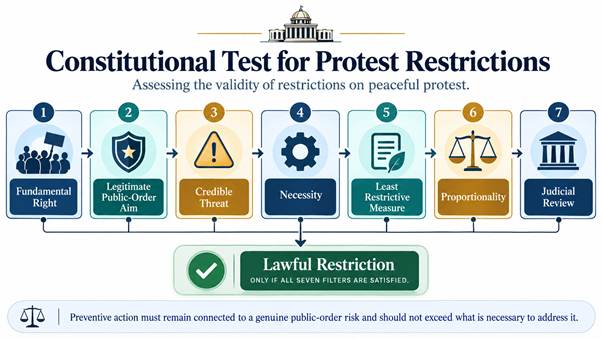
Proportionality Limits State Action
The central constitutional safeguard is proportionality.
A restriction should have a legitimate objective, be rationally connected to that objective, be necessary, and avoid imposing an excessive burden compared with the public benefit achieved.
In Anuradha Bhasin v. Union of India (2020), the Supreme Court accepted that authorities need not wait for actual violence before acting, but preventive restrictions must satisfy constitutional scrutiny and cannot be used to suppress legitimate democratic expression.
Applied to protests:
Specific threat at limited locations → targeted restrictions
may be easier to justify than:
city-wide transport disruption affecting unrelated citizens
Public Transport Restrictions Affect Third-Party Rights
Closing Metro stations or cancelling trains does not affect only protesters.
It can burden:
workers + students + patients + travellers + businesses + ordinary commuters
Therefore, public-order measures must consider the rights of third parties as well.
The Supreme Court’s October 9 intervention reflected this logic: authorities were told to reconsider sweeping restrictions and minimise disruption rather than impose a complete transport shutdown.
Sensitive Zones Justify Greater Regulation, Not Unlimited Power
Delhi contains Parliament, Rashtrapati Bhavan, the Supreme Court and other sensitive establishments within a relatively small area.
Security, crowd capacity and access routes can therefore justify stricter regulation.
A protest permitted at one venue does not automatically create a right to march towards a restricted installation.
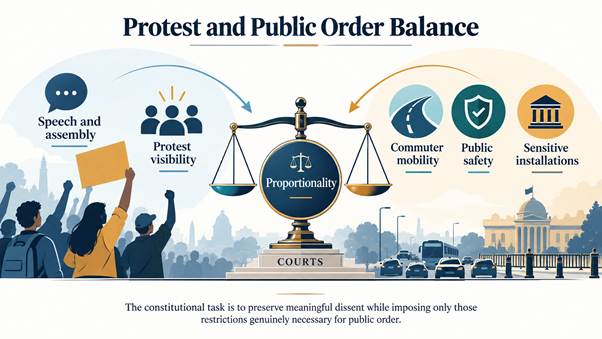
However, protest is also an act of political communication. Sending demonstrators to a location so remote that their message becomes invisible can undermine the practical value of the right.
The balance is:
Meaningful visibility ↔ security of sensitive institutions
Alternative Venues Can Support Proportionality
Where a proposed site is unsuitable because of capacity or security concerns, offering a reasonable alternative venue may help reconcile competing interests.
This converts State action from: prohibition → regulated facilitation
A permission system is therefore not inherently unconstitutional. Its legitimacy depends on clear standards, non-arbitrary application and realistic alternatives.
Shaheen Bagh Reinforced Competing Public Rights
In the Shaheen Bagh case, the Supreme Court held that public ways cannot be occupied indefinitely in a manner that excludes other citizens from their use.
This reinforces a broader principle:
Right to dissent + right of others to mobility and access must coexist
Neither protest rights nor administrative convenience can automatically extinguish the other.
Judicial Review Is the Final Safeguard
Police and executive authorities make the first assessment because preventive decisions often have to be taken before events unfold.
But their conclusions are not final.
Constitutional courts can examine whether restrictions were:
lawful + based on relevant material + necessary + non-arbitrary + proportionate
The Supreme Court’s present scrutiny of Delhi restrictions demonstrates that preventive policing remains subject to judicial oversight. Recent proceedings have continued to stress free movement and protection of peaceful activity while allowing proportionate policing.
The Core Policy Lesson
Indian constitutional law recognises both realities:
The State need not wait for violence before acting.
But equally:
The possibility of disorder cannot become a permanent justification for suppressing peaceful assembly.
The proper constitutional sequence is:
Assess threat → regulate narrowly → facilitate peaceful dissent → protect third-party rights → review disproportionate action
The central issue is therefore not whether the police can regulate protest, but whether the means adopted remain proportionate to the actual public-order threat.
Probable Mains Question
“Preventive policing is constitutionally permissible, but it cannot become a routine mechanism for extinguishing peaceful dissent.” Discuss with reference to Article 19 and the principle of proportionality.
Prelims Drill
MCQ 1
With reference to the right to peaceful protest in India, consider the following statements:
Article 19(1)(a) protects freedom of speech and expression.
Article 19(1)(b) protects the right to assemble peacefully and without arms.
Public order is a constitutionally recognised ground for imposing reasonable restrictions on both these freedoms.
The Constitution guarantees an unrestricted right to protest at any place chosen by protesters.
Which of the statements given above are correct?
A. 1 and 2 only
B. 1, 2 and 3 only
C. 2, 3 and 4 only
D. 1, 2, 3 and 4
Correct Answer: B
Explanation: Articles 19(1)(a) and 19(1)(b) protect expression and peaceful assembly, while Articles 19(2) and 19(3) permit reasonable restrictions on grounds including public order. These freedoms do not create an absolute entitlement to assemble at any location and under any conditions.
MCQ 2
Consider the following statements regarding preventive powers and constitutional review:
Preventive action may sometimes be taken before actual violence occurs.
The principle of proportionality requires examining whether a restriction goes further than necessary to achieve a legitimate objective.
Once a prohibitory order is issued on public-order grounds, constitutional courts cannot examine its necessity or proportionality.
Which of the statements given above are correct?
A. 1 only
B. 1 and 2 only
C. 2 and 3 only
D. 1, 2 and 3
Correct Answer: B
Explanation: Preventive powers allow the State to act against sufficiently credible anticipated threats, but such measures remain open to judicial review. Proportionality helps courts assess whether the restriction is suitable, necessary and excessive in relation to its legitimate objective.