Jantar Mantar and the Constitutional Politics of Protest Space
Jantar Mantar’s significance as a protest site came from both its manageability and its proximity to institutions of power. Its denotification renews the debate over meaningful dissent and regulation of public space.
Jantar Mantar and the Constitutional Politics of Protest Space
Syllabus Mapping: GS Paper II — Fundamental Rights, Democratic Institutions, Civil Liberties, Public Order and Judicial Review.
Source & Date: The Indian Express, 12 October 2026.
Why in News?
Delhi Police has de-notified Jantar Mantar as a designated protest venue and designated three alternatives — Ramlila Ground, Burari Ground and CBD Ground — for protests and demonstrations. The police said the decision followed recommendations of a committee constituted by the Ministry of Home Affairs to examine alternative venues.
The decision is significant because Jantar Mantar had evolved over three decades into Delhi’s most recognisable space for political dissent.
The constitutional issue is broader than the status of one street:
Right to assemble + meaningful visibility of protest ↔ regulation of public space + security + competing public use
Jantar Mantar Was Not Originally Delhi’s Protest Hub
Before Jantar Mantar, the Boat Club lawns near the central government district were a major protest venue.
A turning point came in 1988, when nearly five lakh farmers led by Mahendra Singh Tikait occupied the Boat Club lawns for about a week. Subsequent governments became increasingly reluctant to permit large mobilisations so close to Parliament and major government buildings.
Jantar Mantar emerged as an alternative protest space around 1993.
Its Geography Made It Politically Useful and Administratively Manageable
Jantar Mantar had two important characteristics.
First, it was close enough to Parliament and the central government district for protests to remain politically visible.
Second, it was comparatively small and had limited entry and exit points, making crowd management easier.
The logic was:
Proximity to power + manageable space = effective designated protest venue
Importantly, the source notes that there was no formal ordinance originally declaring it a protest site. It evolved through administrative practice and became an exception within an area otherwise frequently subject to prohibitory orders.
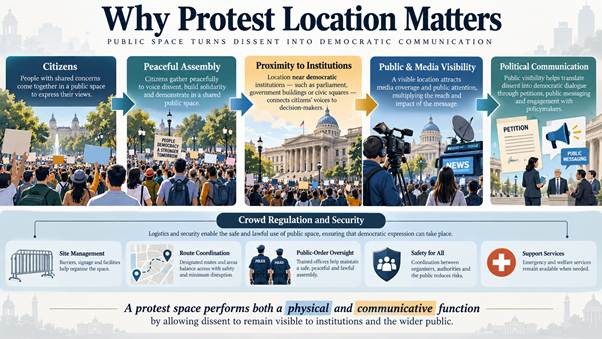
Protest Space Has a Communicative Function
A protest is not merely a gathering of people.
Its political purpose is to communicate a grievance to government, institutions and the wider public.
This means location can matter.
A protest permitted only at a remote venue may formally preserve assembly while reducing its practical visibility.
The constitutional tension is therefore:
Ability to assemble ≠ necessarily ability to communicate effectively
This is why debates over protest sites concern both public order and the substantive value of democratic dissent.
The 2017 NGT Ban Triggered a Constitutional Dispute
In 2017, the National Green Tribunal (NGT) ordered an end to protests at Jantar Mantar after residents complained of noise, waste and disruption.
The NGT directed authorities to shift protesters to Ramlila Maidan and relied on concerns including residential land use and environmental nuisance.
This brought two sets of interests into conflict:
Residents’ health, quiet and environmental rights ↔ protesters’ freedom of peaceful assembly
Supreme Court Rejected a Total Ban in 2018
In Mazdoor Kisan Shakti Sangathan v. Union of India (2018), the Supreme Court rejected a blanket prohibition on demonstrations in the Jantar Mantar area.
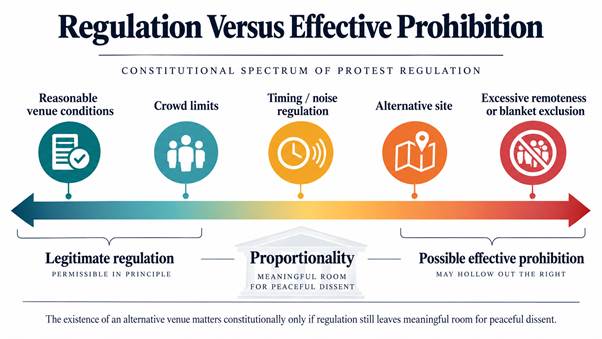
The Court accepted that demonstrations could be regulated, including through conditions relating to crowd size, timing, noise and manner of protest, but held that an absolute ban was not the appropriate constitutional solution.
The enduring principle is:
Regulation of protest → constitutionally permissible
Total extinguishment of peaceful assembly → requires much stronger justification
Article 19 Protects Peaceful Assembly
The constitutional basis of peaceful protest lies principally in:
Article 19(1)(a) — freedom of speech and expression;
Article 19(1)(b) — right to assemble peacefully and without arms.
However, Article 19 permits reasonable restrictions, including restrictions connected with public order.
Therefore, the Constitution does not guarantee that every group can protest:
at every place + in unlimited numbers + for unlimited duration + without conditions
But regulation must remain reasonable and non-arbitrary.
Designated Protest Sites Are a Regulatory Compromise
Designated protest sites attempt to reconcile two competing objectives.
They allow authorities to plan for:
crowd control + policing + traffic management + emergency access + security
while simultaneously preserving:
visibility + accessibility + space for organised dissent
The model works only when the designated venue remains meaningful.
If alternative venues are inaccessible or politically invisible, a formally available protest site may not perform the same democratic function.
Denotification Changes the Geography of Dissent
The 2026 decision does not abolish protest in Delhi. It relocates designated demonstrations to other venues.
The constitutional question is therefore not simply whether alternative sites exist.
It is also whether those alternatives provide a reasonable opportunity for effective peaceful assembly while addressing legitimate security and public-order concerns.
The relevant test is:
Alternative venue + accessibility + adequate capacity + reasonable visibility + proportionate restrictions
Jantar Mantar Became a Symbol Through Repeated Movements
The site acquired political meaning through the diversity of causes represented there.
It hosted, among others:
the 2011 Anna Hazare anti-corruption movement;
protests linked to the 2012 Nirbhaya case;
demonstrations following the death of Nido Tania in 2014;
protests by Tamil Nadu farmers in 2017;
anti-CAA demonstrations in 2019;
and the wrestlers’ protest in 2023.
This accumulated history transformed an ordinary street into a symbolic civic institution.
Public Space Is Part of Democratic Infrastructure
Democracy depends not only on elections, legislatures and courts but also on spaces where citizens can collectively express disagreement.
Such spaces perform several functions:
grievance articulation + mobilisation + public visibility + political accountability + solidarity
For this reason, protest spaces can be understood as part of a city’s democratic infrastructure.
Their regulation involves balancing citizens’ rights not only against security concerns but also against the claims of residents, commuters and other users of public space.
The Core Policy Lesson
The history of Jantar Mantar demonstrates that the right to protest has both a constitutional and a spatial dimension.
The State may regulate the place, manner and size of demonstrations, but the constitutional objective should be to preserve a workable space for dissent rather than merely relocate it out of sight.
The central principle is:
Public order requires regulation; democracy requires meaningful space for disagreement.
The long-term question after Jantar Mantar’s denotification will therefore be whether Delhi’s new protest venues successfully combine security, accessibility and democratic visibility.
Probable Mains Question
“The right to protest depends not only on legal permission to assemble but also on access to meaningful public space.” Discuss in the context of the regulation and relocation of designated protest venues in democratic cities.
Prelims Drill
MCQ 1
With reference to freedom of peaceful assembly under the Constitution of India, consider the following statements:
Article 19(1)(b) guarantees citizens the right to assemble peacefully and without arms.
The right is absolute and cannot be restricted on grounds of public order.
The State may regulate the time, place and manner of public assemblies subject to constitutional limitations.
Which of the statements given above are correct?
A. 1 only
B. 1 and 3 only
C. 2 and 3 only
D. 1, 2 and 3
Correct Answer: B
Explanation: Article 19(1)(b) protects peaceful assembly, but Article 19(3) permits reasonable restrictions in the interests of sovereignty and integrity of India and public order. Regulation is therefore possible, but it cannot be arbitrary.
MCQ 2
With reference to Mazdoor Kisan Shakti Sangathan v. Union of India (2018), consider the following statements:
The case concerned restrictions on protests in the Jantar Mantar area.
The Supreme Court accepted an absolute and permanent ban on all demonstrations at Jantar Mantar.
The judgment recognised the need to balance the rights of protesters with those of residents and other users of public space.
Which of the statements given above are correct?
A. 1 only
B. 1 and 3 only
C. 2 and 3 only
D. 1, 2 and 3
Correct Answer: B
Explanation: The Supreme Court did not endorse a blanket ban. It recognised the constitutional importance of peaceful protest while allowing authorities to devise regulatory mechanisms balancing protest rights with competing public interests.