
Rooftop Solar and Grid Stability
Rapid rooftop-solar expansion supports clean energy, but simultaneous disconnection of large volumes of distributed generation can destabilise grid frequency.
Rooftop Solar and Grid Stability
- Syllabus Mapping: GS Paper III — Energy, Infrastructure, Renewable Energy, Science & Technology and Environmental Sustainability.
- Source & Date: The Indian Express, 1 November 2026.
Why in News?
Sri Lanka's national electricity grid recently suffered a major collapse, after which authorities temporarily asked rooftop solar owners to disconnect their systems while power was being restored.
The episode highlights an emerging challenge for India as its grid-connected rooftop solar capacity expands rapidly. The issue is not whether solar energy is desirable, but whether the electricity system can safely manage large volumes of decentralised and variable generation.
Why Grid Frequency Matters
An electricity grid must continuously balance generation and consumption.
In India and Sri Lanka, the system operates around a nominal frequency of 50 Hz. If electricity generation suddenly falls below demand, frequency declines. If generation exceeds demand, frequency rises.
Large deviations can damage equipment and trigger automatic protection systems. Grid stability therefore depends on rapidly restoring the balance whenever a disturbance occurs.
What Makes Rooftop Solar Different?
Traditional coal, gas and hydropower stations are largely dispatchable: grid operators can instruct them to increase or decrease generation within their technical limits.
Solar output depends primarily on sunlight and is therefore variable. Rooftop systems are also distributed across thousands or millions of individual buildings rather than concentrated in a few power stations.
This makes them harder for system operators to observe, forecast and control directly.
Why Inverters Matter
Solar panels generate direct current, while electricity grids operate on alternating current. An inverter performs the conversion and synchronises the rooftop system with the grid.
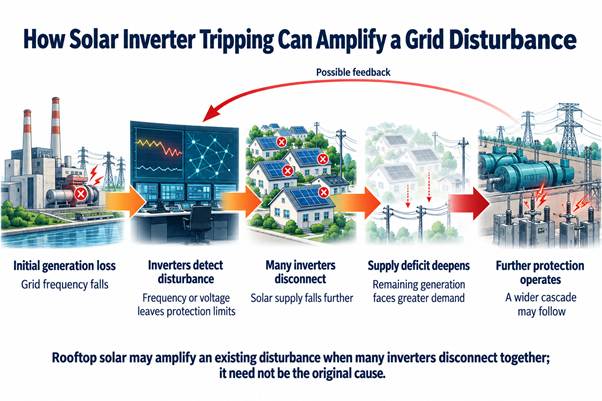
Inverters contain protection settings that disconnect solar systems when voltage or frequency moves beyond specified limits.
This protects equipment, but creates a systemic risk. If thousands of inverters respond identically to a small disturbance and disconnect simultaneously, the grid can suddenly lose a large amount of generation.
What is Ride-Through Capability?
Modern low-voltage and frequency ride-through standards require renewable generators to remain connected during specified temporary disturbances.
Instead of immediately disconnecting when frequency or voltage changes slightly, compliant inverters continue operating within a defined tolerance range.
This prevents a minor grid event from suddenly removing thousands of megawatts of renewable generation.
India therefore needs not only more rooftop solar panels, but also grid-compliant smart inverters with enforceable technical settings.
The System Inertia Challenge
Conventional generators contain large rotating turbines that store kinetic energy. This creates system inertia, which slows the rate at which grid frequency changes after a sudden disturbance.
Solar photovoltaic systems connected through conventional electronic inverters do not naturally provide the same rotating inertia.
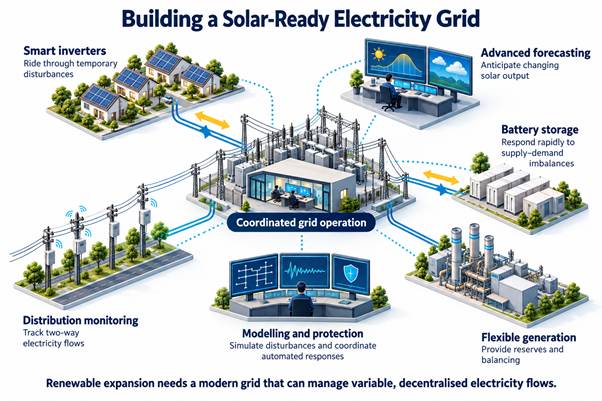
As inverter-based renewable generation increases, frequency can therefore change more rapidly following a disturbance unless the grid obtains flexibility from technologies such as batteries, synchronous condensers, hydropower or advanced grid-forming inverters.
Hosting Capacity Becomes Important
Every distribution feeder has a limit to how much rooftop solar it can integrate safely under existing technical conditions.
This is known as hosting capacity.
Utilities need feeder-level studies that examine voltage, reverse power flows, equipment capacity and likely behaviour during disturbances before rooftop penetration becomes very high.
A feeder that traditionally carried electricity from the grid towards consumers may begin exporting electricity during sunny periods, fundamentally changing its operating characteristics.
Why UFLS May Need Redesign
Under-Frequency Load Shedding (UFLS) automatically disconnects selected electricity demand when frequency falls sharply.
Traditionally, disconnecting a distribution feeder reduces demand and helps restore balance.
But a feeder with heavy rooftop solar may be exporting more electricity than it consumes during daytime. Disconnecting such a feeder could therefore remove generation instead of load and make the shortage worse.
Protection schemes must consequently evolve with changing electricity flows.
Black-Start and Grid Restoration
After a complete blackout, the grid cannot simply switch everything back on simultaneously.
Black start refers to restarting parts of the electricity system without relying on external grid power and then gradually rebuilding the network.
Large volumes of rooftop solar add complexity because thousands of systems may attempt to reconnect as electricity returns. Their reconnection must therefore be sequenced and coordinated with grid-restoration plans.
Lessons for India
India's rooftop solar capacity has reached about 33.41 GW, and further expansion will make distributed generation increasingly important to grid operations.
The next stage therefore requires stronger inverter standards, real-time visibility of distributed generation, feeder-level hosting-capacity studies, energy storage, better renewable forecasting and updated protection systems.
Distribution companies will increasingly need to operate not simply as electricity suppliers but as active managers of two-way power flows.
Core Policy Lesson
Rooftop solar does not inherently make electricity grids unstable. The risk arises when renewable capacity expands faster than the technical standards, monitoring systems and flexibility resources needed to integrate it.
India's energy transition must therefore combine renewable deployment with grid modernisation.
The objective should be a system in which millions of distributed generators behave as coordinated components of the electricity network rather than invisible sources that unexpectedly disconnect during disturbances.
Probable Mains Question
“The next challenge in India's renewable-energy transition is not merely adding solar capacity but integrating decentralised generation without compromising grid stability.” Discuss with reference to rooftop solar, inverter standards and distribution-grid modernisation.
Prelims Drill
MCQ 1
With reference to electricity-grid stability, consider the following statements:
- Grid frequency tends to fall when electricity demand exceeds generation.
- Solar inverters may be designed to remain connected during limited voltage and frequency disturbances.
- Simultaneous disconnection of a large amount of distributed generation can intensify an existing frequency disturbance.
Which of the statements given above are correct?
A. 1 only
B. 1 and 2 only
C. 2 and 3 only
D. 1, 2 and 3
Correct Answer: D
Explanation: A generation deficit causes frequency to decline. Ride-through capability helps renewable generators remain connected during temporary disturbances, while simultaneous inverter tripping can deepen an existing generation deficit.
MCQ 2
Consider the following statements:
- Hosting capacity refers to the amount of distributed generation that a local electricity network can accommodate without unacceptable operational problems.
- Under-frequency load shedding always improves grid stability irrespective of whether the disconnected feeder is importing or exporting electricity.
- Black start refers to restoring an electricity system after a major blackout without depending initially on the external grid.
Which of the statements given above are correct?
A. 1 and 2 only
B. 1 and 3 only
C. 2 and 3 only
D. 1, 2 and 3
Correct Answer: B
Explanation: Hosting capacity measures how much distributed generation a network can safely absorb. A solar-heavy feeder may export electricity, so disconnecting it during under-frequency conditions can sometimes remove generation rather than demand. Black start enables grid restoration after a total or major system collapse.
More Current Affairs - Daily
- India’s State Capacity Stagnation: The Missing Link in Reform 21 Nov 2026
- Holding Two Offices: What Does the Constitution Say About an Office of Profit? 21 Nov 2026
- The Price of War: West Asia Crisis Is Raising India’s Energy Import Bill 21 Nov 2026
- Surveillance Pricing : How Is Personal Data Used to Set Prices? 21 Nov 2026