
Record FPI Inflows: Why Foreign Investors Are Returning to Indian Equities
Foreign portfolio investors have returned strongly to Indian equities in November 2026, supported by earnings, macroeconomic resilience, softer crude prices and global portfolio rotation. However, U.S. interest rates, the dollar and external shocks could quickly reverse tactical flows.

- Syllabus Mapping: GS Paper III — Indian Economy, Capital Markets, External Sector, Foreign Investment, Exchange Rate and Monetary Policy.
- Source & Date: The Hindu, 17 November 2026.
Why in News?
Foreign Portfolio Investors have invested around ₹89,856 crore in Indian equities so far in November 2026, marking a sharp reversal after prolonged periods of foreign selling.
The return of foreign capital reflects a combination of global portfolio rotation, relatively resilient Indian macroeconomic conditions, improved corporate earnings, softer crude oil prices and greater stability in the rupee.
However, the inflows may not yet indicate a permanent structural shift.
What Is Foreign Portfolio Investment?
Foreign Portfolio Investment refers to investment by overseas investors in financial assets such as shares, bonds and other securities without acquiring controlling ownership of the enterprise.
It differs from Foreign Direct Investment, where an investor generally seeks a lasting ownership interest and participation in management.
FPI is therefore usually more liquid and more sensitive to changes in interest rates, exchange rates, valuations and global risk sentiment.
Why Are FPIs Returning to India?
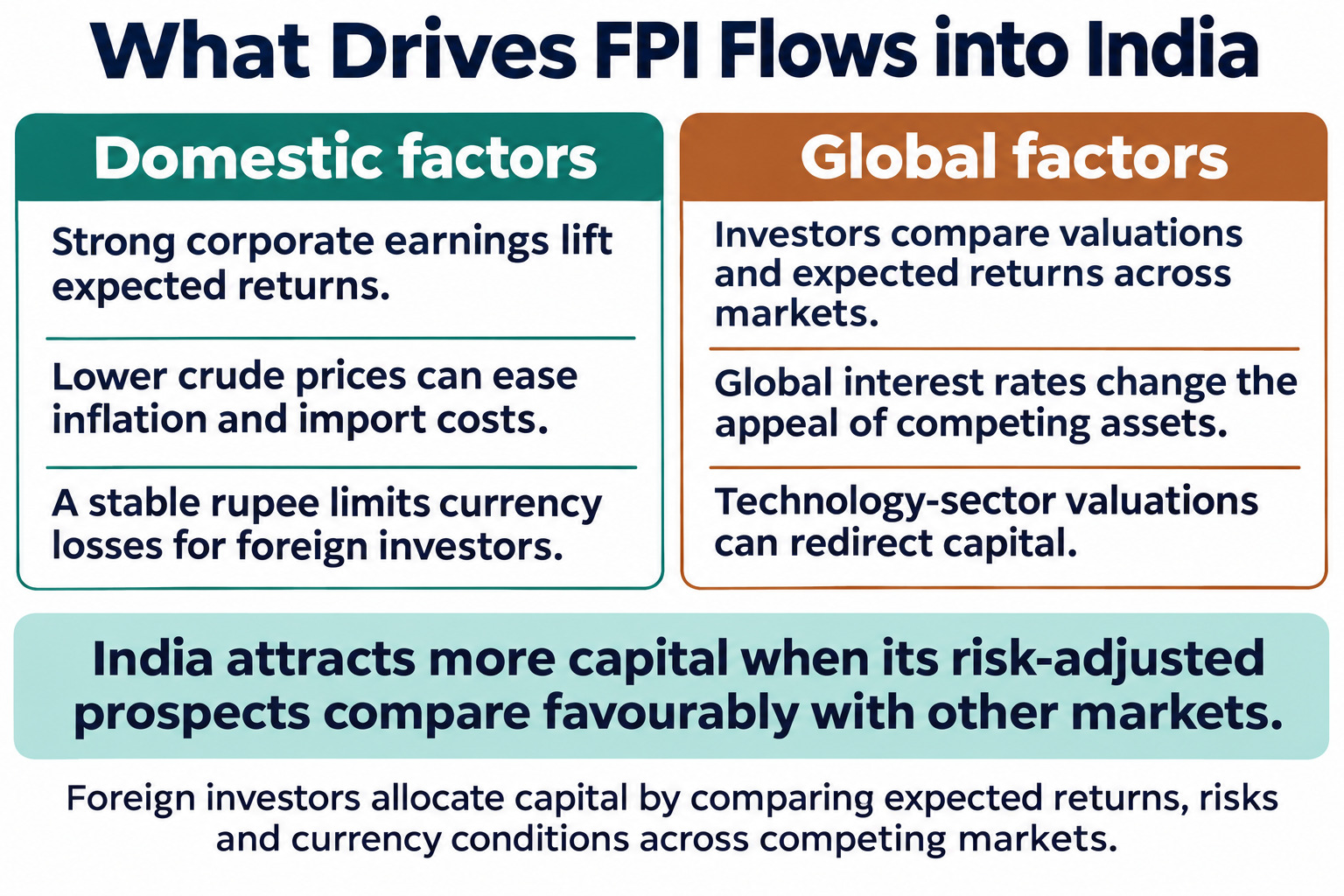
One reason is a change in relative valuations across global markets.
Large amounts of international capital had moved towards technology and artificial-intelligence-related companies in markets such as the United States, South Korea and Taiwan.
When valuations become stretched or expected returns decline, investors rebalance portfolios towards other markets.
India can benefit from such portfolio rotation even without a dramatic change in its underlying economic fundamentals.
Domestic Fundamentals Also Matter
India becomes more attractive when investors expect stronger corporate profits and macroeconomic stability.
Recent factors supporting sentiment include:
- stronger quarterly corporate earnings;
- easing crude oil prices;
- stabilisation of the rupee;
- improvement in major equity indices;
- relative resilience of domestic economic activity.
For an oil-importing country such as India, lower crude prices are particularly important because they can improve inflation, corporate margins and the external balance simultaneously.
Why Is the Money Moving Mainly into Large-Cap Stocks?
Foreign investors often prefer large-cap or blue-chip companies when re-entering a market.
Such companies generally have:
- greater liquidity;
- larger market capitalisation;
- more analyst coverage;
- stronger institutional ownership;
- easier entry and exit for large funds.
This explains why sectors such as banking, information technology, automobiles and telecom can receive substantial foreign inflows even when the broader market remains weak.
Tactical Flow vs Structural Flow
A record monthly inflow does not necessarily mean foreign investors have permanently turned bullish on India.
Part of the current surge may represent tactical allocation.
Tactical investors move money between markets depending on short-term valuations, interest rates and expected returns.
A structural or conviction-led allocation, by contrast, would require sustained confidence in corporate earnings, economic growth and long-term returns.
Therefore, one or two months of strong FPI inflows should not automatically be interpreted as a durable trend.
Why Are Domestic Investors Selling?
Domestic institutional investors have simultaneously booked profits in parts of the equity market.
This illustrates that foreign and domestic investors can take opposite positions at the same time.
Domestic institutions may sell stocks after substantial price appreciation, while foreign investors may consider the same stocks attractive relative to alternatives abroad.
Thus, market movements reflect different investment horizons, valuations and portfolio strategies rather than a single uniform assessment of the economy.
How Do U.S. Interest Rates Affect FPI Flows?
The U.S. Federal Reserve's policy rate is especially important for emerging markets.
The Fed maintained its federal funds target range at 3.75%-4.00% in October 2026, while inflation remained elevated and some policymakers favoured a higher rate.
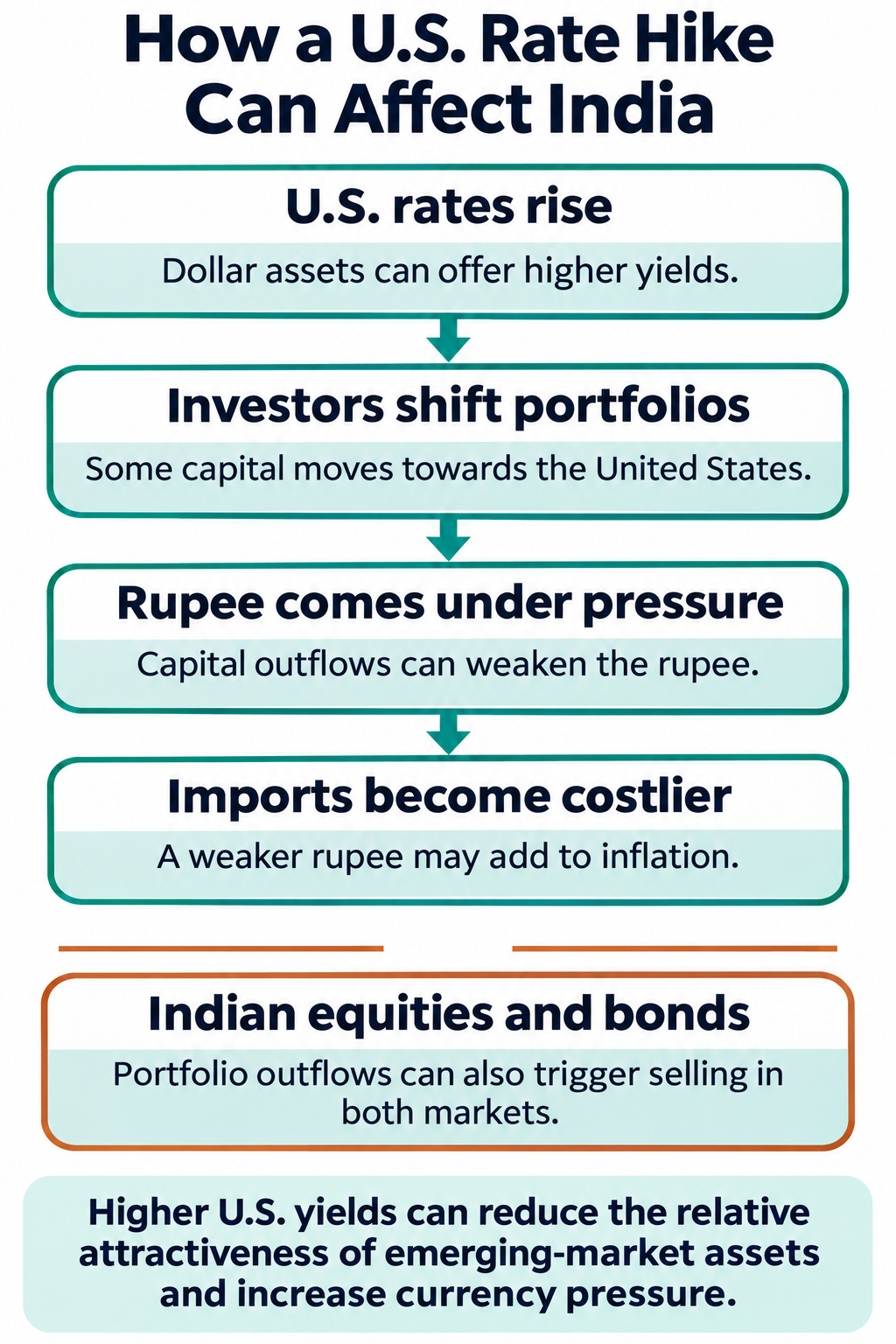
If U.S. interest rates rise, American bonds and other dollar assets become relatively more attractive.
Global investors may then reduce exposure to emerging markets.
This can produce:
capital outflows → stronger dollar → weaker rupee → higher imported inflation → further pressure on Indian financial assets.
Why Does the Rupee Matter to Foreign Investors?
A foreign investor earns returns not only from the movement in Indian share prices but also from the exchange rate.
Suppose an overseas investor earns 10% on Indian equities but the rupee depreciates substantially against the dollar.
Part of the equity gain disappears when the investment is converted back into dollars.
A stable or appreciating rupee therefore makes Indian assets more attractive, while expectations of sharp depreciation can encourage FPI exits.
Why Crude Oil Is a Key Variable?
India imports most of its crude oil requirements.
Higher oil prices can:
- widen the trade deficit;
- increase inflation;
- weaken the rupee;
- raise transport and production costs;
- reduce corporate profit margins.
Lower oil prices generally produce the opposite effects.
Crude oil therefore affects FPI sentiment indirectly through both macroeconomic stability and corporate profitability.
Can Large FPI Inflows Be a Problem?
Foreign capital can deepen financial markets and improve liquidity.
But heavy dependence on portfolio flows can also increase vulnerability.
Because FPI is highly liquid, the same capital that enters rapidly can leave quickly during global shocks.
Large inflows may also strengthen the currency and push asset valuations higher, while sudden reversals can create market and exchange-rate volatility.
This is why the quality and persistence of capital flows matter alongside their absolute size.
What Will Determine Whether the Inflows Continue?
The durability of FPI inflows will depend on several variables:
- corporate earnings growth;
- Indian equity valuations;
- U.S. monetary policy;
- global technology-sector performance;
- crude oil prices;
- geopolitical risks;
- inflation;
- rupee stability.
If earnings remain strong and global financial conditions remain supportive, tactical allocations could gradually become longer-term investments.
If U.S. rates rise sharply or global risk aversion returns, the most tactical portion of the inflows may reverse rapidly.
Core Policy Lesson
Record FPI inflows should not be interpreted simply as foreign investors suddenly becoming permanently optimistic about India.
They reflect the interaction of India's domestic fundamentals with changing relative returns across global markets.
Strong earnings, lower crude prices and currency stability can attract capital, but global interest rates and risk sentiment can reverse these flows quickly.
For India, therefore, the strongest defence against volatile foreign capital is not merely attracting larger inflows but maintaining macroeconomic stability, deeper domestic capital markets and sustainable corporate earnings.
---
Probable Mains Question
“Foreign portfolio flows into emerging markets are determined as much by global financial conditions as by domestic economic fundamentals.” Explain with reference to recent FPI inflows into Indian equities and the transmission of U.S. monetary policy to India.
---
Prelims Drill
MCQ 1
With reference to Foreign Portfolio Investment, consider the following statements:
1. FPI generally involves investment in financial securities without seeking managerial control.
2. FPI flows can be influenced by interest-rate differentials between countries.
3. FPI is necessarily more stable and less reversible than Foreign Direct Investment.
Which of the statements given above are correct?
A. 1 only
B. 1 and 2 only
C. 2 and 3 only
D. 1, 2 and 3
Correct Answer: B
Explanation: FPI consists largely of liquid financial investments and can respond quickly to changes in interest rates, valuations and risk sentiment. It is generally more reversible than FDI.
MCQ 2
Consider the following consequences of a significant increase in U.S. interest rates:
1. Dollar-denominated assets may become relatively more attractive to global investors.
2. Emerging-market currencies may face depreciation pressure due to capital outflows.
3. Higher U.S. interest rates necessarily increase FPI inflows into emerging-market equities.
Which of the statements given above are correct?
A. 1 only
B. 1 and 2 only
C. 2 and 3 only
D. 1, 2 and 3
Correct Answer: B
Explanation: Higher U.S. yields can attract capital towards dollar assets and away from emerging markets, putting pressure on emerging-market currencies and financial assets.
More Current Affairs - Daily
- India’s State Capacity Stagnation: The Missing Link in Reform 21 Nov 2026
- Holding Two Offices: What Does the Constitution Say About an Office of Profit? 21 Nov 2026
- The Price of War: West Asia Crisis Is Raising India’s Energy Import Bill 21 Nov 2026
- Surveillance Pricing : How Is Personal Data Used to Set Prices? 21 Nov 2026