
RBI Rate Hike: Calibrated Tightening Signals a More Restrictive Policy
RBI’s 5.5% repo rate and calibrated-tightening stance indicate greater concern about broadening price pressures and inflation expectations, not merely the latest headline inflation figure.
RBI Rate Hike and the Shift to Calibrated Tightening
- Syllabus Mapping: GS Paper III — Indian Economy, Inflation, Monetary Policy, RBI, Growth and External Sector.
- Source & Date: The Indian Express, 7 October 2026.
Repo Rate Raised to 5.5%
The Monetary Policy Committee increased the policy repo rate by 25 basis points to 5.5%, marking the first rate increase in more than three-and-a-half years.
The more significant change was the shift in policy stance from “neutral” to “calibrated tightening”.
Under a neutral stance, the MPC retains relatively balanced flexibility to move rates in either direction. Calibrated tightening gives policy a restrictive bias, indicating that the near-term choice is more likely to be between a pause and another rate hike, rather than a rate cut.
Neutral stance → two-way flexibility
Calibrated tightening → tightening bias + data dependence
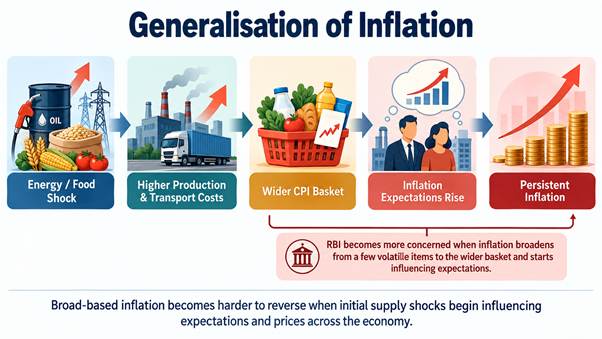
Inflation Is Becoming More Generalised
The key concern is not merely that headline inflation has increased, but that price pressures are spreading across a larger part of the CPI basket.
The number of CPI items recording inflation above 4% increased from 65 in January to 110 in August, while prices of 314 of 358 items were higher in August than in July.
This is referred to as generalisation of inflation.
A supply shock can spread through the economy as:
Energy price rise → transport and input costs → goods and services prices → inflation expectations → persistent inflation
This broadening matters because monetary policy is more effective against second-round demand and expectation effects than against the original supply shock itself.
Forward-Looking Monetary Policy
Retail inflation rose from 4.38% in June to 4.82% in August, but the MPC cannot rely only on recent inflation readings because monetary policy affects the economy with a lag.
Interest-rate changes typically influence growth and inflation over approximately 9-12 months.
The relevant framework is:
Future inflation outlook → policy decision today → financial transmission → demand response → inflation impact later
The RBI projected headline inflation to average close to 5.8% over the next three quarters, while core inflation was projected at 4.4% in 2026-27.
India’s Flexible Inflation-Targeting Framework
The RBI is mandated to target CPI inflation at 4%, with a tolerance band of 2% to 6%.
This is a flexible inflation-targeting framework because monetary policy also takes growth conditions into account.
The central objective is not necessarily to prevent every temporary increase in food or fuel prices, but to stop such shocks from becoming embedded in the wider economy.
Temporary supply shock → manageable
Persistent broad-based inflation → monetary-policy concern
Stronger Growth Expands Policy Space
A major change since the previous policy meeting has been the stronger growth outlook.
The RBI raised its GDP growth projection for the fiscal year from 6.7% to 7.1%, after economic growth of 7.8% in April-June.
Stronger growth gives the central bank more space to tighten monetary policy because the economy may be better positioned to absorb higher borrowing costs.
However, the MPC also noted limited evidence of immediate demand-side inflation, even as strong monetary and credit growth could create future risks.
Global Monetary Tightening Adds External Pressure
Several major central banks have also raised interest rates, including the U.S. Federal Reserve, European Central Bank, Bank of Japan and Reserve Bank of Australia.
The RBI does not mechanically follow foreign central banks; its mandate remains centred on domestic inflation and growth.
However, global rate changes can influence India through:
Global rates ↑ → capital-flow conditions → bond yields and exchange rate → imported inflation and domestic financial conditions
This makes international monetary conditions relevant even when they are not the primary driver of RBI decisions.
Supply-Side Risks Remain Elevated
Weak rainfall, El Niño and higher energy prices continue to create supply-side inflation risks.
Higher crude and cooking-fuel prices can also spread into services such as transport, restaurants and other businesses.
The larger concern is therefore:
Supply shock → cost pass-through → generalised inflation → elevated expectations
Once expectations become entrenched, restoring price stability may require a larger subsequent tightening.
Policy Significance of Calibrated Tightening
The change in stance serves as forward guidance for households, businesses and financial markets.
It signals that interest-rate cuts are unlikely in the near term unless the inflation outlook improves materially.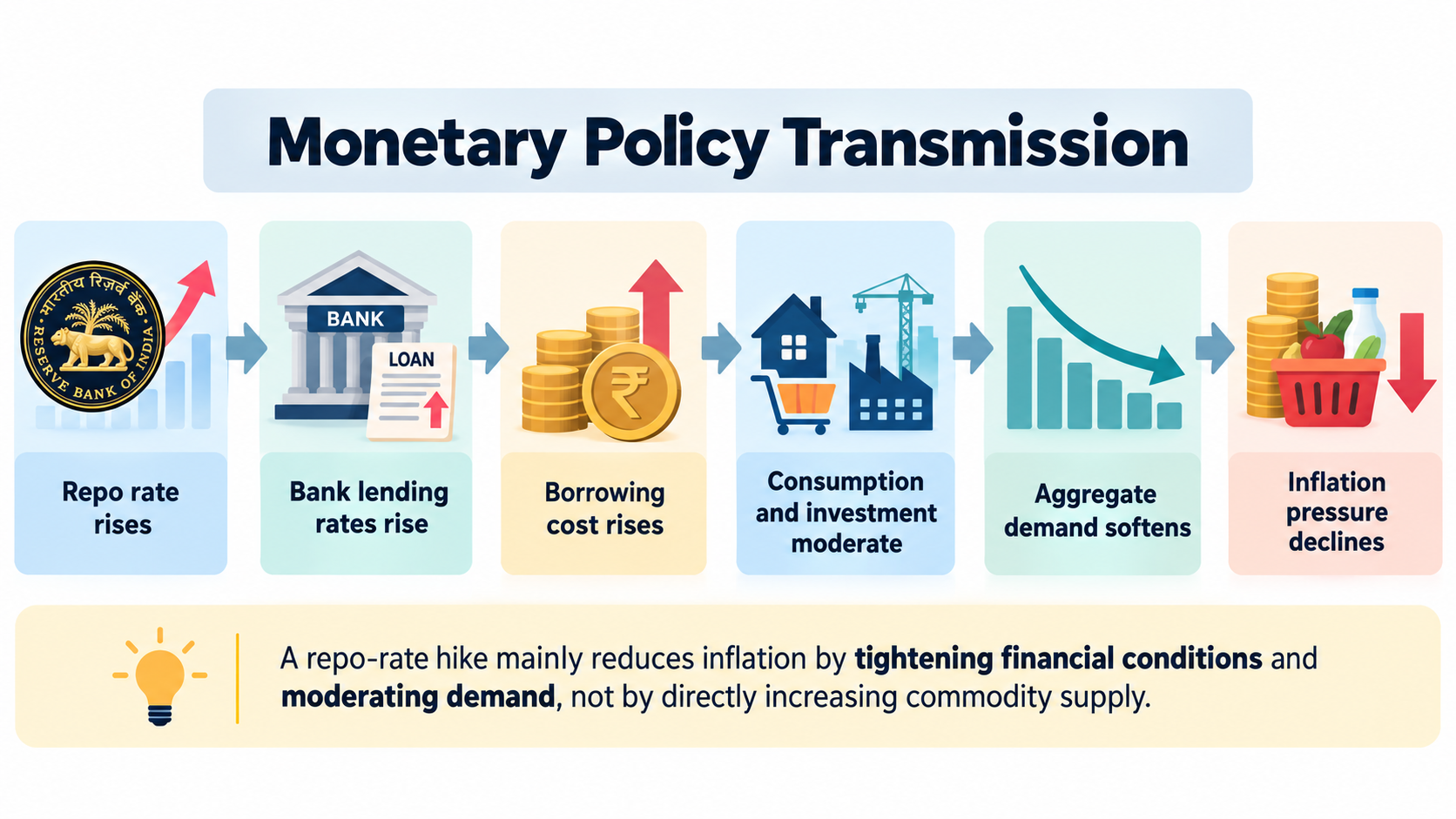
However, calibrated tightening does not imply a predetermined sequence of rate hikes.
Its meaning is better expressed as:
Restrictive bias + continuous data assessment + flexibility to pause
The Core Policy Lesson
The October policy shift reflects the RBI’s concern that inflation could become more persistent and broad-based even though recent headline data have not changed dramatically.
The central policy challenge is:
Price stability ↔ growth stability
A credible monetary-policy framework must respond before inflation expectations become unanchored while avoiding unnecessary damage to consumption, investment and growth.
Probable Mains Question
“A central bank’s challenge is not merely to respond to current inflation but to prevent temporary supply shocks from becoming broad-based and persistent.” Discuss in the context of India’s flexible inflation-targeting framework.
Prelims Drill
MCQ 1
With reference to India’s monetary-policy framework, consider the following statements:
- The Monetary Policy Committee targets inflation measured by the Consumer Price Index.
- The inflation target is 4%, with a tolerance band of 2% to 6%.
- The RBI Governor has a casting vote in case of a tie in the Monetary Policy Committee.
- The Wholesale Price Index is the formal inflation target used by the MPC.
Which of the statements given above are correct?
A. 1 and 2 only
B. 1, 2 and 3 only
C. 2, 3 and 4 only
D. 1, 2, 3 and 4
Correct Answer: B
Explanation: India’s flexible inflation-targeting framework uses CPI inflation, not WPI. The target is 4% within the 2-6% tolerance band, and the RBI Governor has a casting vote when MPC voting results in a tie.
MCQ 2
With reference to monetary-policy transmission, consider the following statements:
- A rise in the repo rate generally tends to increase borrowing costs in the economy.
- Monetary-policy changes may affect inflation and output only after a time lag.
- A higher repo rate can directly increase agricultural output during a supply shortage.
Which of the statements given above are correct?
A. 1 only
B. 1 and 2 only
C. 2 and 3 only
D. 1, 2 and 3
Correct Answer: B
Explanation: Repo-rate increases tighten financial conditions and normally operate with a lag. Monetary policy cannot directly produce additional food or other commodities.
More Current Affairs - Daily
- Election Commission of India: Constitutional Design and Evolution into a Three-Member Body 12 Oct 2026
- Loknayak Jayaprakash Narayan: Total Revolution and Contribution to Democracy 12 Oct 2026
- India’s Russia-Ukraine Initiative: From Black Sea Security to Strategic Autonomy 12 Oct 2026
- Jayaprakash Narayan: Architect of Total Revolution and Defender of Democracy 12 Oct 2026