
RBI’s ₹1 Lakh Crore Liquidity Drain Hits Short-Term Bonds
RBI’s ₹1 lakh crore government-security sale aims to absorb surplus liquidity but has raised yields, especially at the short-to-medium end of the bond market.
RBI’s ₹1 Lakh Crore Liquidity Drain Hits Short-Term Bonds
- Syllabus Mapping: GS Paper III — Indian Economy; Monetary Policy; Banking; Government Securities; Inflation; Exchange Rate.
- Source & Date: Business Today, 15 September 2026. The report states that RBI plans to drain ₹1 lakh crore through government-security sales and that five-year yields rose sharply after the announcement.
Why the RBI Is Draining Liquidity
The Reserve Bank of India (RBI) plans to absorb ₹1 lakh crore of surplus banking-system liquidity through sales of government securities in three tranches beginning September 17, 2026.
The basic mechanism is:
RBI sells G-Secs → banks/financial institutions pay RBI → money leaves the banking system → liquidity falls
This is an Open Market Operation (OMO) sale.
RBI Action | Liquidity Effect |
| Buys G-Secs | Liquidity increases |
| Sells G-Secs | Liquidity decreases |
A crucial distinction is that an OMO sale is not necessarily fresh government borrowing. RBI can sell securities already held on its balance sheet.
Why Surplus Liquidity Built Up
Recent foreign-currency inflows added rupee liquidity to the banking system. When the RBI acquires foreign currency:
RBI buys foreign currency → releases rupees → domestic liquidity rises
Business Today had reported banking-system surplus liquidity of around ₹11.6 lakh crore in early September 2026.
If the RBI later removes some of this rupee liquidity through asset sales, the operation performs a sterilisation-like function by offsetting the domestic liquidity effect of foreign-exchange intervention.
Why Bond Yields Are Rising
Two mechanisms reinforce each other.
Supply effect:
Bond supply ↑ → bond price ↓ → bond yield ↑
Liquidity effect:
System liquidity ↓ → funds become relatively tighter → market rates face upward pressure
Hence, the essential bond-market rule is:
Bond prices and bond yields generally move in opposite directions.
The impact has been strongest in shorter and medium maturities because much of the securities supplied through RBI sales is concentrated in the 3–6 year segment. The five-year yield reportedly jumped by as much as 22 basis points.
Yield Curve and the Shorter End
A yield curve plots yields of comparable bonds across different maturities.
If short- or medium-term yields rise faster than long-term yields, the curve may flatten.
UPSC Trap: Yield-curve flattening does not necessarily require long-term yields to fall. It may occur because shorter-term yields rise faster.
Why Other Pressures Matter
The RBI action is occurring alongside other yield-positive forces.
Government borrowing: Higher Central and State borrowing increases G-Sec supply. The source reported nearly ₹8 lakh crore of federal borrowing scheduled over the following six months.
Inflation: Higher expected inflation lowers the real value of fixed coupon payments, so investors demand higher nominal yields.
Crude oil: For an oil-importing economy, higher crude prices can worsen inflation and external-sector pressures.
Rupee weakness: Currency depreciation can reinforce imported-inflation concerns. The rupee closed near ₹95.96 per US dollar on September 15 according to the report.
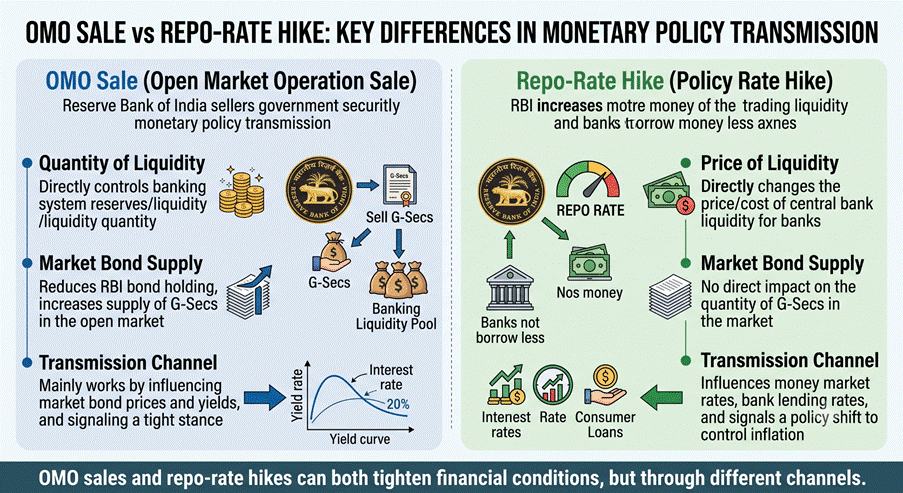
OMO Sale vs Repo-Rate Hike
Instrument | Primary Channel |
| Repo-rate hike | Raises the price of short-term central-bank liquidity |
| OMO sale | Reduces the quantity of liquidity and increases market bond supply |
The RBI directly sets the policy repo rate, while G-Sec yields are market-determined.
Why It Matters for the Economy
Government-security yields act as important benchmark rates.
G-Sec yields ↑ → government borrowing costs ↑ → corporate and bank funding costs may rise → broader cost of capital may increase
The RBI therefore faces a balancing act: excessive liquidity can weaken monetary-policy transmission and intensify inflationary pressures, while aggressive liquidity withdrawal can raise borrowing costs and market volatility.
⚠️ UPSC Trap / Examiner’s Blindspot
OMO sale ≠ fresh government borrowing
Bond price ↑ → yield ↓, and vice versa.
RBI buying dollars generally injects rupee liquidity; RBI selling dollars generally absorbs it.
Liquidity management and policy-rate changes are related but distinct monetary-policy tools.
High-Yield Prelims Data Bank
Concept | Remember |
| OMO sale | Absorbs liquidity |
| OMO purchase | Injects liquidity |
| Bond price vs yield | Inverse relationship |
| Sterilisation | Offsets liquidity effect of forex intervention |
| RBI buys dollars | Rupee liquidity generally rises |
| RBI sells dollars | Rupee liquidity generally falls |
| Current OMO programme | ₹1 lakh crore |
| CPI inflation target | 4% with ±2% tolerance band |
Mains Answer-Writing Value-Add
Micro-Dimensions:
Liquidity management | Bond-market transmission | Inflation expectations | Forex intervention
Keywords:
OMO, G-Secs, liquidity absorption, sterilisation, bond yield, yield curve, monetary transmission, inflation expectations
Probable Mains Question
“Liquidity management is critical to effective monetary-policy transmission.” Explain how Open Market Operations influence banking-system liquidity, government bond yields and broader financial conditions.
Prelims Readiness Drill
MCQ 1
Consider the following statements regarding Open Market Operations:
- An OMO sale by the RBI generally absorbs banking-system liquidity.
- An OMO sale necessarily involves fresh borrowing by the Central Government.
- An increase in the market supply of an existing government bond can exert upward pressure on its yield.
Which of the statements given above are correct?
A. 1 only
B. 1 and 3 only
C. 2 and 3 only
D. 1, 2 and 3
Correct Answer: B
Explanation: Statements 1 and 3 are correct. The RBI can sell government securities already held in its portfolio; this does not necessarily constitute fresh government borrowing.
Trap Identified: RBI sale of an existing G-Sec ≠ fresh government issuance.
MCQ 2
Consider the following statements:
- RBI purchase of US dollars can increase rupee liquidity in the banking system.
- Sterilisation may involve the sale of government securities to offset such liquidity creation.
- Yield-curve flattening necessarily requires long-term bond yields to decline.
Which of the statements given above are correct?
A. 1 only
B. 1 and 2 only
C. 2 and 3 only
D. 1, 2 and 3
Correct Answer: B
Explanation: Statements 1 and 2 are correct. A yield curve may flatten even when long-term yields remain unchanged or rise, provided short-term yields rise faster.
Trap Identified: Flattening describes a change in the yield spread, not necessarily a fall in long-term yields.
More Current Affairs - Daily
- Election Commission of India: Constitutional Design and Evolution into a Three-Member Body 12 Oct 2026
- Loknayak Jayaprakash Narayan: Total Revolution and Contribution to Democracy 12 Oct 2026
- India’s Russia-Ukraine Initiative: From Black Sea Security to Strategic Autonomy 12 Oct 2026
- Jayaprakash Narayan: Architect of Total Revolution and Defender of Democracy 12 Oct 2026