
Rare-Disease Drugs: India’s Next Pharma Frontier
India could become a global hub for rare-disease drug development and manufacturing by combining its large patient base, generic-drug capabilities, biosimilar experience and lower-cost production ecosystem.
Rare-Disease Drugs: India’s Next Pharma Frontier
- Syllabus Mapping: GS Paper II — Health, Government Policies and Social Sector; GS Paper III — Biotechnology, Pharmaceutical Industry, Innovation, Manufacturing and Intellectual Property.
- Source & Date: The Hindu, 29 September 2026.
Why Are Rare-Disease Drugs Important?
A rare disease affects relatively few patients individually, but there are around 8,000 rare diseases worldwide, so their cumulative disease burden is significant. In India, 1,004 rare genetic disorders have been reported so far.
Drugs for such conditions are commonly called orphan drugs because small patient populations historically gave pharmaceutical companies weak commercial incentives to develop them.
The fundamental challenge is:
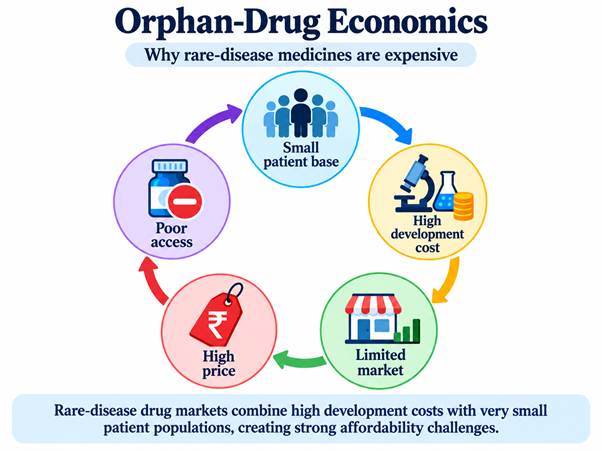
Small patient population → high R&D cost per patient → weak commercial incentives → high drug prices → poor access
Incentive systems can partly reverse this cycle. The U.S. Orphan Drug Act, 1983, used tax incentives, regulatory support and market exclusivity to stimulate orphan-drug development, after which approvals increased substantially.
India’s Two Major Challenges
The first challenge is affordability. Government support can reach ₹50 lakh per patient, but many advanced treatments cost far more than this, and some patients depend on crowdfunding.
The second challenge is availability. Existing medicines serve only about 5% of rare diseases and associated conditions, leaving most patients without an approved treatment.
Thus, India faces both:
Access to existing drugs + development of new drugs
Why India Can Become a Clinical-Trial Hub
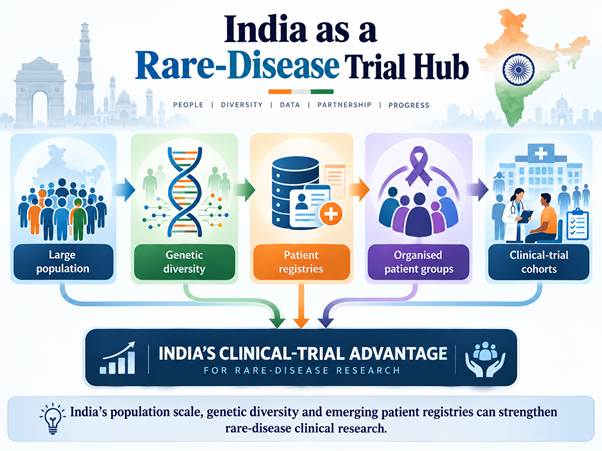
India’s population of over 1.4 billion creates a comparatively large patient pool for conditions that are individually rare. In some communities, endogamy and founder effects can also produce higher prevalence of particular genetic disorders.
Patient organisations and disease registries are gradually improving the ability to identify trial cohorts, while India’s genetic diversity can contribute valuable data for global drug development.
However, Indian patients remain underrepresented in many international orphan-drug trials.
A stronger model would encourage:
global drug developers + Indian research institutions + patient groups + domestic regulators
to work together on clinical development.
Benefit-Sharing and Patient Access
Clinical-trial participation raises an important ethical issue: patients who contribute to drug development should not remain unable to afford the resulting medicine.
One possible framework is benefit-sharing, under which companies receiving access to Indian patients and research networks would also commit to affordable access in India or the wider Global South.
The principle is:
Patient participation → research value → commercial product → fair access
This resembles broader benefit-sharing ideas used in global health, where access to biological information is linked to equitable access to resulting medicines or vaccines.
Why India Has a Manufacturing Advantage
India is already a global leader in pharmaceutical manufacturing. It supplies a very large share of generic medicines used in the United States and has one of the largest numbers of U.S.-approved manufacturing facilities outside the U.S.
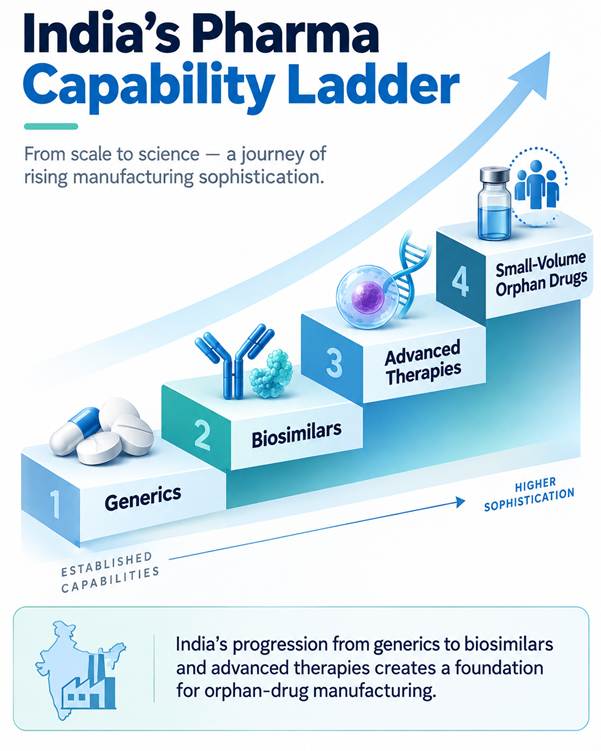
Indian firms also manufacture biosimilars for major markets and have developed capabilities in advanced therapies such as CAR-T cell therapy.
This gives India an important advantage in orphan drugs because rare-disease medicines often require high-quality production at relatively small volumes, an area where flexible Indian manufacturers may be competitive.
Generic strength → biosimilars → advanced therapies → orphan-drug manufacturing
Regulatory Opportunity
Under Rule 101 of the New Drugs and Clinical Trials Rules, 2019, CDSCO has identified specified countries whose approval can, in certain cases, allow a drug to avoid a fresh clinical trial in India before seeking regulatory approval.
A more efficient pathway could rely on bioequivalence, safety and toxicity data, post-market effectiveness and pharmacovigilance, while reducing unnecessary duplication.
This does not mean weaker regulation. The objective is:
Faster approval + strong quality control + post-market surveillance
What Policy Support Could Accelerate the Sector?
India can reduce the initial commercial risk of orphan-drug production without permanently subsidising firms.
Potential tools include:
- Tax incentives for investment in orphan-drug manufacturing.
- Production-linked incentives tied to production, investment, exports and patient access.
- Technology-transfer support involving national laboratories.
- Advanced Market Commitments, where the government guarantees purchase of specified quantities at agreed prices.
- Public procurement and distribution through Centres of Excellence on Rare Diseases, CGHS and Jan Aushadhi channels.
- Export incentives for supplying affordable medicines to low- and middle-income countries.
The policy logic is:
De-risk initial investment → create predictable demand → achieve scale → lower cost → expand access
The Core Opportunity
India should not treat rare-disease drugs only as a welfare expenditure problem.
They can also become a high-value industrial and innovation opportunity if India combines clinical research, biotechnology, regulation, manufacturing and public procurement within a coherent strategy.
The broader transition would be:
Pharmacy of the world → affordable generics leader → advanced biologics producer → global orphan-drug manufacturing hub
The ultimate test, however, is not simply whether India can manufacture these medicines, but whether it can make them safe, commercially viable and accessible to patients who need them.
Probable Mains Question
“India’s experience in affordable generic medicines provides a strong foundation for building a globally competitive orphan-drug industry, but success will depend on balancing innovation, affordability and patient access.” Discuss.
Prelims Drill
MCQ 1
With reference to orphan drugs, consider the following statements:
- They are medicines developed for rare diseases affecting relatively small patient populations.
- Small patient populations can weaken commercial incentives for pharmaceutical companies to develop such drugs.
- Orphan drugs are necessarily generic medicines whose patents have expired.
Which of the statements given above are correct?
A. 1 only
B. 1 and 2 only
C. 2 and 3 only
D. 1, 2 and 3
Correct Answer: B
Explanation: Orphan drugs are associated with rare diseases and small patient populations, but they may be novel patented medicines, biologics, gene therapies or other advanced treatments rather than only generic drugs.
MCQ 2
With reference to rare-disease drug development in India, consider the following statements:
- Rule 101 of the New Drugs and Clinical Trials Rules, 2019 can permit waiver of fresh Indian clinical trials for certain drugs approved in specified countries.
- Pharmacovigilance refers to monitoring adverse effects and safety after a drug reaches the market.
- Advanced Market Commitments involve a government commitment to purchase a specified quantity of a product under agreed conditions.
Which of the statements given above are correct?
A. 1 only
B. 1 and 2 only
C. 2 and 3 only
D. 1, 2 and 3
Correct Answer: D
Explanation: All three statements are correct and together illustrate how regulation, post-market safety monitoring and predictable public procurement can support rare-disease drug access and manufacturing.
More Current Affairs - Daily
- Election Commission of India: Constitutional Design and Evolution into a Three-Member Body 12 Oct 2026
- Loknayak Jayaprakash Narayan: Total Revolution and Contribution to Democracy 12 Oct 2026
- India’s Russia-Ukraine Initiative: From Black Sea Security to Strategic Autonomy 12 Oct 2026
- Jayaprakash Narayan: Architect of Total Revolution and Defender of Democracy 12 Oct 2026