
Rabies in India: Surveillance Gaps and the 2030 Elimination Target
The wide gap between reported rabies deaths and modelled mortality estimates highlights the need for stronger surveillance, death certification and timely post-exposure prophylaxis before India can eliminate dog-mediated human rabies by 2030.
Rabies in India: Surveillance Gaps and the 2030 Elimination Target
- Syllabus Mapping: GS Paper II — Health, Government Programmes and Public-Health Systems; GS Paper III — Communicable Diseases, Epidemiology, Surveillance and One Health.
- Source & Date: The Hindu, 5 October 2026.
Why in the News?
India aims to eliminate dog-mediated human rabies by 2030, but the country still lacks a single comprehensive count of human rabies deaths.
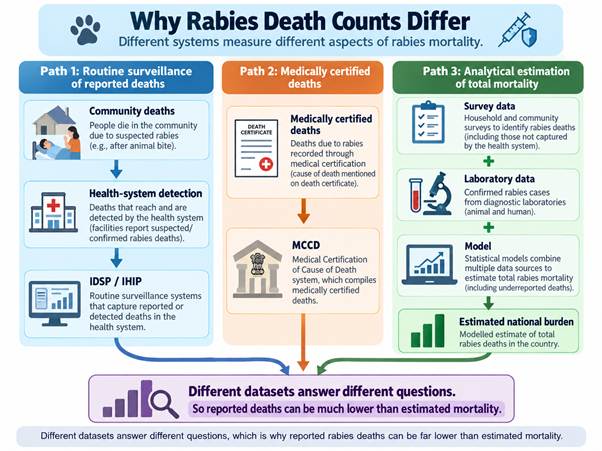
The IDSP-IHIP surveillance system recorded 54 deaths in 2024, while an ICMR-led study estimated around 5,726 deaths annually. These numbers are not directly comparable because they are generated through different methods.
The key distinction is:
Reported surveillance deaths ≠ medically certified deaths ≠ modelled population estimate
Why Do the Numbers Differ?
The Integrated Disease Surveillance Programme/Integrated Health Information Platform (IDSP-IHIP) records cases and deaths reported through the surveillance network.
The Medical Certification of Cause of Death (MCCD) system records medically certified causes of death, but it does not cover all registered deaths in India.
The ICMR-led estimate came from a large community survey combined with laboratory data and a probability decision-tree model, so it attempts to estimate deaths that may never enter routine reporting systems.
Thus:
Surveillance data = detected and reported burden
Modelled estimate = probable population burden
Is Rabies a Notifiable Disease Nationwide?
Rabies is not uniformly notifiable across India. Notification has historically depended on State-level legal requirements and surveillance systems.
The NCDC has been working with States to expand notification, but surveillance alone does not mean that every case automatically enters a national database.
This distinction is important:
Notifiable disease → legal reporting obligation
Disease under surveillance → systematic monitoring, but not necessarily universal legal notification
How Does Disease Surveillance Work?
Under IDSP, reporting may include suspected, presumptive and laboratory-confirmed cases.
Information moves through:
Reporting unit → District Surveillance Unit → State Surveillance Unit → Central Surveillance Unit/NCDC
Unusual clusters can trigger investigation by Rapid Response Teams, followed by laboratory confirmation and control measures.
However, surveillance depends on detection, diagnosis and reporting. Deaths occurring at home or outside formal facilities may be missed.
Why Is Rabies Particularly Prone to Undercounting?
Rabies is almost invariably fatal once clinical symptoms appear, but the infection may follow an animal bite that occurred weeks or months earlier.
Patients may not reach hospitals, deaths may occur outside formal medical settings, and the original exposure may not be recognised.
This creates the chain:
Animal bite → missed exposure → incomplete/no PEP → symptoms after incubation → death outside reporting system → surveillance undercount
Why Is Post-Exposure Prophylaxis Critical?
Rabies deaths are largely preventable if appropriate treatment is given promptly after exposure.
Post-exposure prophylaxis includes:
- Immediate wound washing and wound care.
- Anti-rabies vaccination.
- Rabies immunoglobulin where indicated.
The source reports important gaps: about one in five dog-bite victims had not received anti-rabies vaccine, many did not complete adequate vaccination, and only a small share of eligible victims received passive immunisation.
Therefore: Timely PEP → prevention of clinical rabies → prevention of death
Why Does Surveillance Matter for the 2030 Goal?
India cannot reliably declare elimination if it does not know where human deaths are occurring, where dog-mediated transmission persists and where people fail to receive PEP.
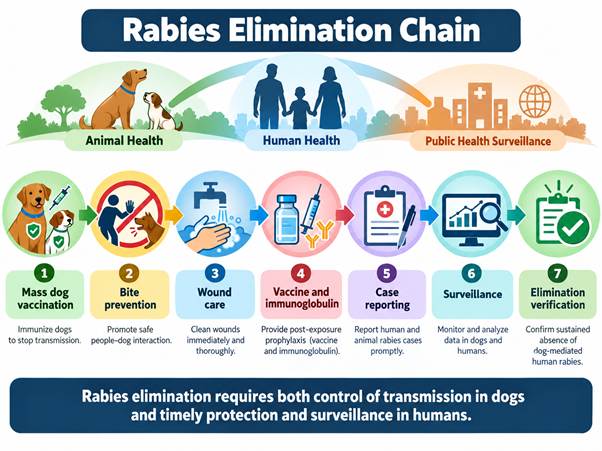
The elimination chain is:
Dog vaccination → bite prevention → prompt PEP → complete treatment → case notification → surveillance → verification of transmission interruption
The Core Policy Lesson
The major problem is not simply that two datasets give different death counts.
The deeper issue is that routine systems may miss deaths occurring outside formal healthcare and certification networks.
India’s 2030 target therefore requires stronger notification, integrated surveillance, death certification, dog vaccination, timely PEP, treatment completion and community awareness.
The central public-health principle is:
A disease cannot be credibly eliminated if the health system cannot reliably detect and count it.
Probable Mains Question
“For elimination of a zoonotic disease, surveillance quality can be as important as treatment availability.” Discuss with reference to India’s rabies-control strategy and the gap between reported and estimated mortality.
Prelims Drill
MCQ 1
With reference to rabies, consider the following statements:
- Rabies is a viral zoonotic disease.
- Once clinical symptoms appear, rabies is almost invariably fatal.
- Post-exposure prophylaxis may include wound care, vaccination and rabies immunoglobulin.
- Human rabies is transmitted mainly through the bite or saliva exposure of infected mammals.
Which of the statements given above are correct?
A. 1 and 2 only
B. 1, 2 and 3 only
C. 1, 2, 3 and 4
D. 2, 3 and 4 only
Correct Answer: C
Explanation: Rabies is a viral zoonosis transmitted mainly through saliva of infected mammals, commonly through bites. Prompt wound care, vaccination and immunoglobulin where indicated can prevent disease after exposure, but clinical rabies is almost invariably fatal.
MCQ 2
With reference to public-health surveillance, consider the following statements:
- A notifiable disease is generally subject to a legal requirement for reporting by designated persons or institutions.
- Disease-surveillance data necessarily capture every case occurring in the population.
- Modelled disease-burden estimates may include cases or deaths missed by routine reporting systems.
- Surveillance systems are useful for detecting unusual clusters and initiating outbreak response.
Which of the statements given above are correct?
A. 1 and 4 only
B. 1, 3 and 4 only
C. 2 and 3 only
D. 1, 2, 3 and 4
Correct Answer: B
Explanation: Notification creates a legal reporting obligation, while surveillance systems can still miss cases that are never detected or reported. Modelled estimates may therefore capture probable burden beyond routine surveillance, and surveillance remains essential for identifying outbreaks and guiding public-health response.
More Current Affairs - Daily
- Election Commission of India: Constitutional Design and Evolution into a Three-Member Body 12 Oct 2026
- Loknayak Jayaprakash Narayan: Total Revolution and Contribution to Democracy 12 Oct 2026
- India’s Russia-Ukraine Initiative: From Black Sea Security to Strategic Autonomy 12 Oct 2026
- Jayaprakash Narayan: Architect of Total Revolution and Defender of Democracy 12 Oct 2026