
Public Executions and State Power
Public executions historically demonstrated state authority and deterrence. Modern penal systems have shifted punishment towards regulated institutions, due process and human dignity.
Public Executions and State Power
- Syllabus Mapping: GS Paper I — World History and Enlightenment; GS Paper IV — State Power, Punishment and Human Dignity.
- Source & Date: The Indian Express, 16 October 2026.
Why in News?
U.S. President Donald Trump has withdrawn approval for livestreaming the scheduled execution of former Army Major Nidal Hasan, who was convicted for killing 13 people at Fort Hood in 2009. Hasan is scheduled to be executed by firing squad on December 3, but the execution will no longer be publicly streamed.
The controversy has revived an old debate about whether punishment should publicly demonstrate state authority or remain a controlled legal process.
Punishment as State Power
In ancient and pre-modern societies, serious crimes were often treated as challenges to the authority of the ruler. Public executions therefore served not only to punish an offender but also to demonstrate the power of the State.
Roman executions were often deliberately visible. Public ceremonies, proclamations and the presence of large crowds transformed punishment into a political spectacle. Authorities also believed that visible suffering would discourage others from committing similar crimes.
However, public punishment carried a risk. If the crowd sympathised with the condemned person, the spectacle could weaken rather than strengthen state authority.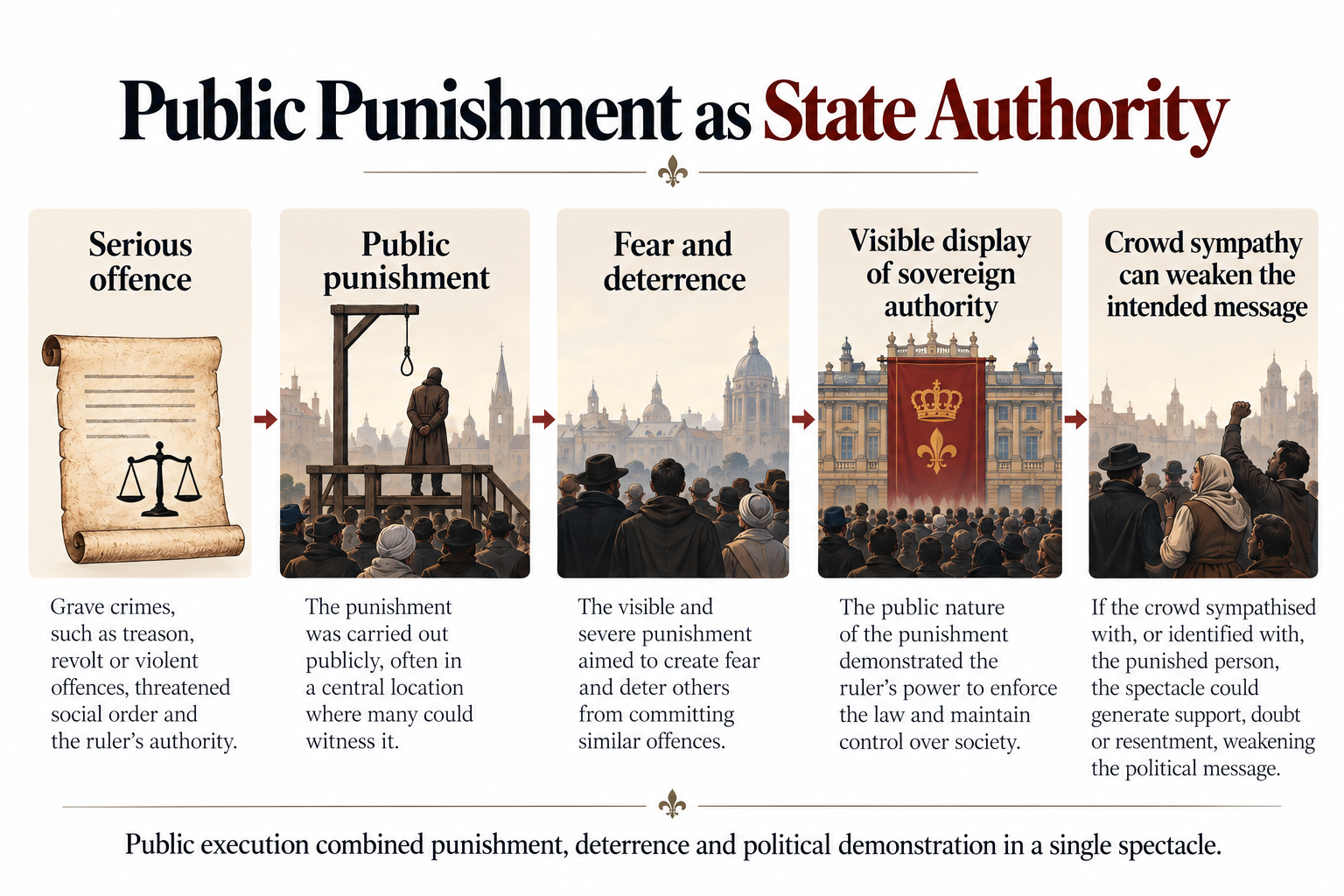
Punishment and Colonial Control
Public punishment was also used to control conquered populations. After the Revolt of 1857, British authorities publicly executed Indian rebels.
Such punishment carried a political message beyond the individual offence. It sought to demonstrate colonial superiority and discourage further resistance.
This shows that punishment can become an instrument of political control when the State uses fear to reinforce obedience.
The Enlightenment Shift
During the eighteenth and nineteenth centuries, Enlightenment ideas promoted rationality, humanism and individual rights. Public executions increasingly appeared brutal and disorderly.
Britain formally ended public executions in 1868, while executions in the United States gradually moved behind prison walls. The 1936 execution of Rainey Bethea is generally regarded as the last legal public execution in the U.S.
The focus slowly changed from displaying suffering to administering punishment through institutions.
Foucault and Modern Punishment
French philosopher Michel Foucault, in Discipline and Punish, argued that this transformation did not mean state power disappeared.
Earlier rulers exercised power visibly on the body of the condemned person. Modern states increasingly relied on prisons, surveillance, supervision and institutional discipline.
The important change was therefore in the method of control. Public violence became less central, while continuous institutional regulation became more important.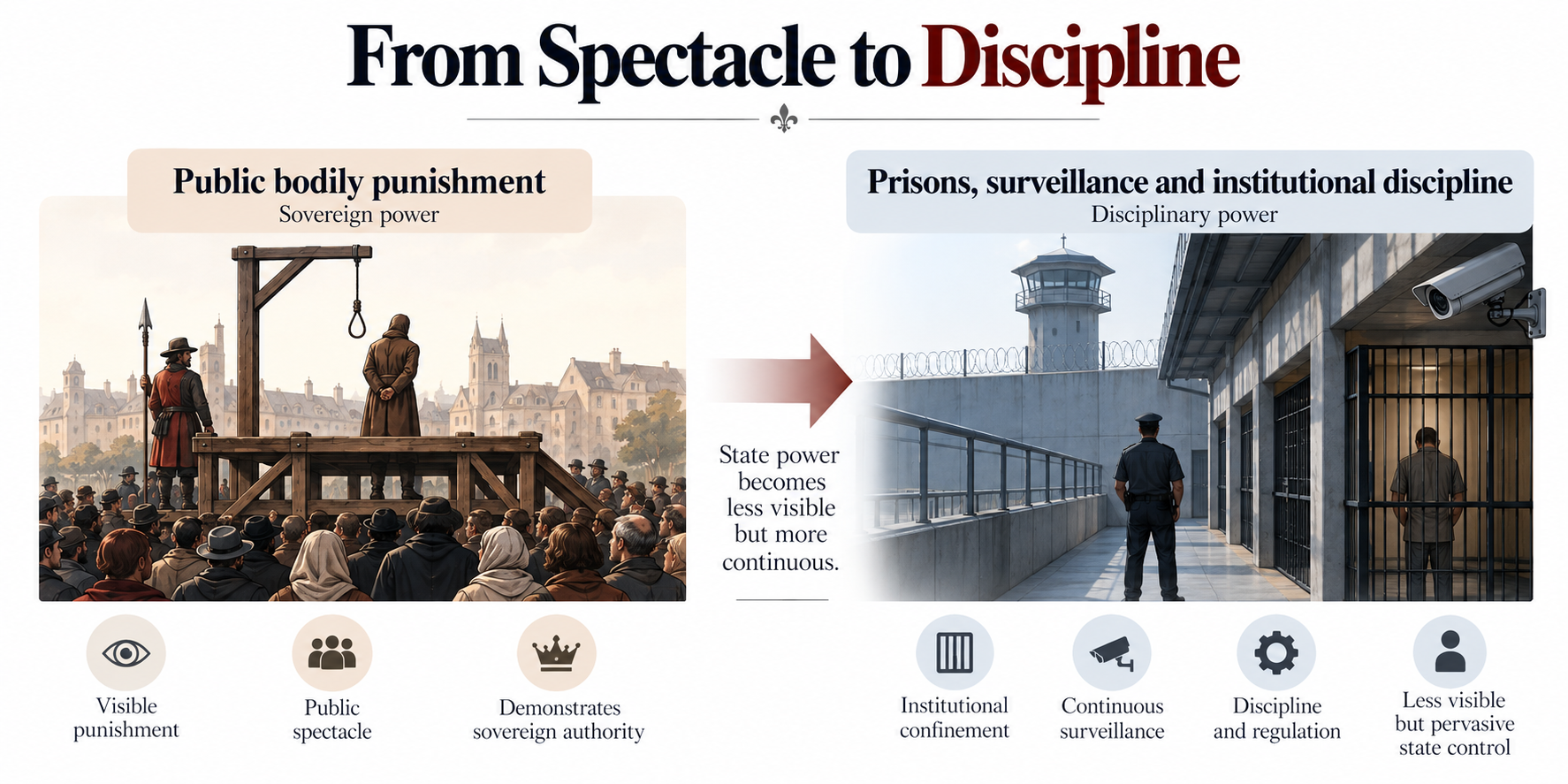
Deterrence and Human Dignity
Supporters of public punishment have often argued that visibility strengthens deterrence. However, whether public executions create additional deterrence remains disputed.
Modern constitutional systems increasingly judge punishment through due process, proportionality and human dignity, rather than through the public visibility of suffering.
India retains capital punishment, but the Supreme Court treats death as an exceptional sentence. In Bachan Singh v. State of Punjab, it developed the “rarest of rare” doctrine. Later judgments have reiterated that life imprisonment is the rule and death is an exceptional punishment.
Core Policy Lesson
The decline of public executions reflects a deeper transformation in state power. Earlier governments displayed authority through visible punishment. Modern constitutional states increasingly seek legitimacy through legal procedure, institutional restraint and respect for human dignity.
Probable Mains Question
“The decline of public executions reflects a transformation in the nature of state power rather than merely a change in methods of punishment.” Discuss with reference to Enlightenment ideas and Michel Foucault.
Prelims Drill
MCQ 1
With reference to the evolution of theories and practices of punishment, consider the following statements:
- Public executions in pre-modern societies could serve both deterrent and political functions.
- Michel Foucault associated the rise of modern prisons with the disappearance of State control over individuals.
- Enlightenment thought contributed to criticism of punishment based primarily on public spectacle.
Which of the statements given above are correct?
A. 1 and 2 only
B. 1 and 3 only
C. 2 and 3 only
D. 1, 2 and 3
Correct Answer: B
Explanation: Public punishment served deterrent as well as political purposes. Foucault argued that state control changed form and increasingly operated through institutions and discipline; he did not argue that it disappeared.
MCQ 2
With reference to capital punishment in India, consider the following statements:
- Life imprisonment is ordinarily treated as the rule, while the death penalty is an exceptional punishment.
- The “rarest of rare” doctrine requires courts to consider circumstances relating only to the nature of the crime.
- Constitutional concern for human dignity remains relevant even when a court considers imposing the death penalty.
Which of the statements given above are correct?
A. 1 only
B. 2 only
C. 1 and 3 only
D. 1, 2 and 3
Correct Answer: C
Explanation: The death penalty is an exceptional sentence. The sentencing process must consider both the crime and the circumstances of the offender, including mitigating factors. Human dignity remains central to the constitutional approach to capital punishment.