
Political Party Finance in India: RUPPs, Tax Exemptions and Transparency Gaps
India’s political-finance framework combines registration, recognition, donations, taxation and disclosure rules, but RUPPs and large political contributions continue to expose significant accountability gaps.
Political Party Finance in India: RUPPs, Tax Exemptions and Transparency Gaps
- Syllabus Mapping: GS Paper II — Representation of the People Act, Election Commission, Electoral Reforms, Transparency and Democratic Institutions; GS Paper IV — Integrity and Accountability in Public Life.
- Source & Date: The Hindu opinion by former Election Commissioner Ashok Lavasa, 25 September 2026, supplemented by ECI, Supreme Court, Income Tax Department, ADR and CHRI material.
Why Is Political-Party Finance in Focus?
A recent BBC investigation examined six Registered Unrecognised Political Parties (RUPPs) that together reported roughly ₹1,700 crore in donations in FY2023-24, despite limited electoral activity.
This has revived questions about whether some registered parties can function primarily as financial vehicles rather than serious electoral organisations.
ADR had earlier found that declared RUPP income rose sharply in FY2022-23, while only 739 of 2,764 RUPPs had relevant financial records available for analysis.
What Is an RUPP?
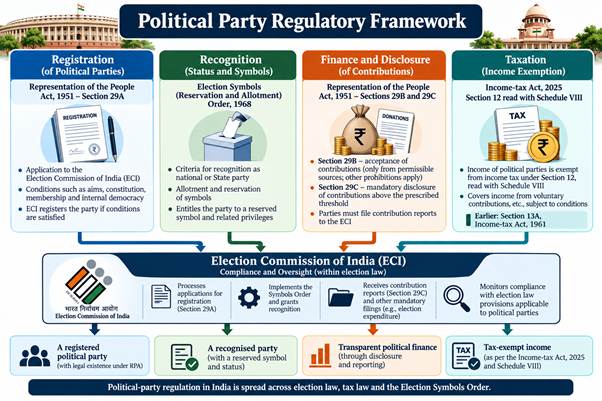
Political parties register with the Election Commission under Section 29A of the Representation of the People Act, 1951.
A party may be:
Registered and recognised as a National or State Party, or
Registered but unrecognised, called an RUPP.
Recognition is linked to electoral performance under the Election Symbols (Reservation and Allotment) Order, 1968.
Thus:
Registration ≠ recognition
An RUPP is still a legally registered political party even though it does not satisfy the criteria for National or State Party recognition.
Can the ECI Deregister a Political Party?
The Supreme Court in Indian National Congress (I) v. Institute of Social Welfare (2002) held that the ECI does not possess a general power to deregister a political party merely for later non-compliance with its commitments.
Limited exceptions include cases such as registration obtained by fraud, fundamental changes destroying the basis of registration, or comparable situations where no detailed adjudicatory inquiry is required.
Therefore:
Delisting ≠ deregistration
The ECI’s 2025 orders delisting RUPPs must be understood separately from cancellation of statutory registration. ECI records show successive delisting exercises during 2025.
How Are Political Donations Regulated?
Under Section 29B of the RPA, registered political parties may accept contributions subject to statutory restrictions.
Political parties also receive favourable tax treatment under Section 13A of the Income-tax Act, provided prescribed conditions relating to accounts, donor records and audit are met.
This creates a strong public-interest argument for financial transparency because tax exemptions effectively involve foregone public revenue.
A CHRI-linked study estimated that tax concessions on political donations resulted in about ₹11,813 crore of foregone revenue over a decade.
How Large Are Political-Party Finances?
A CHRI study of 22 parties found that they collectively had about ₹18,742 crore available during the 2024 general election period, raised around ₹7,416 crore during the campaign, and reported spending about ₹3,862 crore during that period.
These figures show that modern elections operate within a very large financial ecosystem extending beyond individual candidate expenditure.
What Changed After Electoral Bonds?
In Association for Democratic Reforms v. Union of India (2024), the Supreme Court struck down the Electoral Bond Scheme and related amendments enabling anonymous political funding.
The Court held that non-disclosure of political-funding information violated citizens’ Article 19(1)(a) right to information, while unlimited corporate contributions were arbitrary under Article 14.
The judgment therefore established an important principle:
Political funding transparency is linked to the voter’s right to make an informed democratic choice.
Where Are the Main Regulatory Gaps?
India’s political-finance architecture remains fragmented across:
ECI registration + Symbols Order recognition + RPA contribution rules + Income-tax exemptions + party audits + election-expenditure reporting
Major concerns include:
- weak disclosure compliance among many RUPPs,
- limited scrutiny of accounts filed by political parties,
- no general ECI power to deregister inactive parties,
- no comprehensive ceiling on total political-party campaign expenditure,
- and difficulty tracing the purpose and economic logic of very large donations to electorally marginal parties.
What Reforms Are Being Proposed?
Ashok Lavasa argues for stronger auditing, expenditure controls, a digital disclosure portal, tighter tax treatment and automatic deregistration of persistently inactive RUPPs.
These are reform proposals, not current law.
Any automatic deregistration mechanism would likely require statutory change, given the Supreme Court’s interpretation of the ECI’s existing powers.
A durable reform framework could therefore focus on:
standardised disclosures + real-time digital reporting + independent audit + stronger tax scrutiny + clearer deregistration law + limits on political-party election expenditure
The core democratic principle is:
Political parties seek public power, so their financing cannot be treated as an entirely private matter.
Probable Mains Question
“The regulation of political finance is central to electoral integrity because political parties perform public democratic functions while operating through largely private organisational structures.” Discuss with reference to RUPPs, tax exemptions and recent judicial developments in political funding.
Prelims Drill
MCQ 1
With reference to political parties in India, consider the following statements:
- Political parties are registered with the Election Commission under Section 29A of the Representation of the People Act, 1951.
- Every registered political party is automatically recognised as either a National Party or a State Party.
- Recognition of political parties is governed by the Election Symbols (Reservation and Allotment) Order, 1968.
Which of the statements given above are correct?
A. 1 only
B. 1 and 3 only
C. 2 and 3 only
D. 1, 2 and 3
Correct Answer: B
Explanation: A party can remain registered while being unrecognised, which is the basis of the RUPP category. Recognition depends on electoral-performance criteria under the Symbols Order.
MCQ 2
With reference to political-party finance in India, consider the following statements:
- Section 13A of the Income-tax Act provides specified tax treatment for political parties subject to conditions.
- The Supreme Court declared the Electoral Bond Scheme unconstitutional in 2024.
- The Election Commission currently possesses an unrestricted statutory power to deregister any inactive political party.
Which of the statements given above are correct?
A. 1 only
B. 1 and 2 only
C. 2 and 3 only
D. 1, 2 and 3
Correct Answer: B
Explanation: Section 13A provides conditional tax benefits, and the Supreme Court struck down the Electoral Bond Scheme in 2024. The ECI does not possess a general unrestricted deregistration power under the existing statutory framework

More Current Affairs - Daily
- Election Commission of India: Constitutional Design and Evolution into a Three-Member Body 12 Oct 2026
- Loknayak Jayaprakash Narayan: Total Revolution and Contribution to Democracy 12 Oct 2026
- India’s Russia-Ukraine Initiative: From Black Sea Security to Strategic Autonomy 12 Oct 2026
- Jayaprakash Narayan: Architect of Total Revolution and Defender of Democracy 12 Oct 2026