
Current Affairs - Daily
8 October 2026
Nobel Prize in Chemistry 2026: Chiral Chemistry and Autocatalysis
The 2026 Nobel Prize in Chemistry was awarded to Henri B. Kagan and Kenso Soai for their work on non-linear effects and autocatalysis in asymmetric organic synthesis.
Why in News?
- The Nobel Prize in Chemistry 2026 has been awarded to Henri B. Kagan and Kenso Soai for their work on non-linear effects and autocatalysis in asymmetric organic synthesis.
- Their research helps explain how chemical reactions can produce more of one form of a molecule than its mirror-image form.
What are Chiral Molecules?
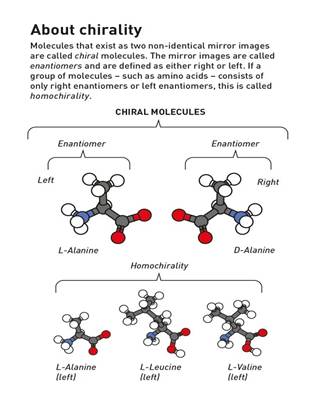
- Some molecules exist in two forms that are mirror images of each other. These forms are called enantiomers.
- Although enantiomers have the same chemical composition, their three-dimensional structures differ.
- This difference can be important because biological systems may respond differently to the two forms.
Origin of the Problem
- In the 19th century, Louis Pasteur observed that tartaric acid existed in two mirror-image forms.
- This raised an important question: why does life generally use only one form of many molecules?
- For example, naturally occurring amino acids are predominantly one-handed, while sugars in DNA and other biological systems show the opposite preference.
Kagan’s Contribution
- In the 1980s, Henri Kagan identified non-linear effects in asymmetric reactions.
- He showed that catalysts containing different combinations of chiral molecules could behave differently.
- This demonstrated that a small initial difference in molecular handedness could potentially be amplified.
Soai’s Contribution
- Kenso Soai developed this idea further through autocatalysis, where a product of a reaction helps produce more of itself.
- His experiments showed that a small initial excess of one molecular form could become much larger through a self-reinforcing process.
- This work became associated with the Soai reaction, an important example of asymmetric autocatalysis.
Significance
- The research has applications in producing highly pure enantiomers.
- This is particularly important in industries dealing with pharmaceuticals, flavours, fragrances and agricultural chemicals.
- The work also contributes to scientific understanding of homochirality, or the predominance of one molecular form in living systems.
Chirality
- Chirality is a property of an object or molecule that makes it non-superimposable on its mirror image.
- Chiral molecules usually contain a stereogenic centre, often a carbon attached to four different groups.
- The two mirror-image forms are called enantiomers.
- Chirality is important in biological systems because different enantiomers can have different activities.
Asymmetric Synthesis
- Asymmetric synthesis is a chemical process that preferentially produces one enantiomer or stereoisomer over another.
- It uses chiral catalysts, reagents, enzymes, or auxiliaries to control stereochemistry.
- Its major goal is to obtain molecules with high enantioselectivity.
- It is particularly important in pharmaceutical and natural-product synthesis.
Asymmetric Reactions
- Asymmetric reactions are chemical reactions in which unequal amounts of stereoisomers, especially enantiomers, are formed.
- They involve stereochemical control during bond formation or transformation.
- Chiral catalysts, ligands, enzymes, or reagents can direct this selectivity.
- Examples include asymmetric hydrogenation, epoxidation, and reduction reactions.
Autocatalysis
- Autocatalysis occurs when a product of a chemical reaction acts as a catalyst for the same reaction.
- The reaction can therefore accelerate as more product is formed.
- In some systems, autocatalysis can generate strong amplification of small initial differences.
- Asymmetric autocatalysis can produce significant enantioenrichment from a very small chiral imbalance.
Practice Question
Q. With reference to chirality, asymmetric synthesis and autocatalysis, consider the following statements:
- Enantiomers have identical three-dimensional arrangements but differ in their chemical composition.
- In asymmetric synthesis, chiral catalysts or reagents can be used to preferentially produce one enantiomer over another.
- Autocatalysis refers to a reaction in which the product formed acts as a catalyst for the same reaction.
- Asymmetric autocatalysis can amplify a small initial excess of one enantiomer and result in significant enantioenrichment.
Which of the statements given above are correct?
(a). 1 and 2 only
(b). 2, 3 and 4 only
(c). 1, 3 and 4 only
(d). 2 and 4 only
Answer: B. 2, 3 and 4 only
Explanation
- Enantiomers have the same chemical composition and connectivity but differ in their three-dimensional arrangement. Hence, Statement 1 is incorrect.
- Asymmetric synthesis uses chiral catalysts, reagents, enzymes or auxiliaries to preferentially produce one enantiomer. Hence, Statement 2 is correct.
- In autocatalysis, the product of a reaction acts as a catalyst for the same reaction, allowing the reaction to accelerate as more product is formed. Hence, Statement 3 is correct.
- Asymmetric autocatalysis can amplify a small initial chiral imbalance, producing a much higher proportion of one enantiomer. Hence, Statement 4 is correct.
More Current Affairs - Daily
- Election Commission of India: Constitutional Design and Evolution into a Three-Member Body 12 Oct 2026
- Loknayak Jayaprakash Narayan: Total Revolution and Contribution to Democracy 12 Oct 2026
- India’s Russia-Ukraine Initiative: From Black Sea Security to Strategic Autonomy 12 Oct 2026
- Jayaprakash Narayan: Architect of Total Revolution and Defender of Democracy 12 Oct 2026