
Nepal’s Climate Call and India: Loss and Damage, Himalayan Risk and Regional Cooperation
Nepal’s 2026 flood disaster has intensified debate over climate justice, loss-and-damage finance and the need for deeper Himalayan cooperation on resilience, data and disaster financing.
Nepal’s Climate Call and India: Loss and Damage, Himalayan Risk and Regional Cooperation
- Syllabus Mapping: GS Paper II — India and its Neighbourhood, International Institutions; GS Paper III — Climate Change, Disaster Management, Infrastructure and Environment.
- Source & Date: The Indian Express opinion, 22 September 2026, supplemented by Government of Nepal, UN, GCF and UNFCCC sources. The opinion argues for moving beyond episodic disaster relief toward regional climate-risk financing.
Why Nepal’s Climate Appeal Matters
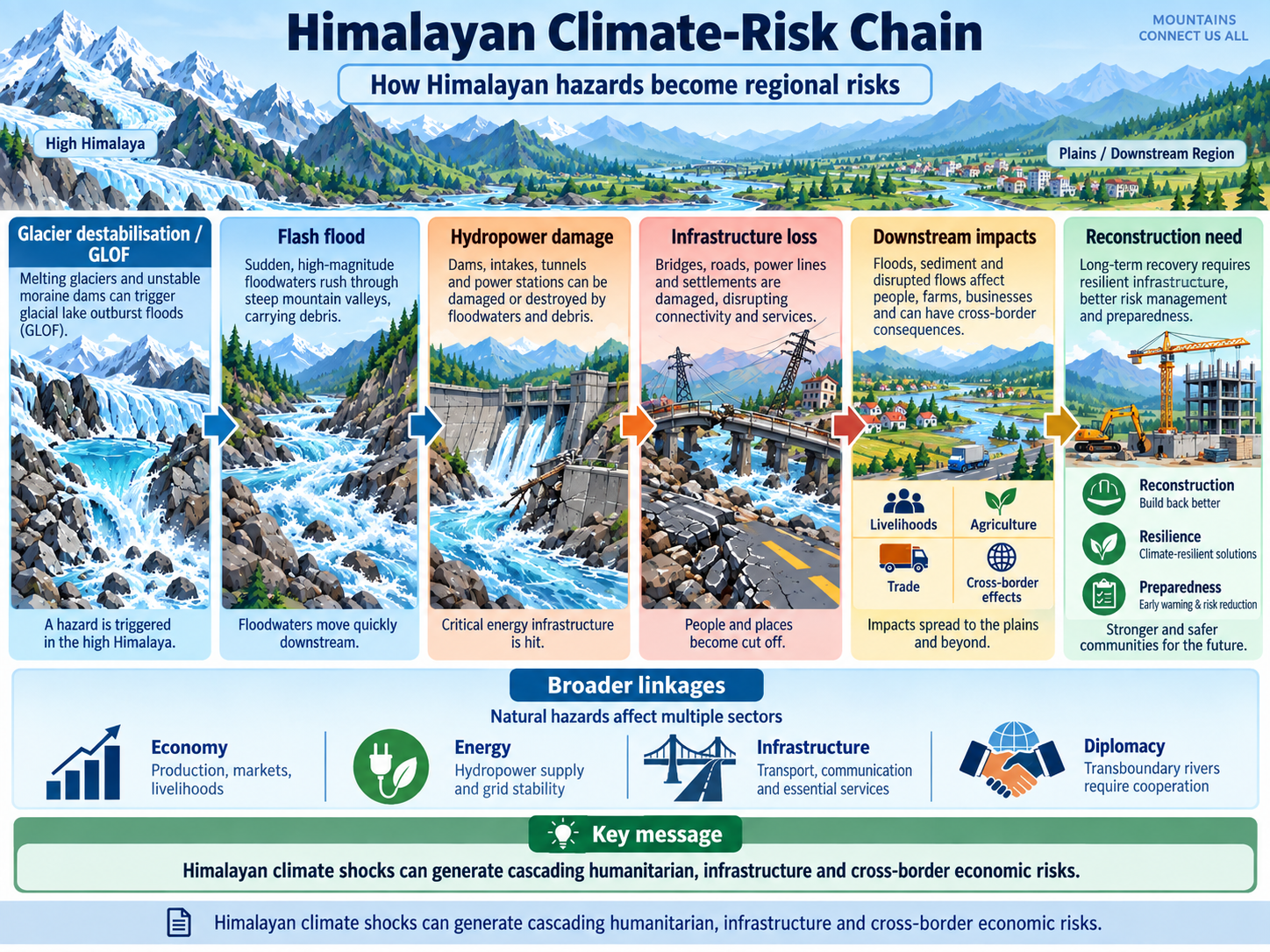
The 26 August 2026 disaster devastated the Bhote Koshi–Trishuli corridor, damaging settlements, roads, agriculture and hydropower infrastructure. Nepal’s government estimates about $1.8 billion in physical damage, $883 million in losses and $4.78 billion in reconstruction needs.
Nepal has approached the Fund for Responding to Loss and Damage (FRLD), arguing that countries contributing relatively little to global emissions nevertheless face severe climate impacts.
This shifts the diplomatic discussion from:
Emergency relief → reconstruction finance → climate justice → long-term resilience
What Is Loss and Damage?
Loss and Damage refers to climate impacts that cannot be fully avoided through mitigation or adaptation.
The FRLD was created to support developing countries particularly vulnerable to climate change. Nepal’s request is currently under consideration.
It differs from ordinary disaster aid because it is linked to the broader climate-justice argument that those with greater historical responsibility and capacity should contribute more.
India has consistently invoked equity, historical responsibility and Common But Differentiated Responsibilities and Respective Capabilities (CBDR-RC) while arguing that developed countries should lead on climate finance and technology transfer.
Why Global Finance Is Seen as Too Slow
Nepal’s experience illustrates a recurring criticism of multilateral climate finance.
A $49.9 million Green Climate Fund project for GLOF and climate-flood resilience received its concept note in 2018, Board approval only in July 2025, and became effective in March 2026.
For fast-moving Himalayan risks, long approval cycles can leave a gap between:
Risk identified → finance approved → infrastructure actually built
This helps explain calls for faster regional financing instruments.
Why India Is Directly Exposed
India and Nepal are linked by shared river systems, cross-border electricity trade and hydropower investment.
Indian entities are involved in major Nepalese projects such as the 900 MW Arun-III and 900 MW Upper Karnali projects.
The 2026 floods affected 13 hydropower projects and around 783 MW of capacity, demonstrating how Himalayan disasters can simultaneously create humanitarian, energy and economic disruption.
Thus Himalayan resilience is not only an environmental issue; it concerns:
Energy security + infrastructure protection + disaster management + bilateral relations
India’s Policy Dilemma
One approach would be to retain a distinction between:
Global climate liability, where India continues to stress developed-country responsibility,
and
Regional resilience cooperation, where India can participate without accepting fault-based compensation.
This distinction matters because accepting general legal liability for neighbouring climate losses could have implications beyond one disaster.
At the same time, limited regional cooperation could leave shared infrastructure and populations more exposed to transboundary risks.
What Could a Regional Mechanism Look Like?
The proposes a South Asian resilience and insurance facility rather than direct compensation.
Possible design features include:
- Parametric insurance: rapid payouts when an agreed rainfall, glacier, flood or satellite threshold is crossed.
- Concessional reconstruction window: financing for disasters that have already occurred.
- Resilience component: part of infrastructure investment earmarked for slope stabilisation, adaptation and resilient local works.
- Shared early-warning platform: satellite, river and glacial-lake data available across borders.
- Multilateral capitalisation: possible participation of institutions such as AIIB, NDB or BIMSTEC, reducing reliance on one donor.
These remain policy proposals, not existing regional arrangements.
Key Design Challenges
Basis risk: A trigger may fail to match actual damage.
Fix: Combine automatic payout with rapid ground verification.
Dominant-funder problem: If India finances most of the pool, it may resemble bilateral aid.
Fix: Multilateral capitalisation and graduated contributions.
Regional politics: Institutional tensions may block cooperation.
Fix: Use narrower functional platforms focused specifically on disaster resilience.
Sensitive data: Hydrological information may be treated strategically.
Fix: Pre-agreed automatic data-sharing protocols.
The Larger Significance
Nepal’s climate appeal raises a broader Himalayan governance question:
Can South Asia move from post-disaster assistance to pre-arranged risk sharing?
COP31 will be held in Antalya from 9–20 November 2026, making climate finance and implementation highly relevant to the wider debate.
For UPSC, the issue links neighbourhood policy, CBDR, climate finance, disaster diplomacy and transboundary ecological security.
Probable Mains Question
“Himalayan climate risks are transforming disaster relief into an issue of regional climate finance and strategic cooperation.” Discuss with reference to Nepal’s recent Loss and Damage appeal and its implications for India.
Prelims Drill
MCQ 1
With reference to climate “Loss and Damage”, consider the following statements:
- It concerns climate impacts that cannot always be fully prevented through mitigation or adaptation.
- The Fund for Responding to Loss and Damage is intended to support particularly vulnerable developing countries.
- Loss and Damage is identical to mitigation finance for reducing greenhouse-gas emissions.
Which of the statements given above are correct?
A. 1 only
B. 1 and 2 only
C. 2 and 3 only
D. 1, 2 and 3
Correct Answer: B
Explanation: Loss and Damage addresses unavoidable or residual climate impacts, whereas mitigation finance primarily aims to reduce emissions. Nepal has approached the FRLD following the 2026 disaster.
MCQ 2
Consider the following statements:
- Parametric insurance pays solely after a conventional assessment of every item of physical loss.
- The Green Climate Fund finances both mitigation and adaptation activities.
- India has invoked CBDR-RC and historical responsibility in international climate negotiations.
Which of the statements given above are correct?
A. 1 only
B. 2 only
C. 2 and 3 only
D. 1, 2 and 3
Correct Answer: C
Explanation: Parametric insurance is generally linked to a predefined measurable trigger rather than waiting for a complete loss assessment. India has consistently invoked equity and CBDR-RC, while the GCF supports climate mitigation and adaptation finance.
More Current Affairs - Daily
- Election Commission of India: Constitutional Design and Evolution into a Three-Member Body 12 Oct 2026
- Loknayak Jayaprakash Narayan: Total Revolution and Contribution to Democracy 12 Oct 2026
- India’s Russia-Ukraine Initiative: From Black Sea Security to Strategic Autonomy 12 Oct 2026
- Jayaprakash Narayan: Architect of Total Revolution and Defender of Democracy 12 Oct 2026