
India’s Digital Tourism Push: National Digital Tourism Stack and Dekho Apna Desh 2.0
The National Digital Tourism Stack seeks to create interoperable digital infrastructure for tourism services, while Dekho Apna Desh 2.0 aims to promote lesser-known, tourism-ready destinations and distribute visitor footfall more evenly.
India’s Digital Tourism Push: National Digital Tourism Stack and Dekho Apna Desh 2.0
- Syllabus Mapping: GS Paper II — Government Policies, Digital Governance and Cooperative Federalism; GS Paper III — Tourism, Infrastructure, Digital Public Infrastructure, Employment and Sustainable Development.
- Source & Date: Ministry of Tourism and PIB, World Tourism Day, 27 September 2026; supplemented by OpenGov Asia coverage.
What Has India Launched?
India has launched two complementary tourism initiatives:
- National Digital Tourism Stack — digital infrastructure for discovering, accessing and verifying tourism services.
- Dekho Apna Desh 2.0 — promotion of tourism-ready, lesser-known destinations to achieve a more balanced distribution of tourist footfall.
The initiatives reflect a shift from promoting individual attractions towards building an integrated tourism ecosystem based on technology, destination management and community participation.
What Is the National Digital Tourism Stack?
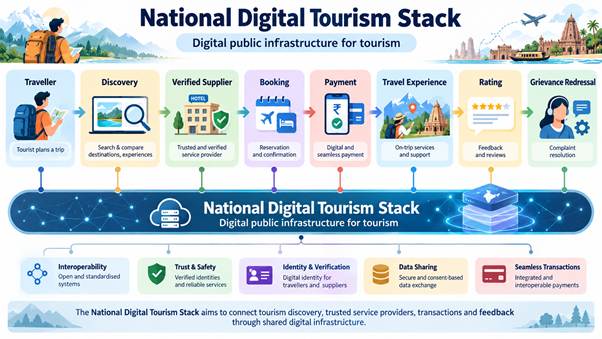
The National Digital Tourism Stack is conceived as an open digital public infrastructure layer for tourism.
It is being developed with support from the Open Network for Digital Commerce (ONDC) and the International Centre for DPI Innovation and Advancement.
Its proposed architecture includes:
verified supplier credentials + search and information services + payments + ratings + grievance redressal
The objective is not merely to create another tourism website, but to make different tourism actors digitally discoverable and interoperable.
Hotels, homestays, guides, transport providers, local experiences and other suppliers could participate through common digital infrastructure rather than depending exclusively on closed proprietary platforms.
A phased rollout is planned, with a pilot expected in January 2027.
Why Is a Digital Stack Important?
India already has several digital tourism systems.
The Incredible India Digital Platform provides destination information, virtual experiences and travel services, while NIDHI+ provides registration, recognition and classification services for tourism-sector businesses.
The new stack can potentially create a broader interoperable layer connecting:
discovery → verification → booking → payment → experience → feedback → grievance redressal
This follows India’s wider Digital Public Infrastructure approach, where common digital rails allow multiple public and private service providers to innovate over shared standards.
 What Is Dekho Apna Desh 2.0?
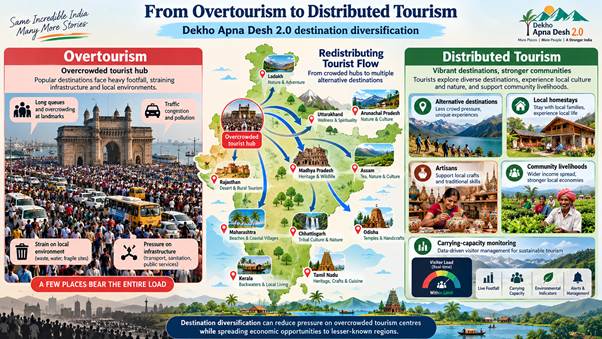
Dekho Apna Desh 2.0 seeks to redirect part of tourism demand towards lesser-known but tourism-ready destinations.
Priority categories include:
hill and mountain destinations + coastal areas and waterfalls + heritage towns + cultural centres + regional pilgrimage destinations
The aim is to create bookable itineraries combining transport, accommodation, food, local culture, crafts and experiences.
Tourism data and visitor feedback can also help authorities monitor carrying capacity and manage visitor flows more sustainably.
Why Does Destination Diversification Matter?
Concentrating tourists at a small number of destinations can produce:
traffic congestion + pressure on water and waste systems + environmental degradation + rising local prices + deterioration of visitor experience
At the same time, nearby or comparable destinations may receive little tourism income.
Diversification can therefore convert:
Overtourism at a few centres → distributed tourism across wider regions
This can also improve resilience because local tourism economies become less dependent on a handful of iconic destinations.
Community-Led Tourism
The alternative-destination strategy seeks to integrate:
artisans + self-help groups + homestays + local guides + women + youth + small entrepreneurs
This is important because tourism’s economic value depends not merely on visitor numbers but on how much expenditure remains within the local economy.
Community participation can strengthen the local multiplier effect, where tourist spending generates secondary income and employment through food, transport, handicrafts and services.
Role of Artificial Intelligence
AI can support tourism through:
personalised itineraries + multilingual assistance + demand forecasting + visitor-flow analysis + destination discovery + sentiment analysis
Data-driven destination management can help predict congestion and improve service planning.
However, digital tourism also requires safeguards relating to privacy, algorithmic bias, cybersecurity, platform concentration and exclusion of digitally weak small suppliers.
Link With Existing Tourism Policy
The initiatives complement rather than replace existing programmes.
- Swadesh Darshan 2.0 focuses on sustainable and destination-centric development.
- PRASHAD develops pilgrimage and heritage tourism infrastructure.
- NIDHI+ creates a digital registry and service-provider ecosystem.
- Incredible India Digital Platform supports destination discovery and travel planning.
The new digital stack can function as connective infrastructure across these components.
The Core Policy Principle
India’s tourism strategy is gradually shifting from: Promoting destinations → managing destination ecosystems
The success of this shift will depend on whether technology can simultaneously improve:
traveller convenience + local livelihoods + competition among service providers + environmental carrying capacity + destination sustainability
Probable Mains Question
“Digital public infrastructure can transform tourism only when improved traveller convenience is combined with destination sustainability and community participation.” Discuss with reference to India’s National Digital Tourism Stack and Dekho Apna Desh 2.0.
Prelims Drill
MCQ 1
With reference to India’s tourism initiatives, consider the following statements:
- The National Digital Tourism Stack is intended to function as open digital public infrastructure for tourism services.
- Dekho Apna Desh 2.0 seeks to promote lesser-known tourism-ready destinations.
- Swadesh Darshan 2.0 primarily follows a destination-centric and sustainable tourism approach.
Which of the statements given above are correct?
A. 1 only
B. 1 and 2 only
C. 2 and 3 only
D. 1, 2 and 3
Correct Answer: D
Explanation: The Digital Tourism Stack focuses on interoperable digital access to tourism services, Dekho Apna Desh 2.0 seeks geographical diversification of tourism, and Swadesh Darshan 2.0 follows a sustainable destination-centric development model.
MCQ 2
Consider the following statements:
- NIDHI+ is associated with registration and classification of tourism service providers.
- PRASHAD focuses on pilgrimage and heritage destination infrastructure.
- Digital Public Infrastructure necessarily requires all tourism services to be provided directly by the government.
Which of the statements given above are correct?
A. 1 only
B. 1 and 2 only
C. 2 and 3 only
D. 1, 2 and 3
Correct Answer: B
Explanation: NIDHI+ supports the digital tourism-service ecosystem, while PRASHAD develops pilgrimage and heritage destinations. Digital Public Infrastructure can provide common digital rails over which both public and private participants offer services.
More Current Affairs - Daily
- Election Commission of India: Constitutional Design and Evolution into a Three-Member Body 12 Oct 2026
- Loknayak Jayaprakash Narayan: Total Revolution and Contribution to Democracy 12 Oct 2026
- India’s Russia-Ukraine Initiative: From Black Sea Security to Strategic Autonomy 12 Oct 2026
- Jayaprakash Narayan: Architect of Total Revolution and Defender of Democracy 12 Oct 2026