
New Mining Law 2026: Why Mineral-Rich States Are Opposing It
The MMDR Amendment Act, 2026 seeks to restrict specified State levies on mineral rights and mineral-bearing land, triggering concerns among mineral-rich States over revenue autonomy and federal balance.
New Mining Law 2026: Why Mineral-Rich States Are Opposing It
- Syllabus Mapping: GS Paper II — Centre-State Relations, Fiscal Federalism and Legislative Powers; GS Paper III — Mining, Natural Resources, Infrastructure and Indian Economy.
- Source & Date: The Indian Express, 25 September 2026, supplemented by the Supreme Court’s 2024 Mineral Area Development Authority judgment and the 2026 MMDR amendment.
What Does the 2026 Law Do?
Parliament passed the Mines and Minerals (Development and Regulation) Amendment Act, 2026 in August.
The amendment seeks to prevent States from imposing specified taxes, cesses or similar levies on mineral rights and mineral-bearing land, except within conditions or limits prescribed by the Centre.
It also provides that certain unpaid or unrecovered dues arising from such levies before commencement of the amendment will be extinguished, while amounts already recovered will not be refunded. Estimates cited in reporting place the outstanding industry-wide dues at around ₹2 lakh crore, although this is not an official final liability figure.
Why Is This Linked to the 2024 Supreme Court Judgment?
In Mineral Area Development Authority v. Steel Authority of India (2024), a nine-judge Bench held by an 8:1 majority that royalty is not a tax.
The Court also held that States possess legislative power under:
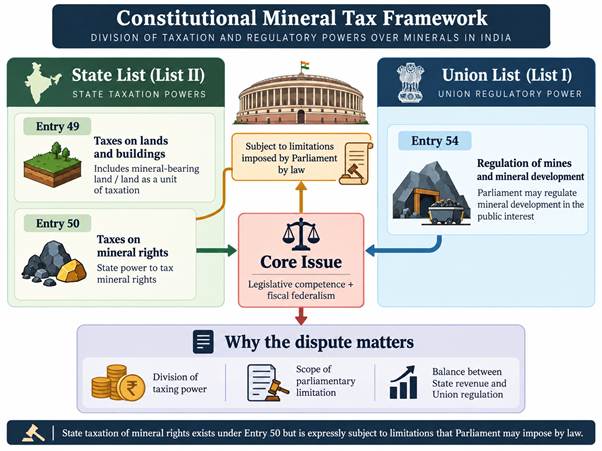
Entry 50, List II — taxes on mineral rights, subject to limitations imposed by Parliament by law relating to mineral development.
Entry 49, List II — taxes on lands and buildings, including mineral-bearing land in appropriate cases.
The judgment overruled the earlier understanding flowing from India Cement Ltd. v. State of Tamil Nadu that royalty itself was a tax.
What About Past Tax Dues?
In a follow-up order on 14 August 2024, the Supreme Court allowed States to raise or renew tax demands from 1 April 2005 onwards.
However, it directed that:
payment be staggered over 12 years from 1 April 2026, and no interest or penalty be imposed on demands relating to the period before 25 July 2024.
The 2026 amendment therefore has major implications for the retrospective revenue that some States expected to collect after the judgment.
Why Are States Opposing the Amendment?
Mineral-rich States argue that mining generates large social and environmental costs, including:
land degradation + displacement + pollution + infrastructure stress
They therefore view taxation of mineral rights and mineral-bearing land as an important part of their fiscal autonomy.
Odisha’s opposition has framed the amendment as an infringement of State financial rights, while similar concerns have been voiced in Jharkhand and other States.
For States with a large mining sector, the issue is not marginal because mineral-related receipts form a substantial share of their own non-tax revenue.
What Is the Centre’s Argument?
The Union government argues that excessive or highly divergent State levies can increase the cost of coal, iron ore, steel and other major minerals, which can then raise infrastructure and manufacturing costs.
The Mines Ministry has said existing mineral-sector levies will not disappear altogether; rather, the policy objective is to ensure that the cumulative burden does not exceed a prescribed ceiling after consultation with States.
The Centre therefore presents the law as a measure for:
cost containment + price uniformity + investment certainty + competitiveness
The Constitutional Question
The dispute turns on the relationship between three constitutional entries.
Entry 49, List II gives States power to tax lands and buildings.
Entry 50, List II gives States power to tax mineral rights, but expressly makes that power subject to limitations imposed by Parliament through a law relating to mineral development.
Entry 54, List I allows Parliament to regulate mines and mineral development to the extent declared expedient in the public interest.
The 2024 judgment held that the MMDR Act, as it then stood, did not impose the relevant limitation on State taxation under Entry 50.
The 2026 amendment can therefore be seen as Parliament attempting to expressly create such a statutory limitation.
Why Is This a Fiscal Federalism Issue?
The controversy creates a direct tension between:
**National market uniformity + lower mineral costs **and
State revenue autonomy + compensation for local environmental and social burdens
The central question is not whether either level of government has an unlimited claim.
It is how India should divide the economic gains and fiscal powers associated with natural resources within a federal system.
The Core Policy Challenge
A sustainable framework should ideally combine:
predictable national rules + consultation with States + protection against excessive levies + adequate revenue for mineral-bearing regions
The broader principle is: Minerals are nationally important economic inputs, but their extraction creates locally concentrated costs.
Probable Mains Question
“The controversy over the MMDR Amendment Act, 2026 reflects the larger tension between national economic uniformity and State fiscal autonomy.” Discuss with reference to the constitutional distribution of powers over mineral taxation.
Prelims Drill
MCQ 1
With reference to taxation of minerals under the Constitution, consider the following statements:
- Entry 50 of the State List deals with taxes on mineral rights.
- The power under Entry 50 is subject to limitations that Parliament may impose by law relating to mineral development.
- Entry 54 of the Union List directly confers a general taxation power on Parliament over mineral rights.
Which of the statements given above are correct?
A. 1 only
B. 1 and 2 only
C. 2 and 3 only
D. 1, 2 and 3
Correct Answer: B
Explanation: Entry 50 expressly concerns State taxation of mineral rights subject to parliamentary limitations, while Entry 54 is a regulatory entry relating to mines and mineral development rather than a standalone taxing entry.
MCQ 2
With reference to the Supreme Court’s 2024 Mineral Area Development Authority judgment, consider the following statements:
- The Court held that royalty is a tax.
- The Court recognised State legislative power to tax mineral rights.
- In its subsequent order, the Court permitted tax demands from 1 April 2005 onwards subject to specified safeguards.
Which of the statements given above are correct?
A. 1 only
B. 2 only
C. 2 and 3 only
D. 1, 2 and 3
Correct Answer: C
Explanation: The Court held that royalty is not a tax and recognised State taxing power over mineral rights; it later allowed demands from 1 April 2005, with staggered payment and waiver of specified interest and penalties.
More Current Affairs - Daily
- Election Commission of India: Constitutional Design and Evolution into a Three-Member Body 12 Oct 2026
- Loknayak Jayaprakash Narayan: Total Revolution and Contribution to Democracy 12 Oct 2026
- India’s Russia-Ukraine Initiative: From Black Sea Security to Strategic Autonomy 12 Oct 2026
- Jayaprakash Narayan: Architect of Total Revolution and Defender of Democracy 12 Oct 2026