
Medicine Pricing in India: DPCO, NPPA and the Affordability Challenge
India regulates prices of essential medicines through the DPCO and NPPA, but non-scheduled drugs, launch prices and supply-chain markups continue to raise major affordability concerns.
Medicine Pricing in India: DPCO, NPPA and the Affordability Challenge
- Syllabus Mapping: GS Paper II — Health, Right to Life, Welfare and Government Regulation; GS Paper III — Pharmaceutical Sector, Price Regulation and Market Governance.
- Source & Date: The Indian Express, in the context of petitions before the Supreme Court on medicine pricing.
Why Is Drug Pricing in Focus?
The Supreme Court questioned the large gap between the price at which certain medicines reach retailers and the Maximum Retail Price printed on their packs. The immediate controversy involved an essential cancer medicine reportedly supplied to retailers at around ₹2,700 while carrying an MRP close to ₹27,000.
The petitions seek tighter price regulation, enforcement of permissible margins, promotion of generic prescribing and stronger control over medicines and medical devices.
The core policy issue is:
Affordable medicines + reasonable commercial return + effective price regulation
What Is the Legal Basis for Drug Price Control?
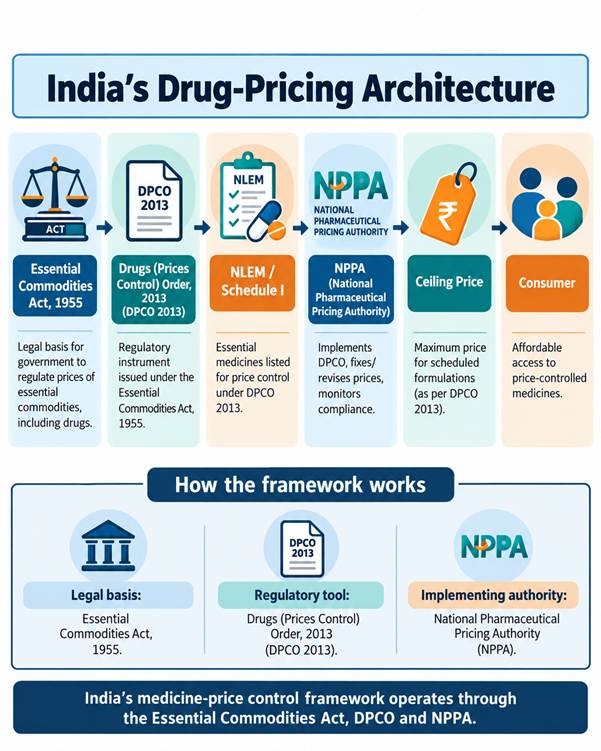
The Essential Commodities Act, 1955 empowers the Union government to regulate the production, supply, distribution and price of essential commodities, including medicines.
Using this authority, the government issued the Drugs (Prices Control) Order, 2013, or DPCO.
The National Pharmaceutical Pricing Authority (NPPA) implements the DPCO and performs functions such as fixing or revising ceiling prices, setting retail prices for certain new drugs, monitoring overcharging and recovering excess amounts where applicable.
Thus:
Essential Commodities Act → DPCO → NPPA → drug-price regulation
Scheduled vs Non-Scheduled Medicines
The DPCO divides formulations into scheduled and non-scheduled categories.
Scheduled formulations are those included in Schedule I, which is based on the National List of Essential Medicines (NLEM) prepared by the Ministry of Health and Family Welfare.
These medicines are subject to ceiling-price regulation.
Non-scheduled formulations are generally outside regular ceiling-price control. Manufacturers can set their initial MRP, but subsequent increases are restricted under the DPCO framework.
The distinction is therefore:
NLEM-linked scheduled formulation → ceiling-price control
Non-scheduled formulation → greater pricing freedom, subject to specified limits
How Is the Ceiling Price Calculated?
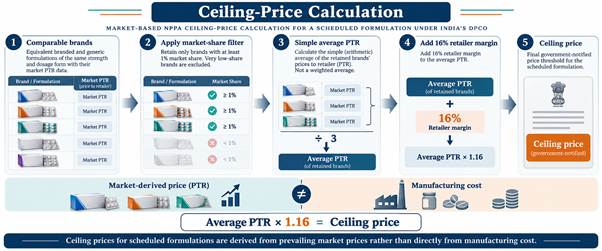
For a scheduled formulation, NPPA examines market prices of brands and generic versions with the same active ingredient, strength and dosage form.
Versions with less than 1% market share are excluded from the calculation.
NPPA then calculates the average Price to Retailer (PTR) of qualifying products and adds a 16% retailer margin.
In simplified form:
Average PTR + 16% retailer margin = ceiling price
The MRP cannot ordinarily exceed this ceiling apart from applicable taxes.
Why Are Non-Scheduled Medicines Controversial?
For non-scheduled medicines, manufacturers generally retain the freedom to determine the initial launch price.
The petitions argue that this creates a regulatory gap because a very high initial MRP can be fixed at launch, after which a cap on subsequent annual increases does little to correct the original pricing level.
This creates the policy concern:
Unregulated launch price → high initial MRP → limited usefulness of later price-increase caps
The petitions therefore seek tighter control over initial prices and supply-chain margins.
What Is the Role of NLEM?
The National List of Essential Medicines identifies medicines considered necessary for meeting priority healthcare needs.
Inclusion in the NLEM is important because it forms the basis for Schedule I of the DPCO and therefore for regular ceiling-price control.
However, only a portion of the total pharmaceutical market falls within this scheduled framework, leaving many formulations outside direct ceiling-price regulation.
Why Are Generic Medicines Relevant?
Generic medicines contain the same active ingredient as their branded equivalents but can often be sold at substantially lower prices.
The petitions raise concerns that prescribing practices and branded-market structures may reduce the affordability advantage of generics.
The wider policy objective is not simply cheaper medicines, but:
quality assurance + generic competition + rational prescribing + affordable access
Article 21 and the Right to Health
The petitions also connect medicine affordability with Article 21, arguing that access to essential treatment forms part of the broader constitutional protection of life and health.
The present litigation therefore raises a wider governance question: how far should the State regulate private pharmaceutical pricing to protect access to healthcare?
The balance is between:
Innovation and commercial viability ↔ affordability and public-health access
The Core Policy Lesson
India already has a structured system for controlling prices of essential medicines, but major gaps can emerge where products fall outside scheduled price control or where supply-chain margins become disproportionately large.
The central reform challenge is:
Essential-medicine coverage + transparent launch pricing + margin regulation + generic competition + strong enforcement
The debate before the Supreme Court is therefore not simply about one medicine or one retailer margin; it concerns how India balances pharmaceutical markets with the constitutional and public-health objective of affordable access to treatment.
Probable Mains Question
“Drug-price regulation in India must balance pharmaceutical innovation and commercial viability with the constitutional objective of affordable healthcare.” Discuss with reference to the DPCO, NPPA and the role of essential-medicine lists.
Prelims Drill
MCQ 1
With reference to drug-price regulation in India, consider the following statements:
- The Drugs (Prices Control) Order derives its regulatory basis from the Essential Commodities Act, 1955.
- The National Pharmaceutical Pricing Authority implements the DPCO.
- All medicines sold in India are subject to the same statutory ceiling price.
Which of the statements given above are correct?
A. 1 only
B. 1 and 2 only
C. 2 and 3 only
D. 1, 2 and 3
Correct Answer: B
Explanation: The DPCO operates under the Essential Commodities Act and is implemented by NPPA. However, regular ceiling-price control primarily applies to scheduled formulations, while non-scheduled medicines are governed differently.
MCQ 2
With reference to the National List of Essential Medicines and DPCO, consider the following statements:
- The NLEM is prepared by the Ministry of Health and Family Welfare.
- Schedule I of the DPCO is linked to the NLEM.
- Inclusion of a formulation in Schedule I generally brings it under ceiling-price regulation.
- NPPA directly determines whether a medicine should be included in the NLEM.
Which of the statements given above are correct?
A. 1 and 2 only
B. 1, 2 and 3 only
C. 2, 3 and 4 only
D. 1, 2, 3 and 4
Correct Answer: B
Explanation: The Ministry of Health and Family Welfare prepares the NLEM, while NPPA implements price regulation under the DPCO. Scheduled formulations based on the NLEM are generally subject to ceiling-price control; preparation of the NLEM itself is not NPPA’s function.
More Current Affairs - Daily
- Election Commission of India: Constitutional Design and Evolution into a Three-Member Body 12 Oct 2026
- Loknayak Jayaprakash Narayan: Total Revolution and Contribution to Democracy 12 Oct 2026
- India’s Russia-Ukraine Initiative: From Black Sea Security to Strategic Autonomy 12 Oct 2026
- Jayaprakash Narayan: Architect of Total Revolution and Defender of Democracy 12 Oct 2026