
The Lotus: Botanical Features and Cultural Significance
The Lotus: Botanical Features and Cultural Heritage
The lotus is an aquatic flowering plant found mainly in shallow ponds, lakes, marshes and slow-moving waters.
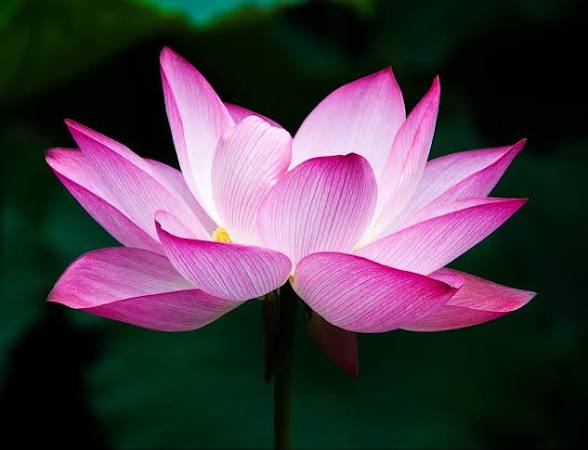
- Although it grows in muddy, low-oxygen conditions, its beauty and clean appearance have made it a symbol of purity, spiritual growth and triumph over adversity.
Botanical Features
- The lotus is a perennial aquatic plant belonging to the family Nelumbonaceae. Its underground stem, or rhizome, grows in the sediment at the bottom of water bodies. Its long, flexible leaf and flower stalks carry the leaves and flowers to the water’s surface.
- The surface of lotus leaves has microscopic structures and a waxy coating that prevent water and dust from adhering to it.
- This self-cleaning property is known as the ‘lotus effect’. The principle is used to develop water-repellent and self-cleaning surfaces.
- Lotus flowers can generate heat and regulate their temperature. This process, known as thermogenesis, may help attract pollinators.
- Lotus seeds are extremely long-lived. Scientists have successfully germinated a lotus seed around 1,300 years old.
Major Species of Lotus
Two main species are generally recognised in the genus Nelumbo.
- Indian or sacred lotus (Nelumbo nucifera) - Native to Asia and parts of Australia.
- American lotus (Nelumbo lutea) - Native to North America and the Caribbean.
The lotus and the water lily are both aquatic plants, but they belong to different botanical families.
Economic and Culinary Importance
- The lotus is India’s national flower. Its rhizomes, seeds and leaf stalks are eaten. In India, the rhizome, known as kamal kakdi, is cooked as a vegetable and used to make pickles and crisps.
- The lotus is also grown as an ornamental plant and used in traditional medicinal products.
Religious and Cultural Significance
- In Hinduism, the lotus is associated with Brahma, Vishnu, Lakshmi and Saraswati. According to Hindu mythology, Brahma appeared on a lotus that grew from Lord Vishnu’s navel. Hence, Brahma is known as Padmaja and Kamalasana, while Vishnu is called Padmanabha.
- In Buddhism, the lotus symbolises spiritual enlightenment, purity and freedom from worldly attachments. It is also significant in Jainism. The red lotus is the emblem of Padmaprabha, the sixth Tirthankara.
The Lotus in Indian Art and Architecture
- Lotus motifs were widely used on Mauryan-era Ashokan pillars, in Buddhist stupas and the Ajanta murals, and in Hindu temples and Mughal architecture.
- In Sanskrit literature, particularly in the works of Kalidasa, the lotus has symbolised beauty and purity. It forms an important part of India’s natural, religious and cultural heritage.
Question - Consider the following statements about the botanical features of the lotus.
I. The lotus rhizome is a modified root that grows in the sediment at the bottom of a body of water.
II. Microscopic structures and a waxy coating on the surface of lotus leaves are responsible for the ‘lotus effect’.
Which of the above statements is correct?
A) I only
B) II only
C) Both I and II
D) Neither I nor II
Answer - (B)
Explanation - The lotus rhizome is a modified stem that grows in the sediment at the bottom of a body of water. Microscopic structures and a waxy coating allow water droplets to roll off lotus leaves, carrying dust particles with them. This self-cleaning property is known as the ‘lotus effect’.
More Current Affairs - Daily
- MINDMAP - Delimitation: Why Use the 2011 Census Instead of 2027? 28 Nov 2026
- Left-Wing Politics in India: History, Ideology and Today 28 Nov 2026
- Dalai Lama’s Escape: From Nehru’s Dilemma to India-China Tensions 28 Nov 2026
- Cash Transfer Schemes: Welfare, Fiscal Trade-Offs and Accountability 28 Nov 2026