
Cash Transfer Schemes: Welfare, Fiscal Trade-Offs and Accountability
Cash transfers can provide immediate income support, but recurring commitments may constrain spending on education, healthcare and essential services. Rigorous prior appraisal can improve targeting, fiscal sustainability and policy effectiveness.
- Syllabus Mapping: GS Paper III — Government Budgeting, Fiscal Policy, Resource Mobilisation and Inclusive Growth; GS Paper II — Welfare Schemes, Governance and Accountability.
- Source: The Hindu, The Fiscal Cost of Cash-Transfer Schemes.
Why in News?
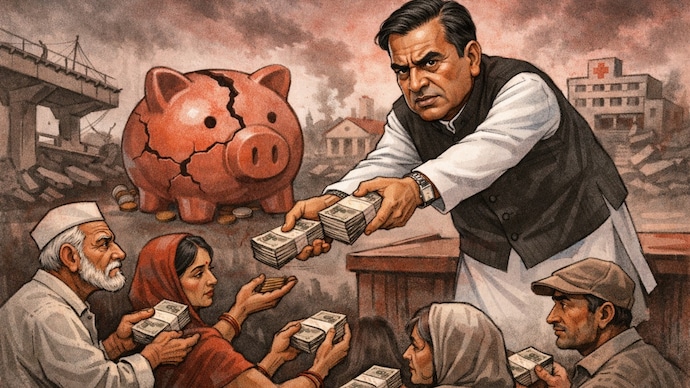
Unconditional cash transfers have become increasingly prominent in State-level electoral competition.
- 12 States were expected to spend around ₹1.68 trillion on unconditional transfers for women in 2025-26.
- This represented approximately 0.5% of India's GDP, compared with less than 0.2% two years earlier.
- RBI budget estimates placed aggregate State subsidy expenditure at ₹4.26 trillion in 2025-26, up from ₹1.87 trillion in 2018-19.
The policy debate concerns whether these schemes receive sufficient scrutiny before becoming recurring fiscal commitments.
Why Do Cash Transfers Create Fiscal Trade-Offs?
Cash transfers can raise disposable income, support consumption and provide immediate relief to vulnerable households.
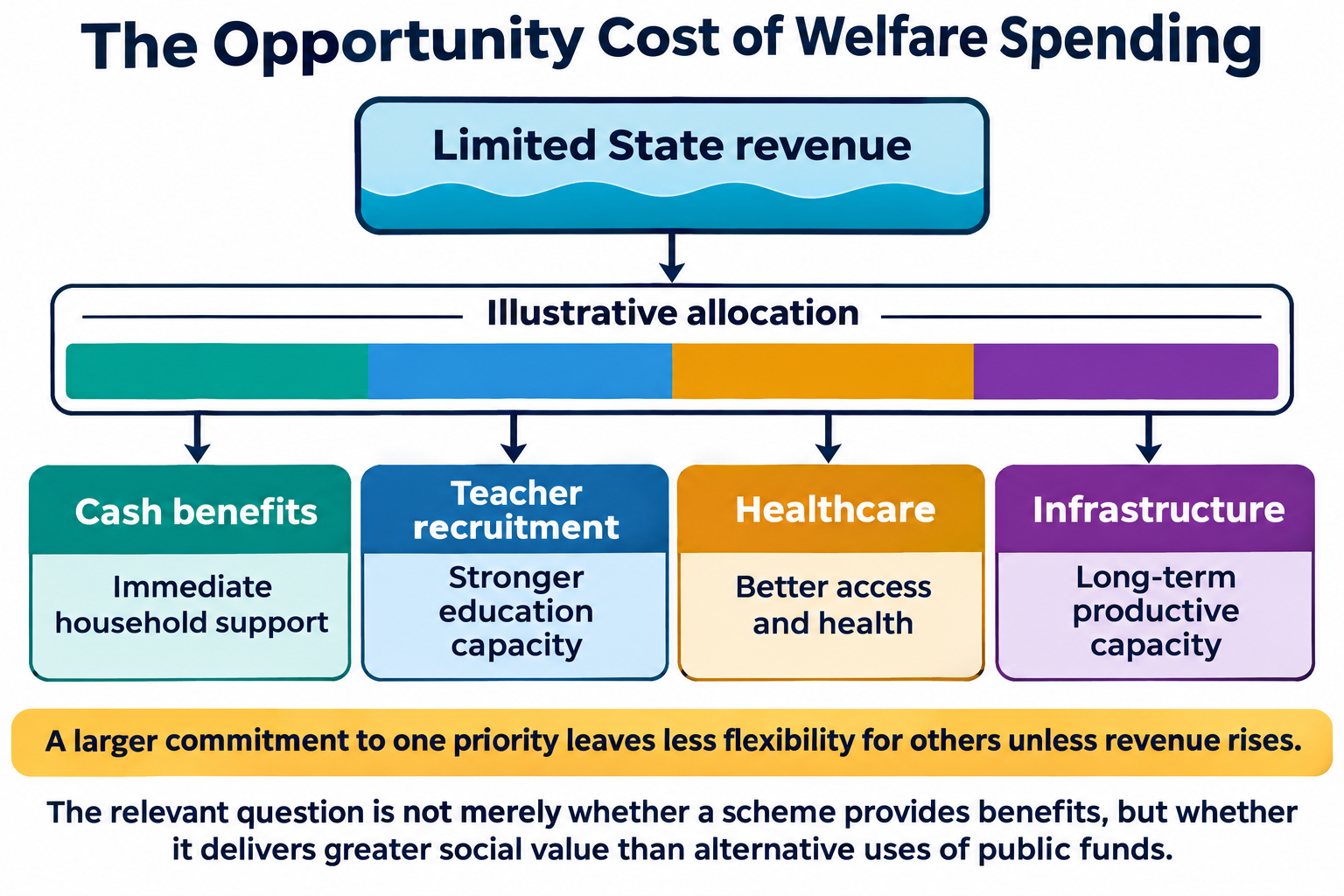
However, public resources are limited.
- Opportunity cost: Money allocated to recurring transfers cannot simultaneously finance other priorities.
- Fiscal rigidity: Regular payments become politically difficult to withdraw.
- Crowding out: Governments may postpone recruitment, infrastructure or essential service expenditure.
- Deficit pressure: Unfunded commitments may increase borrowing or force spending cuts.
The higher-education scholarships in Tamil Nadu with long-standing teaching vacancies, illustrating why financing student access without adequate institutional capacity may limit educational outcomes.
Why Is Prior Evaluation Necessary?
Infrastructure projects usually require a Detailed Project Report (DPR) covering objectives, costs, alternatives and risks.
Social programmes should undergo comparable ex ante appraisal, meaning assessment before implementation.
Such evaluation should examine:
- actual needs and intended beneficiaries;
- alternative programme designs;
- expected social and economic benefits;
- behavioural responses and implementation risks;
- long-term affordability under realistic revenue projections.
This creates an evidence base against which legislatures, auditors and citizens can subsequently assess performance.
Universal vs Targeted Transfers: The Economic Trade-Off
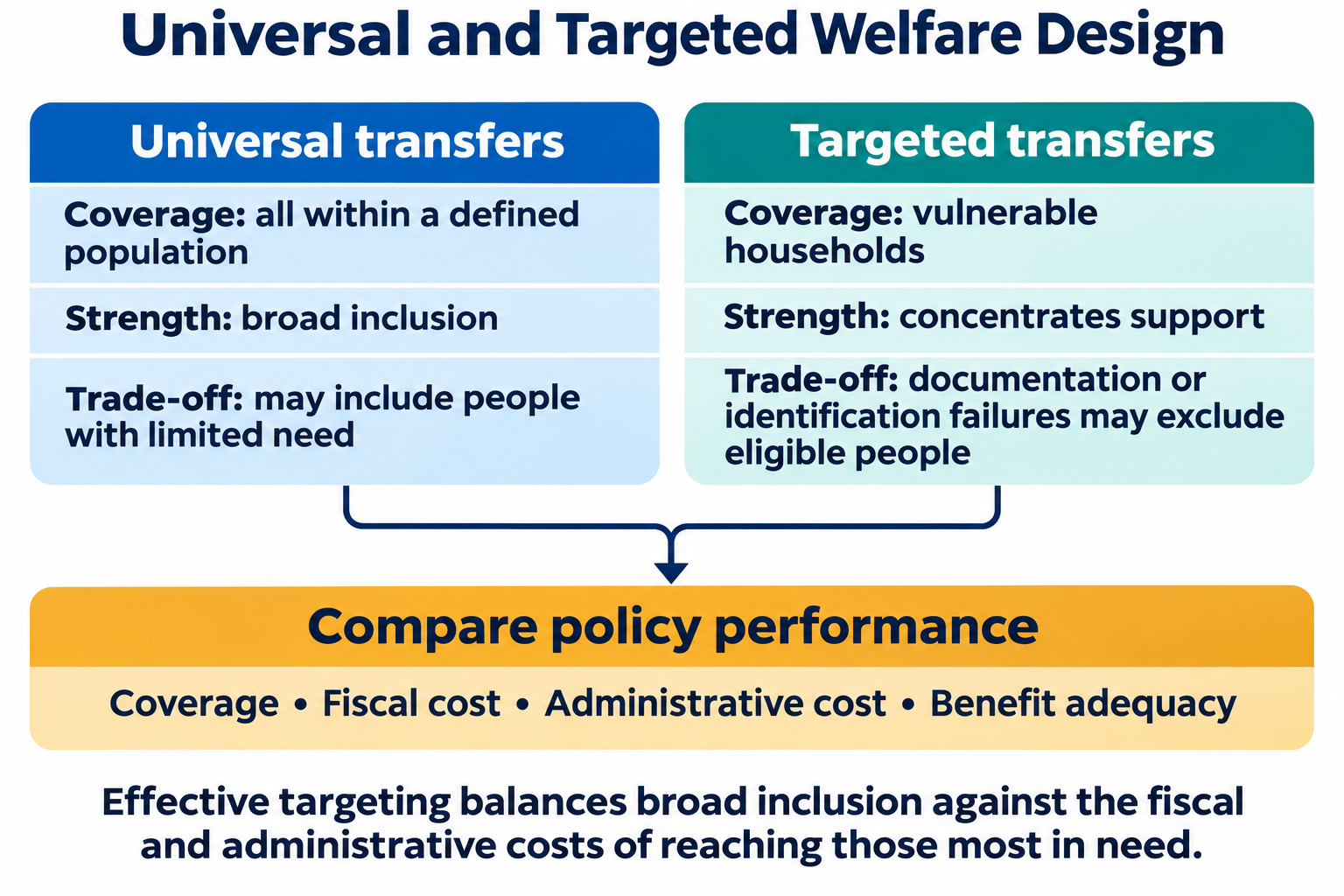
Universal schemes provide benefits to everyone within a defined population.
- They minimise exclusion of eligible people.
- However, they may also benefit relatively well-off recipients, increasing fiscal cost.
Targeted schemes concentrate resources on selected vulnerable groups.
- They can provide larger benefits to those most in need.
- However, identification errors, documentation barriers and administrative weaknesses may exclude deserving households.
The choice involves balancing inclusion errors, exclusion errors, administrative costs and equity.
What Should a Social DPR Contain?
It should include:
- baseline needs assessment and measurable objectives;
- comparison of cash, in-kind, conditional and unconditional alternatives;
- beneficiary identification and coverage estimates;
- analysis of household decision-making, including gender inequalities;
- inflation-adjusted benefit design and potential local price effects;
- ten-year fiscal projections and periodic review or sunset provisions.
Pilot programmes and real-time monitoring could help improve scheme design before large-scale expansion.
Core Policy Lesson
Cash transfers should not be judged solely as either desirable welfare or undesirable populism.
Their effectiveness depends on who receives support, how behaviour changes, what alternatives are sacrificed and whether future budgets can sustain the commitment.
A social DPR would make welfare promises more transparent, evidence-based and accountable without rejecting the underlying objective of social protection.
---
Probable Mains Question
“Cash-transfer schemes can enhance household welfare but may also create long-term fiscal rigidity and expenditure trade-offs.” Discuss the importance of ex ante appraisal, targeting and fiscal sustainability in designing social-sector programmes.
---
Prelims Drill
With reference to welfare economics, consider the following statements:
1. An inclusion error occurs when an ineligible person receives a programme benefit.
2. An exclusion error occurs when an eligible person does not receive a programme benefit.
3. Universal programmes necessarily eliminate all administrative costs.
Which of the statements given above are correct?
A. 1 only
B. 1 and 2 only
C. 2 and 3 only
D. 1, 2 and 3
Correct Answer: B
Explanation: Inclusion and exclusion errors concern beneficiary selection. Universal programmes can reduce some eligibility-related errors but still involve delivery, verification and administrative costs.