
Lottery Regulation in India: Regulation, Revenue and Federalism
State-organised lotteries are legally permitted subject to statutory conditions, but the policy debate centres on whether strict regulation can protect consumers more effectively than blanket prohibition.
Lottery Regulation in India: Regulation, Revenue and Federalism
- Syllabus Mapping: GS Paper II — Centre-State Relations, Legislative Powers and Governance; GS Paper III — Public Finance, Taxation and Informal Economy; GS Paper IV — Paternalism, Individual Choice and Regulatory Ethics.
- Source & Date: The Hindu, 27 September 2026, supplemented by the Lotteries (Regulation) Act, 1998, parliamentary data and Supreme Court jurisprudence.
What Is the Current Legal Framework?
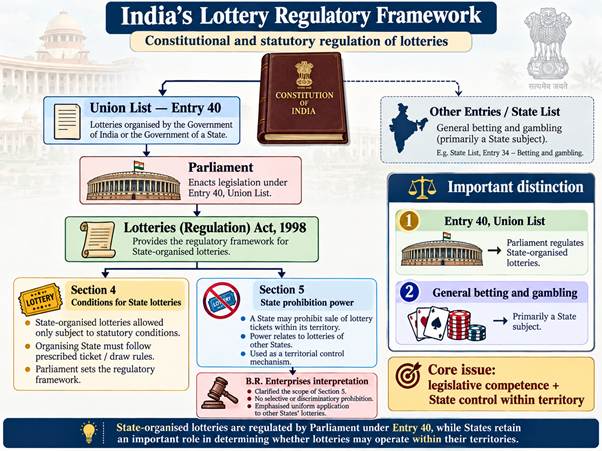
Government-organised lotteries fall under Entry 40 of the Union List, while betting and gambling generally fall under Entry 34 of the State List.
The Lotteries (Regulation) Act, 1998 allows State governments to organise, conduct or promote lotteries subject to conditions prescribed under Section 4.
These conditions regulate matters such as ticket issuance, draws, prize structures and the manner in which State lotteries are conducted.
A Lok Sabha reply in 2023 identified nine States operating lotteries: Arunachal Pradesh, Goa, Kerala, Maharashtra, Mizoram, Nagaland, Punjab, Sikkim and West Bengal.
Why Is Section 5 Important?
Section 5 empowers a State to prohibit the sale of tickets of lotteries organised by other States.
However, the Supreme Court in B.R. Enterprises v. State of Uttar Pradesh (1999) limited the manner in which this power can be exercised.
A State that wishes to prohibit lotteries organised by other States must itself adopt a lottery-free policy.
Under the present judicial interpretation:
A State cannot operate its own lottery while simultaneously excluding lotteries organised by every other State.
This creates a regulatory dilemma because the destination State bears local enforcement responsibilities but cannot selectively retain its own lottery market while excluding outside lotteries.
Why Are Lotteries Treated Differently From Ordinary Trade?
The Supreme Court has treated lotteries as a form of gambling and therefore as res extra commercium.
Lottery activity consequently does not receive the same constitutional protection as ordinary lawful trade under Article 19(1)(g).
It also does not enjoy the same freedom of inter-State trade ordinarily associated with Article 301.
This gives governments relatively wide constitutional space to regulate, restrict or prohibit lotteries.
Regulation Versus Prohibition
A blanket prohibition can eliminate the legal supply of lottery tickets without necessarily eliminating demand for gambling.
Demand may migrate towards:
Matka + satta + smuggled lottery tickets + offshore gambling portals + unregulated digital operators
Illegal markets generally lack audited prize funds, transparent draws, age restrictions, consumer grievance mechanisms and effective financial oversight.
Governments may simultaneously lose tax and non-tax revenue while spending additional resources on enforcement.
The relevant policy choice is therefore not between a harmless legal market and a harmful illegal market.
It is between different regulatory arrangements for managing an activity that already carries significant social risks.
What Are the Social Risks?
Lotteries can disproportionately affect lower-income households because participants may repeatedly spend limited disposable income on extremely low-probability outcomes.
Rapid draws, large jackpots and aggressive marketing can distort perceptions of winning probabilities and encourage compulsive play or loss-chasing.
An accountable framework would therefore require:
minimum-age rules + transparent odds + advertising restrictions + prohibition or limitation of credit-based purchases + secure prize funds + responsible-gambling safeguards + reliable audit trails
The regulatory objective should be harm reduction rather than promotion of lotteries as a normal investment or wealth-creation instrument.
Why Do States Care About Lottery Revenue?
Lotteries can provide States with both non-tax revenue and GST receipts.
Kerala provides an important public-operator model.
In FY2023-24, Kerala recorded approximately ₹1,129.71 crore in net lottery revenue, while lottery activity also generated substantial GST collections.
Lottery surpluses can therefore become an additional fiscal resource for governments facing pressure to finance health, welfare and other public programmes.
However, dependence on lottery revenue also creates an ethical tension because the State simultaneously acts as regulator, operator and revenue beneficiary.
Key Regulatory Reforms
One possible reform is to amend Section 5 of the Lotteries (Regulation) Act, 1998 so that a State may prohibit lotteries organised by other States even while continuing to operate its own lottery.
Such a system would require a principle of uniform treatment, under which the destination State either permits all eligible outside State lotteries or excludes them all rather than discriminating between individual States.
A second possible reform is the creation of a new statutory mechanism allowing two or more States to jointly organise a common lottery.
Such an arrangement could pool:
players + prize funds + technology + administrative costs + regulatory infrastructure
Participating States could retain regulatory autonomy while benefiting from a larger common market.
Both changes would require legislative amendment because they are not part of the existing statutory framework.
Public-Operator Model
A transparent regulatory architecture could rely primarily on government departments, statutory entities or tightly supervised operators.
Private entities may still provide technology, distribution or retail services, but core functions such as draw integrity, prize-fund management and financial reporting require strong public oversight.
Retail networks can also be designed to support livelihood opportunities for:
small vendors + persons with disabilities + women’s self-help groups + cooperatives
Kerala’s departmental model demonstrates one possible approach, though States may choose different institutional structures.
What Would Accountable Regulation Require?
A credible lottery system would require:
transparent draws + independent audits + real-time sales records + traceable prize payments + responsible advertising + protection of minors + public disclosure of revenue use + strong action against illegal operators
Technology can improve auditability through digital ticket validation, centralised databases and automated reconciliation of sales and prize payments.
Public disclosure of how lottery surpluses are used can also strengthen accountability when governments justify lotteries partly on revenue grounds.
The Core Policy Question
Lottery policy involves a three-way balance between:
Individual choice + social protection + State revenue
Complete prohibition may reduce legal access but can also encourage underground markets.
Unrestricted commercialisation can increase addiction, regressive spending and exploitation.
The more sustainable approach is therefore to evaluate whether strict, transparent and accountable regulation can reduce social harm while preserving State autonomy and preventing illegal gambling markets from expanding.
Probable Mains Question
“The regulation of lotteries in India illustrates the tension between paternalistic social policy, State fiscal autonomy and individual choice.” Discuss in the context of the Lotteries (Regulation) Act, 1998 and the federal distribution of legislative powers.
Prelims Drill
MCQ 1
With reference to lotteries in India, consider the following statements:
- Lotteries organised by the Government of India or a State government fall under Entry 40 of the Union List.
- Betting and gambling are generally included in the State List.
- Under the current judicial interpretation, a State may operate its own lottery while prohibiting all lotteries organised by other States.
Which of the statements given above are correct?
A. 1 only
B. 1 and 2 only
C. 2 and 3 only
D. 1, 2 and 3
Correct Answer: B
Explanation: Government-organised lotteries fall under Entry 40 of the Union List, while betting and gambling generally fall under Entry 34 of the State List. The Supreme Court in B.R. Enterprises held that a State seeking to prohibit lotteries organised by other States must itself adopt a lottery-free policy.
MCQ 2
With reference to the Lotteries (Regulation) Act, 1998, consider the following statements:
- Section 4 prescribes conditions subject to which State lotteries may be organised.
- Section 5 deals with a State’s power concerning lotteries organised by other States.
- State-organised lotteries are treated by the Supreme Court as ordinary trade fully protected under Article 19(1)(g).
Which of the statements given above are correct?
A. 1 only
B. 1 and 2 only
C. 2 and 3 only
D. 1, 2 and 3
Correct Answer: B
Explanation: Sections 4 and 5 regulate the organisation and territorial sale of State lotteries. Supreme Court jurisprudence treats lotteries as gambling rather than ordinary constitutionally protected trade.
More Current Affairs - Daily
- Election Commission of India: Constitutional Design and Evolution into a Three-Member Body 12 Oct 2026
- Loknayak Jayaprakash Narayan: Total Revolution and Contribution to Democracy 12 Oct 2026
- India’s Russia-Ukraine Initiative: From Black Sea Security to Strategic Autonomy 12 Oct 2026
- Jayaprakash Narayan: Architect of Total Revolution and Defender of Democracy 12 Oct 2026