
Leprosy in India: Child Cases, Ongoing Transmission and the 2027 Target
Continued detection of new leprosy cases among children, including some with Grade-2 disability, indicates ongoing transmission and gaps in early diagnosis in parts of India.
Leprosy in India: Child Cases, Ongoing Transmission and the 2027 Target
- Syllabus Mapping: GS Paper II — Health, Government Policies and Vulnerable Sections; GS Paper III — Communicable Diseases, Epidemiology and Public Health.
- Source & Date: The Hindu, 4 October 2026, based on the latest National Leprosy Eradication Programme annual report and WHO global update.
Why Is Leprosy in Focus?
India recorded 91,783 new leprosy cases in 2025-26, including 3,832 children below 15 years. Among these children, 37 already had Grade-2 disability at diagnosis, indicating that some cases were detected only after visible impairment had developed.
The child caseload was substantially above the National Leprosy Eradication Programme’s annual target, even as India pursues the National Strategic Plan for Leprosy 2023-27, which seeks interruption of transmission at the district level by 2027.
The central epidemiological concern is:
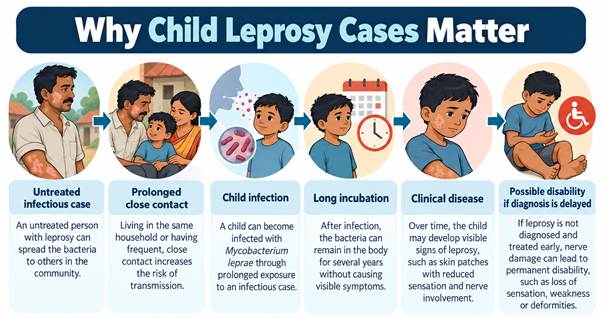
New child cases → evidence of recent transmission → delayed detection in some cases → continuing community reservoir
What Is Leprosy?
Leprosy, or Hansen’s disease, is a chronic bacterial infection caused mainly by Mycobacterium leprae.
It primarily affects the skin and peripheral nerves and can lead to sensory loss, muscle weakness, deformity and disability when diagnosis and treatment are delayed.
Transmission occurs mainly through prolonged, close contact with an untreated person. The disease has a long incubation period, averaging about five years and sometimes considerably longer.
Leprosy is curable through multidrug therapy (MDT), which is provided through public-health programmes.
Why Are Child Cases Important?
The WHO treats newly detected cases among children below 15 years as an important indicator of recent transmission because children have had less lifetime exposure than adults.
However, a child case does not by itself reveal exactly when or where infection occurred because of the disease’s long incubation period.
The distinction is important:
Child case = evidence suggesting ongoing transmission
Child case ≠ proof of the exact source or timing of infection
What Does Grade-2 Disability Indicate?
Grade-2 disability, or G2D, refers to visible deformity or damage associated with advanced disease.
Its presence at the time of diagnosis is important because early treatment can prevent much of the progression to disability.
Thus:
G2D at diagnosis → delayed case detection → longer untreated period → greater disability and transmission risk
India reported 1,945 newly detected patients with G2D in 2025-26, with a national G2D rate of 1.34 per million population, above the programme objective of less than one per million.
What Does “Interruption of Transmission” Mean?
Under India’s 2023-27 strategic roadmap, a district is considered to have interrupted transmission after reporting zero new indigenous child cases for five consecutive years.
This is stricter than simply reducing disease prevalence.
The difference can be understood as:
Lower prevalence → fewer people living with disease at a point in time
Interruption of transmission → sustained absence of new indigenous transmission indicators
This distinction matters because a disease can fall below a numerical elimination threshold while continuing to generate new infections.
Where Are the Gaps?
The continuing burden reflects several challenges:
- Delayed diagnosis, particularly in hard-to-reach populations.
- Incomplete active case detection and household contact screening.
- Long incubation period, which makes recent transmission difficult to track.
- Stigma and discrimination, which can discourage early reporting.
- Geographical concentration of disease, with several high-burden districts continuing to record prevalence above one case per 10,000 population.
Changes in reported case numbers must also be interpreted carefully because stronger case-finding can temporarily increase detected cases without necessarily indicating that transmission itself has suddenly risen.
What Should the Public-Health Response Prioritise?
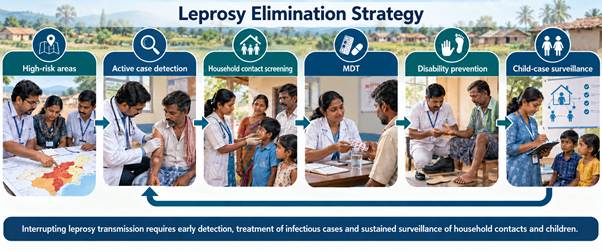
The NLEP focuses on active case detection, household contact surveys, intensified surveillance in high-endemic districts, early treatment and disability prevention.
The operational chain should be:
Active surveillance → early diagnosis → immediate MDT → contact screening → disability prevention → reduced transmission
The Core Policy Lesson
Leprosy is curable, but elimination depends not only on availability of treatment but also on finding cases early enough to prevent disability and further transmission.
The continued detection of children, particularly those already showing Grade-2 disability, reveals the gap between programme targets and disease detection on the ground.
India’s 2027 goal therefore depends on moving from passive treatment towards active surveillance, rapid diagnosis, contact tracing, stigma reduction and district-level transmission monitoring.
Probable Mains Question
“For communicable diseases such as leprosy, elimination requires more than reducing prevalence; it requires sustained interruption of transmission and early detection.” Discuss with reference to India’s National Leprosy Eradication Programme.
Prelims Drill
MCQ 1
With reference to leprosy, consider the following statements:
- It is caused mainly by Mycobacterium leprae.
- It primarily affects the skin and peripheral nerves.
- It is generally transmitted through brief casual contact with an infected person.
- It is curable with multidrug therapy.
Which of the statements given above are correct?
A. 1 and 2 only
B. 1, 2 and 4 only
C. 2, 3 and 4 only
D. 1, 2, 3 and 4
Correct Answer: B
Explanation: Leprosy is a chronic bacterial disease caused mainly by Mycobacterium leprae, affecting the skin and peripheral nerves. Transmission generally requires prolonged close contact with an untreated patient rather than brief casual contact, and the disease is curable with multidrug therapy.
MCQ 2
With reference to disease-control terminology and leprosy surveillance, consider the following statements:
- Prevalence measures the existing burden of disease in a population at a given time.
- Detection of new leprosy cases among children can indicate recent transmission in a community.
- A fall in prevalence necessarily proves that transmission of the disease has completely stopped.
Which of the statements given above are correct?
A. 1 only
B. 1 and 2 only
C. 2 and 3 only
D. 1, 2 and 3
Correct Answer: B
Explanation: Prevalence reflects the existing disease burden, while new child cases are an epidemiological indicator of continuing or recent transmission. A fall in prevalence does not by itself prove that transmission has ceased, which is why transmission-focused surveillance remains necessary even after prevalence declines.
More Current Affairs - Daily
- Election Commission of India: Constitutional Design and Evolution into a Three-Member Body 12 Oct 2026
- Loknayak Jayaprakash Narayan: Total Revolution and Contribution to Democracy 12 Oct 2026
- India’s Russia-Ukraine Initiative: From Black Sea Security to Strategic Autonomy 12 Oct 2026
- Jayaprakash Narayan: Architect of Total Revolution and Defender of Democracy 12 Oct 2026