
Inflation Generalisation in India
September data indicate rising breadth and price momentum.
Inflation Generalisation in India
- Syllabus Mapping: GS Paper III — Indian Economy, Inflation, Monetary Policy, RBI and Growth.
- Source & Date: The Indian Express, 13 October 2026.
Why in News?
India’s Consumer Price Index (CPI) inflation rose sharply to 5.54% in September 2026 from 4.83% in August, strengthening evidence that price pressures are spreading across the household consumption basket.
The RBI had already acknowledged on October 7 that there was “some evidence of elevated inflation expectations and generalisation of inflation”, reversing its August assessment that there were only limited signs of such broadening.
- The central issue is no longer merely: Are food or fuel prices rising?
- It is increasingly: How widely and persistently are prices rising across the economy?
Inflation Generalisation Means Broader Price Increases
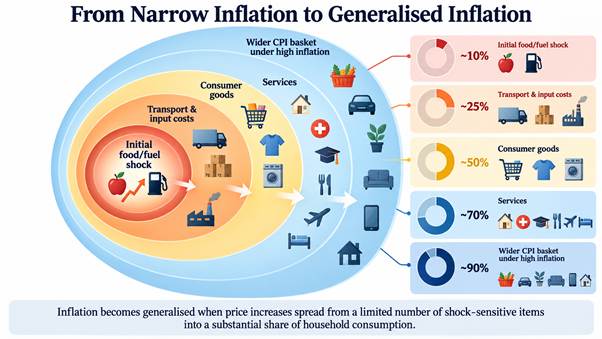
Inflation can initially be concentrated in a few categories, particularly those vulnerable to supply shocks such as food and fuel.
Generalisation of inflation occurs when price increases begin spreading across several categories of goods and services in a sustained manner.
The transition can be represented as:
Food/fuel shock → production and transport costs → consumer goods and services → wider CPI basket → inflation expectations
This matters because broad-based inflation tends to be more persistent than isolated price shocks.
CPI Breadth Shows the Spread of Inflation
One simple way to measure generalisation is to count how many items in the CPI basket are recording inflation above the RBI’s 4% medium-term target.
India’s CPI basket contains 358 items.
In January 2026, only 65 items recorded inflation of 4% or more.
By September, this had risen to 129 items.
Thus:
More items above 4% → broader inflationary pressure
However, this measure gives every item equal importance even though different items have very different weights in household expenditure.
Inflation and Price Momentum Measure Different Things
Headline inflation is generally measured as the year-on-year percentage change in prices.
For example:
September 2026 CPI inflation = price level in September 2026 compared with September 2025
This measure can be affected by what happened to prices a year earlier.
Policymakers therefore also examine month-on-month price changes, known as price momentum.
Price momentum asks:
Are prices rising right now compared with the previous month?
In February, prices of 236 of the 358 CPI items rose from the previous month.
By September, the number had increased to 319 items.
This suggests broad current price momentum, even before considering the year-on-year inflation rate.
Base Effects Can Distort Year-on-Year Inflation
Year-on-year inflation depends on both the current price level and the price level in the corresponding month of the previous year.
Suppose prices rose unusually sharply a year ago.
Even substantial current price increases may produce a relatively modest year-on-year inflation rate because the comparison base is already high.
This is a favourable base effect.
Conversely:
Low or falling prices last year → lower comparison base → current inflation appears higher
This is an unfavourable base effect.
Therefore: Headline inflation ≠ pure measure of current price momentum
Diffusion Indices Capture Inflation Breadth More Accurately
A diffusion index provides a more refined measure of how widely inflation is spreading.
Unlike a simple count of CPI items, it can take account of each item’s weight in the CPI basket.
This matters because an item representing a very small share of household expenditure should not necessarily receive the same importance as a major component.
According to the RBI’s CPI diffusion index, the share of the basket registering inflation above 4% increased from:
16% in January → 37% in August → nearly 46% in September
The trend therefore indicates progressive broadening of price pressures.
Different Measures Can Give Different Signals
Inflation generalisation does not have a single universally accepted measure.
Some economists combine:
- CPI inflation breadth;
- price momentum;
- household inflation expectations;
- business inflation expectations;
- rural wage growth;
- urban wage growth.
For example, Nomura’s broader generalisation index had earlier suggested that inflation breadth remained below its historical average.
This illustrates an important analytical principle:
One inflation indicator may show broadening while another may indicate that generalisation remains historically moderate.
Policy judgement therefore requires multiple indicators rather than a single threshold.
Inflation Expectations Can Make Price Pressures Persistent
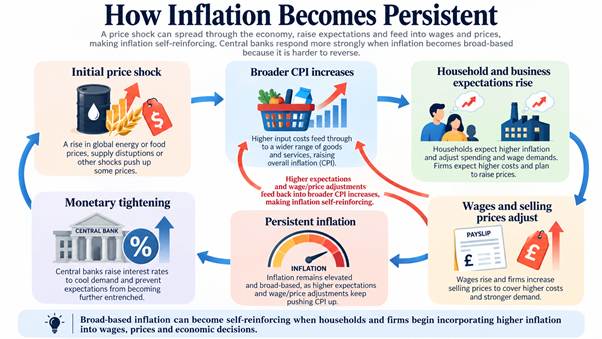
Inflation becomes more difficult to control when households and firms begin expecting higher prices to persist.
The transmission can become:
Current inflation → higher expectations → wage demands and price revisions → future inflation
For a central bank, preventing such a feedback loop is important because it can transform a temporary shock into persistent inflation.
The RBI’s reference to elevated inflation expectations is therefore significant alongside the broader CPI data.
Generalisation Matters for RBI Interest Rates
Monetary policy cannot directly produce more food, crude oil or other scarce commodities.
However, the RBI can act to prevent supply shocks from spreading into aggregate demand and inflation expectations.
The basic logic is:
Generalised inflation → greater persistence risk → stronger monetary-policy response
If inflation remains concentrated in a few supply-sensitive items, the central bank may be more willing to tolerate temporary increases.
If inflation becomes broad-based, additional repo-rate increases become more likely because monetary policy is better suited to restraining economy-wide demand and expectations.
Broader Inflation Strengthens the Higher-for-Longer Case
The RBI recently raised the repo rate and shifted its stance towards calibrated tightening.
The September inflation data strengthen the argument that monetary policy may need to remain restrictive for longer.
The policy chain is:
Inflation breadth ↑ → persistence risk ↑ → inflation expectations ↑ → probability of further tightening ↑
Market expectations after the September CPI release have consequently shifted towards additional rate increases over the coming months.
India’s Inflation-Targeting Framework Provides the Anchor
India follows a flexible inflation-targeting framework centred on CPI inflation.
The medium-term target is: 4% inflation with a tolerance band of 2% to 6%
The 4% figure is therefore relevant not only for headline CPI but also as a benchmark for examining how much of the consumption basket is experiencing elevated inflation.
The objective is not simply to keep inflation below 6%.
The policy framework ultimately seeks to anchor inflation around 4% over the medium term.
The Core Policy Lesson
A rise in headline CPI alone does not reveal whether inflation is becoming entrenched.
Policymakers must ask three different questions:
- Level — How high is inflation?
- Momentum — Are prices rising rapidly now?
- Breadth — How much of the consumption basket is affected?
September’s data suggest pressure on all three dimensions.
The most important transition is:
Isolated supply shock → broad price momentum → generalised inflation → persistent inflation risk
This is why inflation generalisation matters directly for the RBI’s future interest-rate decisions.
Probable Mains Question
“For monetary policy, the breadth and persistence of inflation can matter as much as the headline inflation rate.” Discuss with reference to price momentum, diffusion indices and India’s flexible inflation-targeting framework.
Prelims Drill
MCQ 1
With reference to inflation measurement, consider the following statements:
- Year-on-year inflation compares the current price level with the corresponding period of the previous year.
- Month-on-month price change can provide information about current price momentum.
- A high-base effect from the previous year can, other things being equal, moderate the current year-on-year inflation rate.
Which of the statements given above are correct?
A. 1 only
B. 1 and 2 only
C. 2 and 3 only
D. 1, 2 and 3
Correct Answer: D
Explanation: Year-on-year inflation depends on the current as well as previous-year price level. Month-on-month changes help identify current price momentum, while a high comparison base can reduce the measured year-on-year inflation rate even when prices continue to rise.
MCQ 2
With reference to India’s inflation-targeting framework, consider the following statements:
- The inflation target is defined in terms of the Consumer Price Index.
- The medium-term inflation target is 4%.
- The tolerance band around the target is 2% to 6%.
- A diffusion index can be used to assess how broadly price increases are distributed across a consumption basket.
Which of the statements given above are correct?
A. 1 and 2 only
B. 1, 2 and 3 only
C. 1, 2, 3 and 4
D. 2, 3 and 4 only
Correct Answer: C
Explanation: India’s flexible inflation-targeting framework uses CPI inflation with a 4% target and a 2-6% tolerance band. A diffusion index can complement headline inflation by showing the breadth of price increases across different components of the consumption basket.