India-Russia Relations in an Era of Multi-Alignment
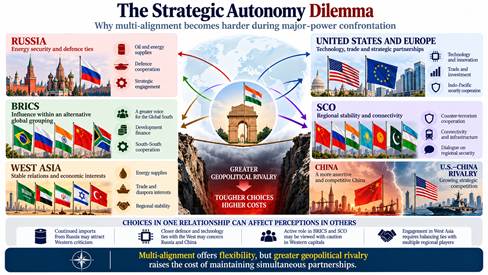
India’s strategic autonomy increasingly depends on maintaining parallel partnerships with competing power centres, but intensifying geopolitical rivalry is making this balancing exercise more difficult.
India-Russia Relations in an Era of Multi-Alignment
- Syllabus Mapping: GS Paper II — India’s Foreign Relations, Bilateral Relations and Global Groupings.
- Source & Date: The Hindu, 28 October 2026.
Why in News?
India's effort to balance relations with Russia, the West and other major powers could generate mistrust in Moscow.
The immediate context is India's participation in the SCO and BRICS, its continuing economic relationship with Russia, and Prime Minister Narendra Modi's public call in Bishkek for movement from an “endless war” towards an end to the Ukraine conflict.
What is Strategic Autonomy?
Strategic autonomy refers to a State's capacity to take foreign-policy decisions according to its own interests rather than automatically following an alliance bloc.
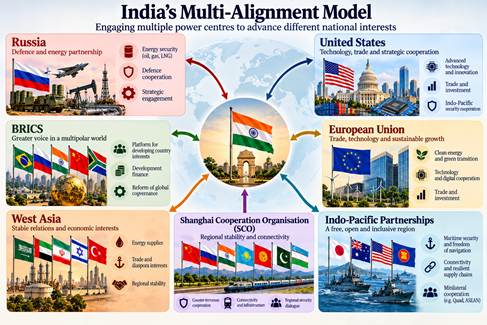
For India, this increasingly takes the form of multi-alignment: cooperating with the United States and Europe while simultaneously maintaining partnerships with Russia, participating in BRICS and SCO, and engaging countries across West Asia and the Global South.
The purpose is not equal distance from every power, but flexibility across different issues.
Why Russia Still Matters
Russia remains important for India in defence, energy, nuclear cooperation and diplomacy.
Officially, both countries continue to describe their relationship as a Special and Privileged Strategic Partnership based on long-standing cooperation and mutual interests.
India's purchases of Russian oil have also expanded the economic dimension of the relationship, particularly since the Ukraine conflict.
But Defence Dependence Is Changing
India's military relationship with Russia remains substantial, but dependence has declined.
SIPRI estimates that Russia's share of India's major arms imports fell from 70% in 2011-15 to 40% in 2021-25, while India increasingly sourced equipment from France, Israel and the United States.
This is better understood as supplier diversification rather than a complete abandonment of Russia.
BRICS and SCO Add Complexity
BRICS and the SCO allow India to engage Russia, China and other non-Western powers while supporting a more multipolar international system.
The 2026 BRICS New Delhi Declaration reaffirmed peaceful settlement of disputes, expressed concern about tensions in West Asia and strongly reiterated support for Palestinian rights and a two-state solution.
Yet India also maintains close strategic relations with Western countries. This creates situations where its position on one conflict may not mirror its position on another.
Does Balancing Necessarily Erode Trust?
That conclusion remains an interpretation, not an established fact.
The repeated public criticism of Russia could create doubts in Moscow. However, official India-Russia documents continue to describe the partnership as resilient and strategically important.
Trust therefore depends not on identical positions on every conflict, but on whether both countries continue to see sufficient strategic and economic value in the relationship.
Core Policy Lesson
India's challenge is moving from simple balancing to issue-based strategic autonomy.
Its relationships with Russia, the West, BRICS members and West Asian powers increasingly overlap and sometimes conflict. The sustainability of multi-alignment will depend on clear communication, diversified economic and defence partnerships, and the ability to disagree with partners without allowing individual disagreements to define the entire relationship.
Probable Mains Question
“Strategic autonomy in an increasingly polarised world requires India to manage simultaneous partnerships rather than maintain equidistance between major powers.” Discuss with reference to contemporary India-Russia relations.
Prelims Drill MCQ
Consider the following statements regarding India-Russia relations:
- Defence cooperation has historically been an important component of the bilateral relationship.
- Diversification of India's arms suppliers necessarily implies the termination of defence cooperation with Russia.
- India and Russia officially describe their relationship as a Special and Privileged Strategic Partnership.
Which of the statements given above are correct?
A. 1 only
B. 1 and 3 only
C. 2 and 3 only
D. 1, 2 and 3
Correct Answer: B
Explanation: India has diversified defence procurement, but Russia remains an important defence partner. Diversification reduces concentration risk rather than automatically ending an existing strategic relationship.