
SLPs and the Supreme Court’s Growing Caseload
Article 136 gives the Supreme Court broad discretionary appellate power, but the large volume of SLPs raises questions about how much routine appellate work the country’s highest constitutional court should undertake.
SLPs and the Supreme Court’s Growing Caseload
- Syllabus Mapping: GS Paper II — Judiciary, Constitutional Bodies, Separation of Powers and Judicial Reforms.
- Source & Date: The Indian Express, 27 October 2026.
Why in News?
The Supreme Court is handling more than 96,000 pending cases with a sanctioned strength of 38 judges, while Special Leave Petitions form a very large share of fresh filings.
This has revived an old institutional question: should the Supreme Court continue to function as a widely accessible final appellate court, or should it more aggressively reserve its time for constitutional questions and disputes of wider legal importance?
What is a Special Leave Petition?
A Special Leave Petition, or SLP, arises from Article 136 of the Constitution.
It gives the Supreme Court discretionary power to grant special leave to appeal against judgments, decrees, determinations, sentences or orders passed by courts and tribunals, subject to constitutional limitations.
The crucial point is that an SLP is not an automatic appeal. The Court may refuse to hear it.
The framers intended this extraordinary power to serve as a safety valve for exceptional injustice rather than a routine final stage of litigation.
Why SLPs Matter for Pendency
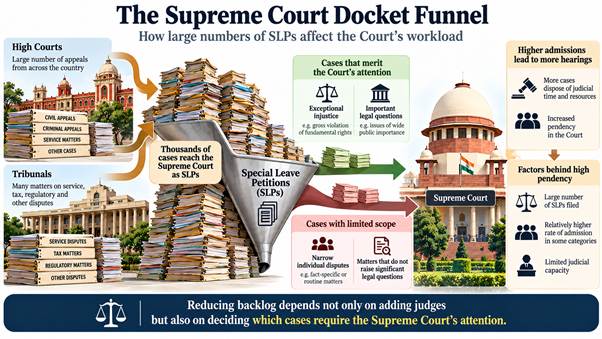
Over time, SLPs have become one of the largest components of the Supreme Court's docket.
This creates an institutional trade-off. Every routine service dispute, criminal matter or private appeal admitted by the Court uses judicial time that could otherwise be spent on constitutional interpretation, Centre-State disputes or questions affecting large numbers of people.
Increasing the number of judges may therefore provide only partial relief if the volume of cases admitted continues to grow simultaneously.
Constitutional Court or General Court of Appeal?
The Supreme Court performs two broad roles.
It is a constitutional court, deciding questions concerning fundamental rights, constitutional interpretation and federal relations. It is also the country's highest appellate court.
The difficulty arises when the appellate function becomes so large that it reduces the time available for the constitutional function.
This does not mean that individual injustice is unimportant. Article 136 exists precisely because exceptional cases may require correction even without a major constitutional question.
Why Filtering Is Difficult
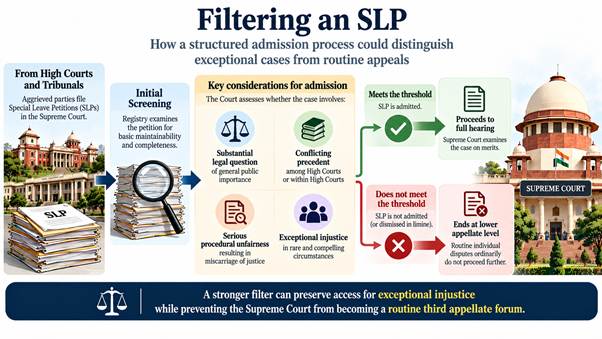
A stricter threshold could prioritise cases involving substantial questions of law, conflicting High Court judgments or grave miscarriage of justice.
However, defining such a threshold is difficult. The Supreme Court has previously recognised the danger of excessive SLP litigation, but has also resisted rigidly restricting Article 136 because exceptional cases cannot always be predicted in advance.
The challenge is therefore to structure discretion without eliminating it.
Possible Reforms
Reform proposals include clearer admission guidelines, stronger case-management systems and greater reliance on High Courts as the final forum for ordinary disputes.
Other proposals have suggested regional benches or separating constitutional and appellate work, but these address institutional structure rather than the basic question of how many SLPs should be admitted.
A durable solution therefore requires both capacity expansion and docket discipline.
Core Policy Lesson
The SLP debate is ultimately about the institutional identity of the Supreme Court.
Broad access under Article 136 protects against exceptional injustice, but excessive reliance on this jurisdiction can turn the Court into a general court of appeal.
The objective of reform should therefore not be to eliminate SLPs, but to preserve their extraordinary character through clearer and more consistent admission standards.
Probable Mains Question
“The growing use of Article 136 has blurred the distinction between the Supreme Court’s constitutional and appellate roles.” Discuss the need for reforming the admission of Special Leave Petitions while preserving access to justice.
Prelims Drill
MCQ 1
With reference to Article 136 of the Constitution, consider the following statements:
- It gives the Supreme Court discretionary power to grant special leave to appeal.
- Every petition filed under Article 136 creates an automatic right to a full appeal before the Supreme Court.
- The jurisdiction can extend to decisions of certain courts and tribunals.
Which of the statements given above are correct?
A. 1 only
B. 1 and 3 only
C. 2 and 3 only
D. 1, 2 and 3
Correct Answer: B
Explanation: Article 136 creates a discretionary power in the Supreme Court rather than an automatic appellate right. The Court may grant or refuse special leave.
MCQ 2
Consider the following statements regarding judicial pendency:
- Increasing the number of judges can reduce pendency even if case inflow remains unchanged.
- If the number of cases admitted rises alongside judicial capacity, the reduction in backlog may be limited.
- Docket filtering concerns the criteria used to determine which cases receive judicial hearing.
Which of the statements given above are correct?
A. 1 and 2 only
B. 2 and 3 only
C. 1 and 3 only
D. 1, 2 and 3
Correct Answer: D
Explanation: Judicial capacity matters, but so does case inflow. If admissions rise with capacity, pendency may persist. Docket filtering therefore becomes an important case-management tool.
More Current Affairs - Daily
- Buddhist Diplomacy: Sustaining Dialogue When Political Negotiations Stall 29 Oct 2026
- Nearly All Shallow-Water Coral Reef Ecosystems Face Collapse Risk by 2075 29 Oct 2026
- E100 and Flex-Fuel Vehicles in India 29 Oct 2026
- Rapid Spread of Water Hyacinth Threatens Aquatic Biodiversity and Livelihoods 29 Oct 2026