
E100 and Flex-Fuel Vehicles in India
The new rules create a regulatory pathway for ethanol-based fuels up to E100, but these fuels are meant only for flex-fuel vehicles specifically designed and certified for such use.
E100 and Flex-Fuel Vehicles in India
- Syllabus Mapping: GS Paper III — Energy, Biofuels, Environment, Transport and Science & Technology.
- Source & Date: The Hindu, 27 October 2026.
Why in News?
The Ministry of Road Transport and Highways has amended the Central Motor Vehicles Rules, 1989 to recognise ethanol-based fuels containing up to 100% ethanol, or E100, for use in compatible vehicles.
The changes modify provisions relating to emission standards and testing and create the regulatory pathway needed for flex-fuel vehicles that can operate on petrol, ethanol blends or pure ethanol.
What Are E20, E85 and E100?
The number indicates the approximate proportion of ethanol in the fuel blend.
E20 contains 20% ethanol and the remainder petrol. E85 contains a much higher proportion of ethanol, while E100 consists essentially of ethanol subject to applicable fuel specifications.
A flex-fuel vehicle is designed to operate across a range of petrol-ethanol blends. Its fuel system, engine calibration and materials must therefore tolerate higher ethanol concentrations.
Existing Vehicles Should Not Switch Automatically
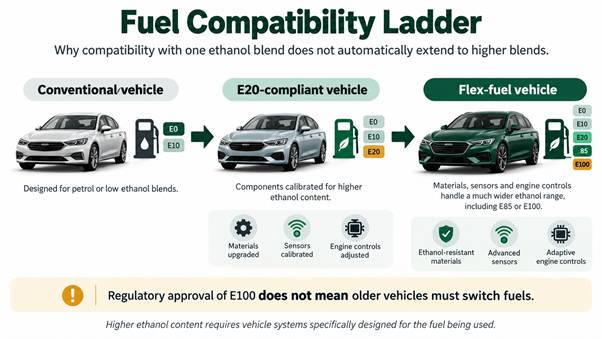
The new rules do not mean that existing petrol vehicles should begin using E85 or E100.
Compatibility with E10 or E20 does not automatically make a vehicle compatible with much higher ethanol blends. Higher ethanol content can require different seals, hoses, fuel-system materials and engine-management settings.
Motorists should therefore follow the manufacturer's fuel-compatibility guidance rather than treating E85 or E100 as interchangeable with normal petrol.
Why Homologation Matters
The amendment mainly enables homologation, the formal process through which authorised testing agencies verify that a vehicle or component meets prescribed technical, safety and emission requirements.
Without recognised E100 standards, manufacturers would face difficulty securing type approval for vehicles designed to use pure or near-pure ethanol.
The new framework therefore does not itself create mass E100 use. It creates the regulatory architecture through which such vehicles can be tested, certified and sold.
India Has Already Moved to E20
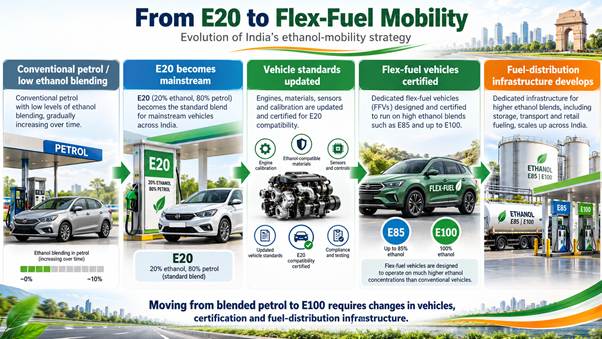
India achieved the 20% ethanol-blending target in 2025, ahead of the original 2030 timeline under the National Policy on Biofuels, 2018.
The policy focus is now moving from simply increasing ethanol in conventional petrol towards vehicles designed to operate with substantially higher ethanol concentrations.
This represents a shift from fuel blending within the existing vehicle fleet to developing a separate flex-fuel vehicle ecosystem.
Consumer and Infrastructure Concerns
Ethanol contains less energy per unit volume than petrol. As a result, higher ethanol blends can reduce fuel economy even when engines are designed to use them.
Higher blends also raise concerns about storage, moisture absorption and fuel quality. Ethanol has an affinity for water, which makes proper storage and dedicated dispensing systems particularly important.
Another issue is economics. Increasing ethanol content does not automatically mean cheaper pump prices because ethanol production itself has feedstock, processing and procurement costs.
Ethanol and Energy Security
Higher domestic ethanol use can reduce part of India's dependence on imported petroleum and create demand for domestically produced biofuel feedstocks.
However, the environmental benefit depends on the entire lifecycle of ethanol, including the crop used, irrigation, fertiliser, processing energy and land use.
Therefore, replacing petrol with ethanol cannot be assessed only through tailpipe emissions.
Ethanol versus Electrification
Flex-fuel technology and electric vehicles address the transport transition differently.
Ethanol allows part of the existing liquid-fuel system to continue while substituting renewable fuel for petroleum. Electrification replaces the internal-combustion drivetrain itself and can deliver deeper emission reductions as electricity generation becomes cleaner.
The two technologies need not be treated as immediate substitutes. Ethanol can support near- and medium-term petroleum substitution, while electrification may play a larger role in long-term decarbonisation.
Core Policy Lesson
The E100 amendment is primarily an enabling regulation, not an instruction for all vehicles to begin using pure ethanol.
Its significance lies in allowing manufacturers to certify flex-fuel vehicles and creating space for a future E85 and E100 market.
The effectiveness of the policy will depend on vehicle compatibility, fuel availability, consumer economics, lifecycle emissions and the ability to develop dedicated storage and dispensing infrastructure without slowing the broader transition towards cleaner mobility.
Probable Mains Question
“Flex-fuel vehicles can improve energy diversification, but ethanol-based mobility also involves technological, economic and environmental trade-offs.” Discuss in the context of India’s move towards E85 and E100 fuels.
Prelims Drill
MCQ 1
With reference to flex-fuel vehicles, consider the following statements:
- They are designed to operate on more than one petrol-ethanol fuel composition.
- Compatibility of a vehicle with E20 necessarily makes it suitable for E85 or E100.
- Higher ethanol blends may require changes in engine calibration and fuel-system materials.
Which of the statements given above are correct?
A. 1 only
B. 1 and 3 only
C. 2 and 3 only
D. 1, 2 and 3
Correct Answer: B
Explanation: Flex-fuel vehicles are specifically designed for a wide range of ethanol blends. E20 compatibility alone does not establish compatibility with E85 or E100.
MCQ 2
Consider the following statements regarding ethanol-based transport fuels:
- Ethanol generally has lower energy density than petrol.
- Higher ethanol use can potentially reduce dependence on imported petroleum.
- The environmental impact of ethanol can be assessed solely from emissions produced at the vehicle's exhaust.
Which of the statements given above are correct?
A. 1 only
B. 1 and 2 only
C. 2 and 3 only
D. 1, 2 and 3
Correct Answer: B
Explanation: Ethanol has lower energy density than petrol and can substitute part of petroleum demand. Its environmental performance depends on lifecycle factors such as feedstock cultivation, water use, processing and land use, not only tailpipe emissions.
More Current Affairs - Daily
- Buddhist Diplomacy: Sustaining Dialogue When Political Negotiations Stall 29 Oct 2026
- Nearly All Shallow-Water Coral Reef Ecosystems Face Collapse Risk by 2075 29 Oct 2026
- SLPs and the Supreme Court’s Growing Caseload 29 Oct 2026
- Rapid Spread of Water Hyacinth Threatens Aquatic Biodiversity and Livelihoods 29 Oct 2026