
India–Nepal Relations : Balen Shah’s Visit
Why in News?
Nepal’s Prime Minister Balendra Shah, popularly known as Balen Shah, paid a state visit to India on 22–23 November 2026. This was his first bilateral visit abroad since taking office in March 2026. On 23 November, he held his first in-person talks with Prime Minister Narendra Modi in New Delhi.
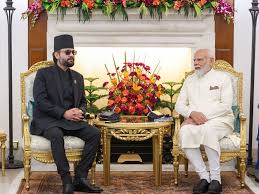
- The two prime ministers adopted the joint vision document ‘Viksit Bharat and Samunnat Nepal’ (Developed India and Prosperous Nepal). It calls for expanding cooperation in trade, connectivity and energy, as well as in digital services, innovation and disaster management.
Key Dimensions of India–Nepal Relations
- Trade and investment — India is Nepal’s largest trading partner, a major transit partner and its largest source of foreign direct investment (FDI). In FY 2025–26, bilateral merchandise trade stood at approximately US$9.38 billion. India received more than 80% of Nepal’s merchandise exports and accounts for nearly one-third of the total FDI Nepal has received. The bilateral trade treaty gives Nepalese goods duty-free access to the Indian market.
- Transit and connectivity — India announced a new route for Nepal’s transit trade through Deendayal Port at Kandla, Gujarat. This will give landlocked Nepal an additional route for maritime trade. The two leaders welcomed the launch of the direct Ayodhya–Janakpur rail service and agreed to allow flights in both directions on the Kathmandu–Bhairahawa–Lucknow air route.
- Energy, water and disaster management — Both countries agreed to advance work on the Pancheshwar and Saptakoshi–Sunkoshi multipurpose projects. They will share water and weather data in real time to strengthen flood early warning.
- Development assistance — India announced ₹15,000 crore in development assistance for Nepal. This includes a ₹3,500 crore grant for post-disaster reconstruction and new infrastructure, and an ₹11,500 crore line of credit for energy projects.
- Open border and unresolved disputes — Both countries agreed to keep the border open and strengthen cooperation against cross-border crime. Differences over Kalapani, Lipulekh and Limpiyadhura persist. The joint vision document calls for resolving outstanding boundary and water issues through dialogue.
Major Treaties and Agreements
Year | Treaty or Agreement | Key Provisions and Significance |
| 1815–1816 | Treaty of Sugauli | The East India Company and Nepal signed the treaty in December 1815 and exchanged the ratified instruments in March 1816. Under Article 5, Nepal renounced its claims to territories west of the Kali River. |
| 1950 | Treaty of Peace and Friendship | Signed on 31 July 1950, the treaty committed both countries to respecting each other’s sovereignty, territorial integrity and independence. It provides for reciprocal privileges for their citizens in matters such as residence, trade and movement. |
| 1954 | Kosi Project Agreement | It provided the basis for constructing, operating and maintaining the Kosi Barrage and associated structures. The agreement was amended in 1966. |
| 1959 | Gandak Project Agreement | It provided the basis for constructing, operating and maintaining the Gandak Barrage and associated structures. The agreement was amended in 1964. |
| 1996 | Mahakali Treaty | The treaty provides for the integrated development of the Mahakali River. It covers the Sarada Barrage, the Tanakpur Barrage and the Pancheshwar Multipurpose Project. |
| 2009 | Bilateral Treaty of Trade | It provides the basis for duty-free access for Nepalese goods to the Indian market. The treaty was automatically renewed in October 2023. |
| 2014 | Electric Power Trade Agreement | It established a framework for cross-border electricity trade, transmission interconnection and grid connectivity. |
| 2023 | Revised Treaty of Transit | Signed on 1 June 2023, the treaty gives Nepal access to agreed transit routes for trade with third countries. |
| 2024 | Long-Term Power Trade Agreement | It sets a target of increasing electricity exports from Nepal to India to 10,000 MW within ten years. |
Multiple-Choice Question
Question: With reference to India–Nepal relations, consider the following statements.
- The newly announced route for Nepal’s transit trade is linked to Deendayal Port in Gujarat.
- The Long-Term Power Trade Agreement aims to increase electricity exports from India to Nepal to 10,000 MW within ten years.
- The 1996 Mahakali Treaty covers the Sarada Barrage, the Tanakpur Barrage and the Pancheshwar Multipurpose Project.
Which of the statements given above are correct?
(A) 1 and 2 only
(B) 1 and 3 only
(C) 2 and 3 only
(D) 1, 2 and 3
Answer: (B)
Explanation: Statement 1 is correct. Deendayal Port at Kandla is in Gujarat. Statement 2 is incorrect because the 10,000 MW target applies to electricity exports from Nepal to India. Statement 3 is correct. The Mahakali Treaty covers the Sarada Barrage, the Tanakpur Barrage and the Pancheshwar Multipurpose Project.