
Global Rating Agencies has raised India’s FY27 Growth Forecast
Stronger-than-expected June-quarter growth, resilient domestic demand, investment, exports and government spending have prompted major global rating agencies to raise India’s FY27 GDP forecasts.
Global Rating Agencies Has Raised India’s FY27 Growth Forecast
- Syllabus Mapping: GS Paper III — Indian Economy, Growth and Development, Inflation, Investment, Monetary Policy and External Sector.
- Source & Date: Business Today, 23 September 2026; S&P Global Ratings, Fitch Ratings and Moody’s Ratings.
What Has Changed?
India’s economy grew 7.8% year-on-year in the June quarter of FY27, substantially stronger than several agencies had expected.
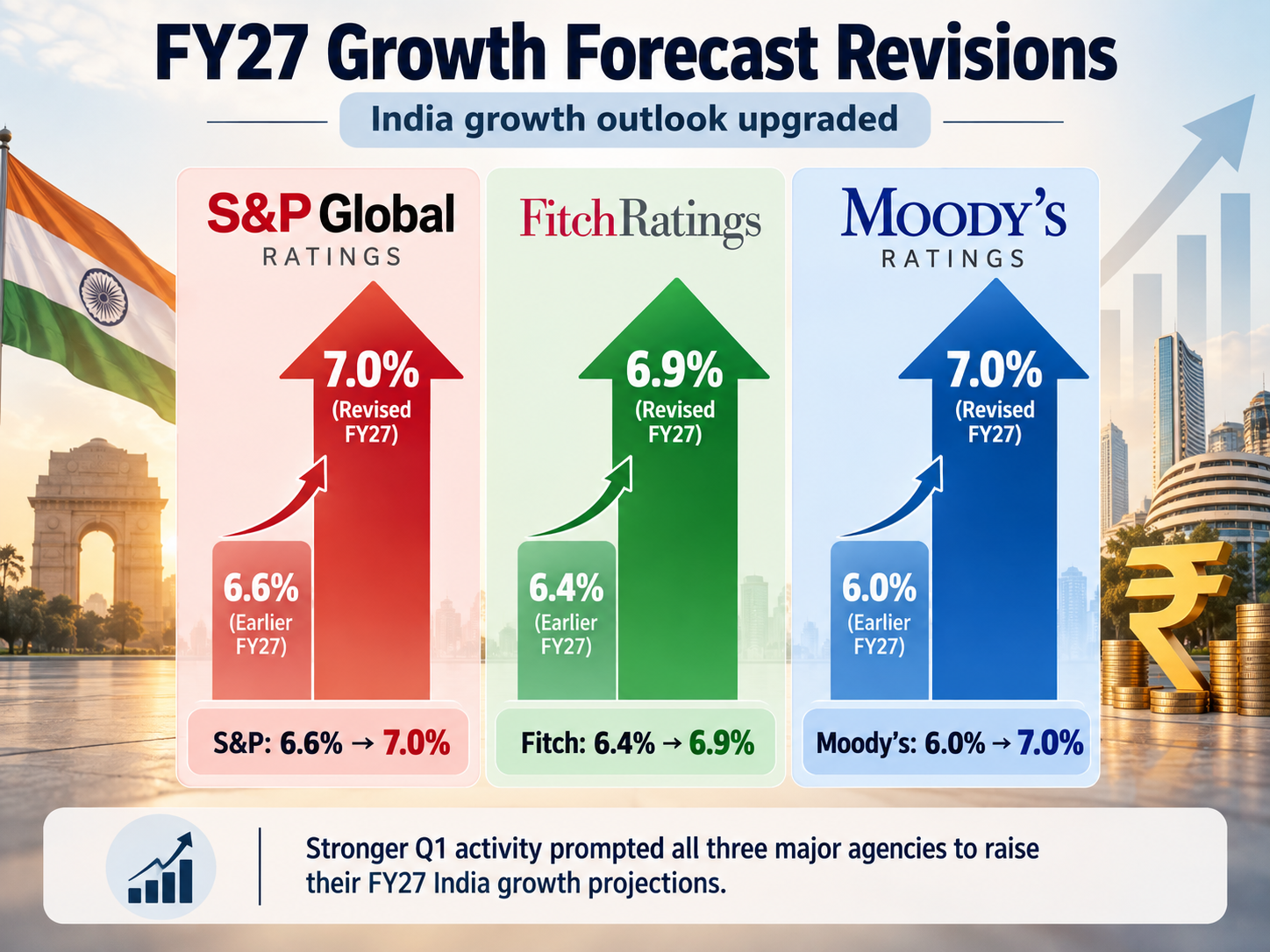
Importantly:
Higher GDP forecast ≠ sovereign credit-rating upgrade
The agencies have become more optimistic about near-term growth, but India’s sovereign ratings remain separate assessments of creditworthiness.
Why Has Growth Been Stronger Than Expected?
S&P identifies four major drivers:
Robust industrial activity + healthy consumption + strong goods exports + accelerating government investment
It raised FY27 growth to 7% after the June-quarter performance exceeded expectations.
Moody’s similarly highlighted stronger private consumption, capital formation, infrastructure spending and resilience of the services sector despite the Middle East conflict.
Fitch also cited resilience to the energy-price shock and expects private investment to strengthen, with investment growth exceeding 10% this fiscal year.
What Does This Say About India’s Growth Model?
The revisions suggest that current growth is being supported by a combination of:
Domestic demand + public capex + improving private investment + exports
This is important because domestic demand can partially cushion India from weak global growth.
At the same time, stronger investment is critical because sustained high growth requires expansion of productive capacity rather than consumption alone.
Why Are the Agencies Still Cautious?
All three expect some moderation during the second half of FY27.
S&P notes that the temporary boost from GST rationalisation and income-tax cuts may fade and that cumulative rainfall was 15% below normal through September 9, creating risks for agricultural output and food inflation.
Fitch expects weaker momentum in manufacturing and services and sees below-normal rainfall and inflation weighing on rural and household demand.
Moody’s highlights risks from:
high energy prices + food inflation + higher subsidy expenditure + weaker external demand
Higher Growth Can Coexist With Higher Interest Rates
A stronger growth outlook does not automatically imply easier monetary policy.
If rapid growth coincides with rising inflation, RBI may need to maintain or tighten monetary conditions.
S&P expects FY27 consumer inflation around 5.1% and sees scope for a 25-basis-point policy-rate increase. Fitch expects tightening as inflationary pressure rises.
Thus:
Strong growth + rising inflation → possible monetary tightening
This is not contradictory. Monetary policy responds primarily to inflation and macroeconomic stability, not growth alone.
What Are Credit Rating Agencies?
Credit Rating Agencies assess the ability and willingness of borrowers to meet debt obligations.
For sovereign governments, this is called a Sovereign Credit Rating.
The broad investment-grade threshold is:
- S&P/Fitch: BBB- and above
- Moody’s: Baa3 and above
India currently remains investment grade:
- S&P: BBB, Stable
- Fitch: BBB-, Stable
- Moody’s: Baa3, Stable
Ratings consider factors such as:
growth prospects + government debt + fiscal deficit + external vulnerability + institutions + debt affordability
Hence rapid GDP growth alone does not guarantee a rating upgrade.
Why Sovereign Ratings Matter
A stronger rating can influence perceptions of sovereign risk and financing costs.
However, two common simplifications should be avoided:
Sovereign ceiling is not an absolute rule: some companies can, in particular circumstances, receive ratings above their sovereign.
Masala bonds are not foreign-currency bonds: they are rupee-denominated bonds issued overseas, so the currency risk is principally borne by investors rather than the Indian issuer.
Domestic credit-rating agencies operating in India are regulated by SEBI under the SEBI (Credit Rating Agencies) Regulations, 1999, last amended in January 2026.
The Core Economic Signal
The forecast revisions indicate greater confidence in India’s near-term growth resilience.
But sustainability will depend on managing:
Inflation + monsoon risks + energy prices + fiscal consolidation + private investment
Therefore:
A growth upgrade is encouraging—but it is not the same as an improvement in sovereign creditworthiness.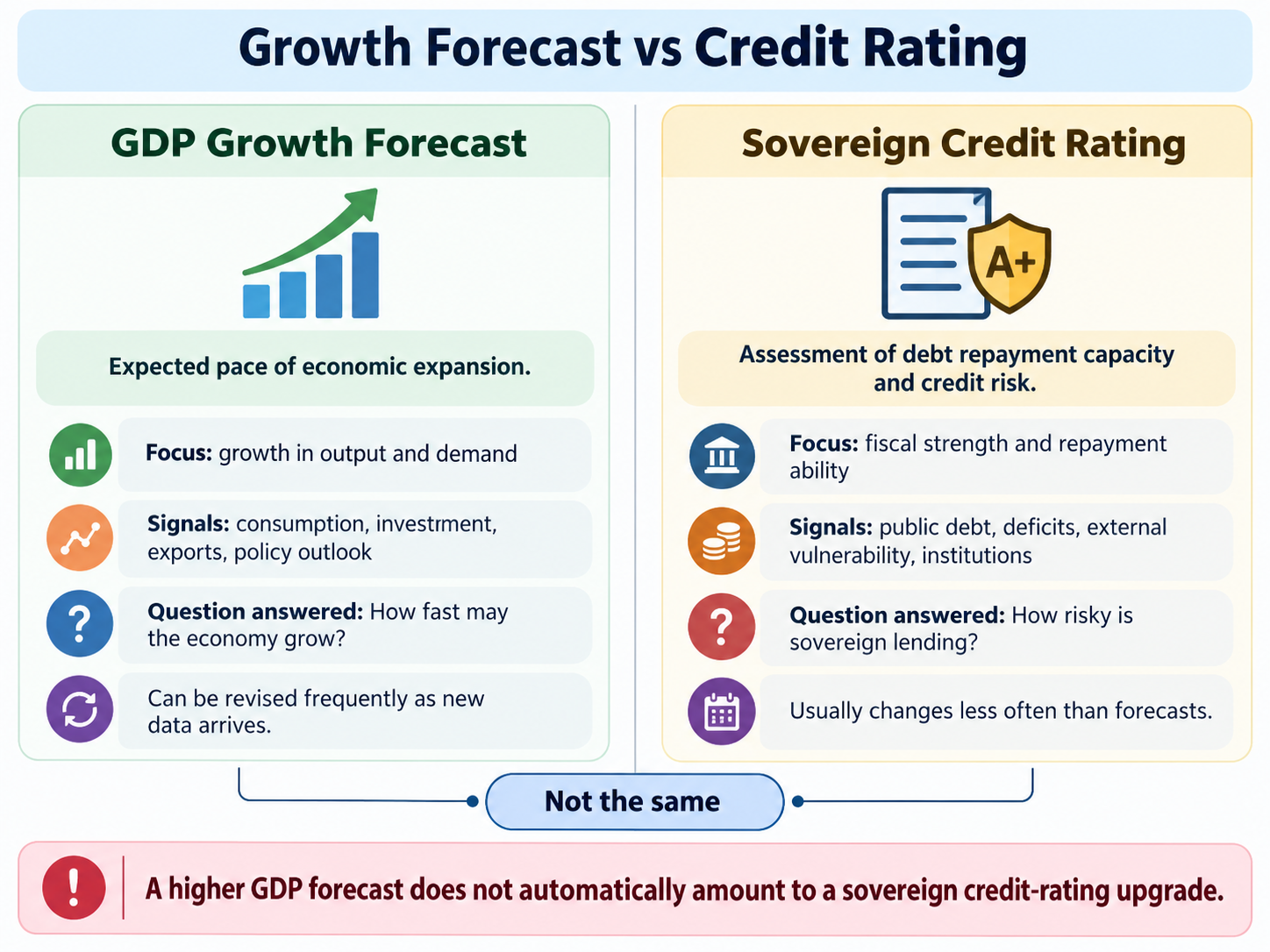
Probable Mains Question
“A strong growth outlook does not automatically translate into stronger sovereign creditworthiness.” Discuss with reference to India’s recent GDP forecast upgrades by global credit-rating agencies.
Prelims Drill
MCQ 1
With reference to sovereign credit ratings, consider the following statements:
- BBB- is generally the lowest investment-grade rating in the S&P and Fitch scales.
- Baa3 is generally the lowest investment-grade rating in Moody’s scale.
- An upward revision in a country’s GDP-growth forecast necessarily constitutes a sovereign-rating upgrade.
Which of the statements given above are correct?
A. 1 only
B. 1 and 2 only
C. 2 and 3 only
D. 1, 2 and 3
Correct Answer: B
Explanation: Statements 1 and 2 describe the conventional investment-grade thresholds. A GDP-growth forecast is an economic projection, while a sovereign rating is an assessment of credit risk; the two are related but distinct.
MCQ 2
Consider the following statements:
- Masala bonds are rupee-denominated bonds issued in overseas markets.
- Credit Rating Agencies operating in India are regulated by SEBI under the SEBI (Credit Rating Agencies) Regulations, 1999.
- Strong economic growth by itself guarantees an improvement in a sovereign credit rating.
Which of the statements given above are correct?
A. 1 only
B. 1 and 2 only
C. 2 and 3 only
D. 1, 2 and 3
Correct Answer: B
Explanation: Sovereign ratings also consider fiscal strength, debt, institutions, external finances and debt affordability. Strong GDP growth is therefore only one input into the rating assessment. SEBI regulates Indian CRAs under the 1999 regulations.
More Current Affairs - Daily
- Election Commission of India: Constitutional Design and Evolution into a Three-Member Body 12 Oct 2026
- Loknayak Jayaprakash Narayan: Total Revolution and Contribution to Democracy 12 Oct 2026
- India’s Russia-Ukraine Initiative: From Black Sea Security to Strategic Autonomy 12 Oct 2026
- Jayaprakash Narayan: Architect of Total Revolution and Defender of Democracy 12 Oct 2026