
NITI Aayog Releases India Electric Mobility Index 2025: Delhi Top Spot
NITI Aayog released the second edition of the India Electric Mobility Index (IEMI) 2025 in New Delhi on 16 September 2026. The index evaluates policy preparedness and implementation outcomes for e-mobility across Indian states and union territories.
India Electric Mobility Index 2025
NITI Aayog released the second edition of the India Electric Mobility Index (IEMI) 2025 in New Delhi on 16 September 2026.
Delhi emerged as the top-performing State/UT in electric mobility, followed by Maharashtra, Karnataka, Chandigarh and Goa.
The Index assesses both policy preparedness and implementation outcomes at the sub-national level and tracks progress towards States’ and UTs’ electric-mobility goals.
How is the Index calculated?
IEMI evaluates and scores all 28 States and 8 Union Territories on a scale of 0–100 through 16 indicators grouped under three core themes: Transport Electrification Progress, Charging Infrastructure Readiness, and EV Research and Innovation Status.
These themes capture demand-side EV adoption, development of charging infrastructure and the supply-side research and innovation ecosystem.
Performance Highlights
Delhi retained its leadership position, while Maharashtra, Karnataka, Chandigarh and Goa emerged among the other top performers.
The highest score under IEMI increased from 77 in 2024 to 84 in 2025, indicating improvement in the overall electric-mobility ecosystem.
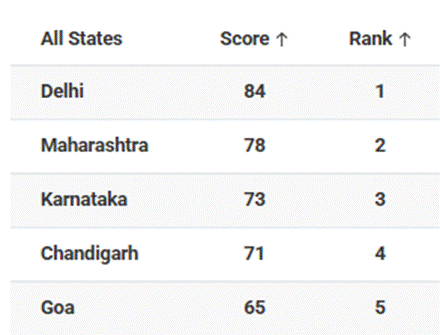
The first edition had ranked Delhi, Maharashtra and Chandigarh as the leading frontrunners.
The rise of Karnataka and Goa among the top-performing regions in the second edition indicates changing State-level performance in EV adoption and ecosystem development.
Why is it important?
IEMI provides a transparent framework for benchmarking State and UT performance, identifying policy and infrastructure gaps, and encouraging peer learning and competitive federalism.
It can support better targeting of EV policies, charging-network expansion, research, innovation and investment.
At the release, NITI Aayog Member Rajiv Gauba described electric mobility as an economic, environmental and strategic imperative for Viksit Bharat 2047.
He also noted estimates that electric vehicles could account for about 40% of all new car sales by 2040.
PRELIMS MCQ
Q. The India Electric Mobility Index (IEMI) 2025, released by NITI Aayog, primarily serves which of the following purposes?
(A) To rank automobile manufacturers on the basis of annual EV production
(B) To assess and compare the electric-mobility progress of States and Union Territories
(C) To determine subsidies available to individual electric-vehicle buyers
(D) To estimate India’s total electricity demand from electric vehicles
Answer: (B)
Explanation: The India Electric Mobility Index 2025 evaluates all 28 States and 8 Union Territories on a 0–100 scale using 16 indicators. It measures their performance across Transport Electrification Progress, Charging Infrastructure Readiness, and EV Research and Innovation Status. Delhi ranked first in the 2025 edition, while the Index is intended to promote benchmarking, competitive federalism, peer learning and better policy formulation for India’s electric-mobility transition.
More Current Affairs - Daily
- Election Commission of India: Constitutional Design and Evolution into a Three-Member Body 12 Oct 2026
- Loknayak Jayaprakash Narayan: Total Revolution and Contribution to Democracy 12 Oct 2026
- India’s Russia-Ukraine Initiative: From Black Sea Security to Strategic Autonomy 12 Oct 2026
- Jayaprakash Narayan: Architect of Total Revolution and Defender of Democracy 12 Oct 2026