
India and China: Coexistence Amid Strategic Competition
India and China are neither formal adversaries nor strategic partners. Despite their boundary dispute, power competition and trust deficit, stability requires a combination of deterrence, dialogue and crisis management.
India and China: Coexistence Amid Strategic Competition
- Syllabus Mapping: GS Paper II — India and its Neighbourhood, Bilateral Relations and International Relations; GS Paper III — Border Management and Security.
- Source & Date: The Hindu, 31 October 2026.
Why in News?
India-China relations remain characterised by managed coexistence rather than full normalisation.
Repeated patrol-related tensions along the Line of Actual Control, unresolved territorial claims and the continuing trust deficit following the 2020 Galwan Valley clash show that restoring stability requires more than periodic disengagement at individual friction points.
The Boundary Problem
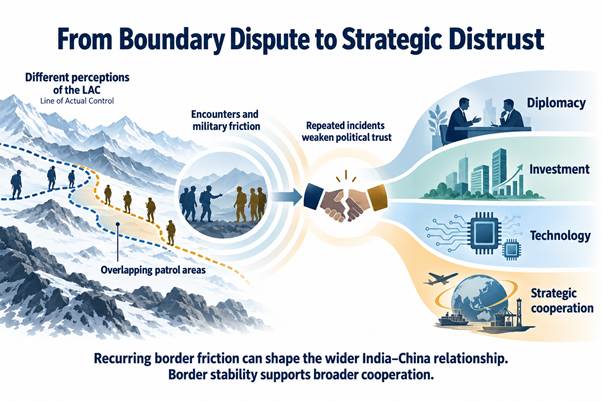
The India-China boundary is divided into western, middle and eastern sectors, but the two countries do not share a mutually agreed understanding of the entire Line of Actual Control (LAC).
Different perceptions of where the LAC lies can cause patrols from both sides to enter areas claimed by the other.
The boundary question is therefore not merely about territory. It is also a problem of different maps, patrol practices and competing perceptions of sovereignty.
Why 2020 Changed the Relationship
For several decades after the late 1980s, India and China attempted to separate the unresolved boundary question from the wider bilateral relationship.
The Galwan Valley clash in 2020, in which 20 Indian soldiers were killed, fundamentally weakened that arrangement.
Since then, India has emphasised that peace and tranquillity along the border are necessary for normal bilateral relations.
Lessons from Earlier Engagement
The 1988 visit of Prime Minister Rajiv Gandhi to China marked an important attempt to rebuild relations after decades of distrust following the 1962 war.
The broader approach was pragmatic: continue negotiations on the boundary while allowing cooperation in other areas to develop.
Subsequent agreements attempted to maintain peace and reduce the possibility that local military encounters would escalate into wider conflict.
The experience demonstrates that unresolved territorial disputes do not automatically prevent cooperation, provided effective mechanisms exist to manage them.
Strategic Competition Goes Beyond the Border
India-China relations now operate within a much wider geopolitical environment.
China's rapid economic and military rise, its growing presence in the Indian Ocean and its close relationship with Pakistan shape India's security calculations.
At the same time, India's participation in arrangements such as the Quad and its expanding strategic partnerships with the United States, Japan and Australia influence Chinese perceptions of India's external alignment.
Thus, bilateral relations increasingly combine the traditional boundary dispute with a broader Asian balance-of-power competition.
Conflict Is Costly for Both
Military competition does not mean that war is inevitable.
The Himalayan terrain makes large-scale operations difficult and costly, while both countries have wider economic and strategic priorities that would be disrupted by prolonged conflict.
The key challenge is therefore preventing a limited patrol incident or tactical confrontation from producing unintended escalation.
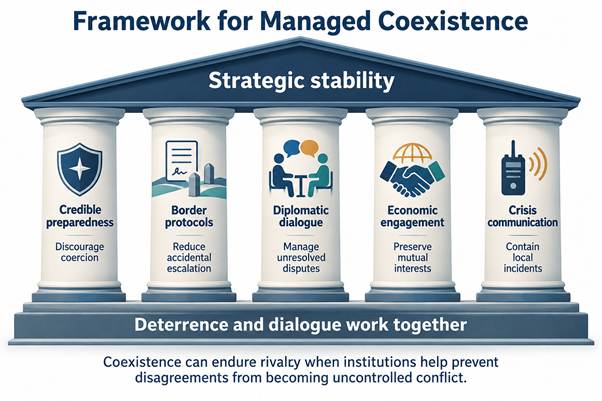
This requires reliable communication channels, clear operational protocols and disciplined behaviour by forces deployed near disputed areas.
Understanding China Matters
Effective strategy requires assessment of both capabilities and intentions.
Underestimating China's military modernisation could weaken deterrence, but assuming that every increase in Chinese capability signals an intention to initiate war could also produce unnecessary escalation.
India therefore needs strong China expertise covering military affairs, economics, technology, domestic politics, language and strategic culture.
Better understanding improves both deterrence and diplomacy because policy can respond to actual behaviour rather than assumptions.
Deterrence and Dialogue Are Complementary
Peace cannot depend exclusively on goodwill.
India needs strong border infrastructure, surveillance, logistics, intelligence and credible military capabilities so that unilateral changes to the status quo become difficult.
At the same time, military preparedness must be supported by diplomatic and commander-level mechanisms capable of managing patrol encounters and negotiating disengagement.
Deterrence reduces incentives for coercion; dialogue reduces the risk of miscalculation.
Economic Interdependence Has Limits
India and China also maintain substantial economic relations despite their political difficulties.
Economic interaction can increase the cost of conflict, but commercial ties alone cannot resolve strategic disagreements.
Where dependence becomes concentrated in critical sectors, economic ties may themselves create vulnerabilities. Coexistence therefore requires both continued economic engagement and greater resilience in strategically sensitive supply chains.
Core Policy Lesson
India-China relations are unlikely to fit neatly into either friendship or permanent hostility.
The more realistic framework is competitive coexistence supported by strategic stability.
India must remain capable of deterring coercion along the border while maintaining diplomatic channels, improving knowledge of China and preventing local incidents from defining the entire relationship.
Peaceful coexistence is therefore possible, but it requires credible deterrence, effective crisis management, sustained dialogue and mutual respect for existing agreements.
Probable Mains Question
“India-China relations are increasingly characterised by competitive coexistence rather than either partnership or inevitable conflict.” Discuss the role of deterrence, border-management mechanisms and strategic dialogue in maintaining stability between the two countries.
Prelims Drill
MCQ 1
With reference to the Line of Actual Control between India and China, consider the following statements:
- The entire LAC is mutually delineated and demarcated on the ground.
- Differing perceptions of the LAC can result in overlapping patrol activity.
- Peace and tranquillity agreements can manage border behaviour even without a final boundary settlement.
Which of the statements given above are correct?
A. 1 only
B. 1 and 2 only
C. 2 and 3 only
D. 1, 2 and 3
Correct Answer: C
Explanation: India and China do not have a mutually agreed delineation of the entire LAC. Differing perceptions can therefore generate patrol encounters, while confidence-building and border-management arrangements can help maintain stability pending a final settlement.

More Current Affairs - Daily
- India’s State Capacity Stagnation: The Missing Link in Reform 21 Nov 2026
- Holding Two Offices: What Does the Constitution Say About an Office of Profit? 21 Nov 2026
- The Price of War: West Asia Crisis Is Raising India’s Energy Import Bill 21 Nov 2026
- Surveillance Pricing : How Is Personal Data Used to Set Prices? 21 Nov 2026